

start from the compilation of Francis Lucazeau
(personal communication).
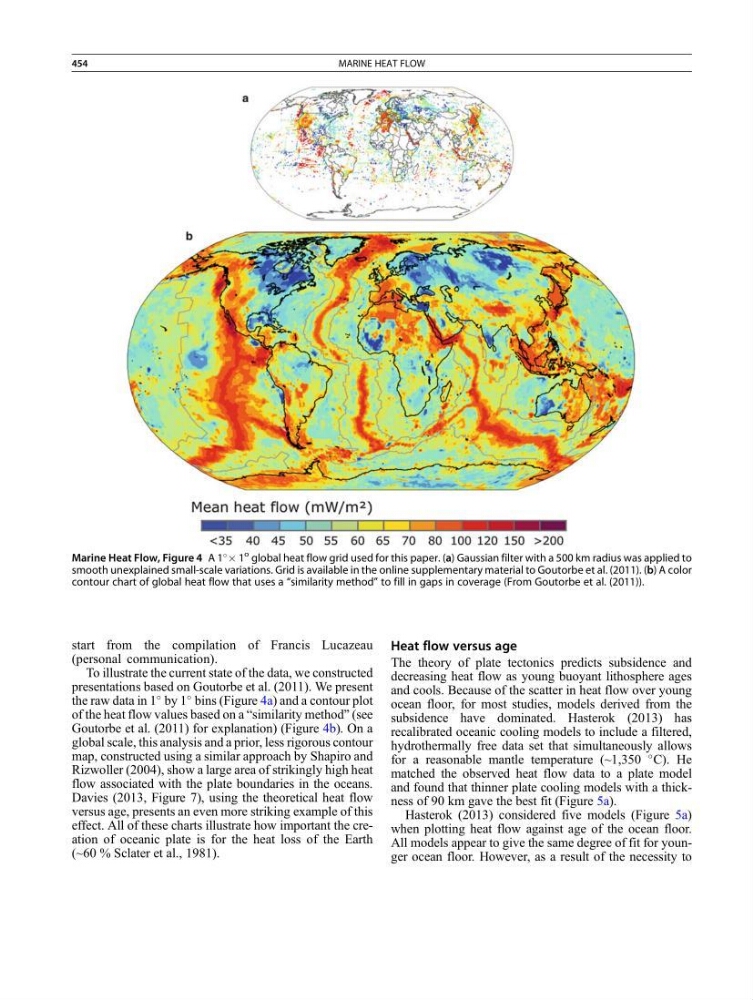
To illustrate the current state of the data, we constructed
presentations based on Goutorbe et al. (2011). We present
the raw data in 1
by 1
bins (Figure 4a) and a contour plot
of the heat flow values based on a “similarity method” (see
Goutorbe et al. (2011) for explanation) (Figure 4b). On a
global scale, this analysis and a prior, less rigorous contour
map, constructed using a similar approach by Shapiro and
Rizwoller (2004), show a large area of strikingly high heat
flow associated with the plate boundaries in the oceans.
Davies (2013, Figure 7), using the theoretical heat flow
versus age, presents an even more striking example of this
effect. All of these charts illustrate how important the creation of oceanic plate is for the heat loss of the Earth
(~60 % Sclater et al., 1981).
Heat flow versus age
The theory of plate tectonics predicts subsidence and
decreasing heat flow as young buoyant lithosphere ages
and cools. Because of the scatter in heat flow over young
ocean floor, for most studies, models derived from the
subsidence have dominated. Hasterok (2013) has
recalibrated oceanic cooling models to include a filtered,
hydrothermally free data set that simultaneously allows
for a reasonable mantle temperature (~1,350
C). He
matched the observed heat flow data to a plate model
and found that thinner plate cooling models with a thickness of 90 km gave the best fit (Figure 5a).
Hasterok (2013) considered five models (Figure 5a)
when plotting heat flow against age of the ocean floor.
All models appear to give the same degree of fit for younger ocean floor. However, as a result of the necessity to
Marine Heat Flow, Figure 4 A 1
 1
o global heat flow grid used for this paper. (a) Gaussian filter with a 500 km radius was applied to
smooth unexplained small-scale variations. Grid is available in the online supplementary material to Goutorbe et al. (2011). (b) A color
contour chart of global heat flow that uses a “similarity method” to fill in gaps in coverage (From Goutorbe et al. (2011)).
454
MARINE HEAT FLOW
(personal communication).
To illustrate the current state of the data, we constructed
presentations based on Goutorbe et al. (2011). We present
the raw data in 1
by 1
bins (Figure 4a) and a contour plot
of the heat flow values based on a “similarity method” (see
Goutorbe et al. (2011) for explanation) (Figure 4b). On a
global scale, this analysis and a prior, less rigorous contour
map, constructed using a similar approach by Shapiro and
Rizwoller (2004), show a large area of strikingly high heat
flow associated with the plate boundaries in the oceans.
Davies (2013, Figure 7), using the theoretical heat flow
versus age, presents an even more striking example of this
effect. All of these charts illustrate how important the creation of oceanic plate is for the heat loss of the Earth
(~60 % Sclater et al., 1981).
Heat flow versus age
The theory of plate tectonics predicts subsidence and
decreasing heat flow as young buoyant lithosphere ages
and cools. Because of the scatter in heat flow over young
ocean floor, for most studies, models derived from the
subsidence have dominated. Hasterok (2013) has
recalibrated oceanic cooling models to include a filtered,
hydrothermally free data set that simultaneously allows
for a reasonable mantle temperature (~1,350
C). He
matched the observed heat flow data to a plate model
and found that thinner plate cooling models with a thickness of 90 km gave the best fit (Figure 5a).
Hasterok (2013) considered five models (Figure 5a)
when plotting heat flow against age of the ocean floor.
All models appear to give the same degree of fit for younger ocean floor. However, as a result of the necessity to
Marine Heat Flow, Figure 4 A 1
 1
o global heat flow grid used for this paper. (a) Gaussian filter with a 500 km radius was applied to
smooth unexplained small-scale variations. Grid is available in the online supplementary material to Goutorbe et al. (2011). (b) A color
contour chart of global heat flow that uses a “similarity method” to fill in gaps in coverage (From Goutorbe et al. (2011)).
454
MARINE HEAT FLOW