

commonly diagenetic birnessite; lesser amounts of X-ray
amorphous Fe oxyhydroxides also occur. Minor amounts
of detrital aluminosilicate minerals and quartz and
authigenic minerals (formed in the sediment from alteration of other materials: volcanic glass, minerals, microfossils) are also present. The sheet and tunnel structures
of the diagenetic Mn-oxide minerals, which allow for the
acquisition from sediment pore fluids of large amounts
of Ni, Cu, and other metals that strengthen the mineral
structure, are important physical properties of Mn
nodules.
Mn nodules typically have three to six times more Mn
than Fe (Table 1), in contrast to Fe-Mn crusts, another type
of deep-ocean mineral deposit (see entry on “Cobalt-rich
Manganese Crusts”). Mn concentrations can be greater than
30 % in diagenetic nodules, such as Peru Basin nodules.
Nickel and Cu have been the metals of greatest economic
interest and have mean concentrations in four nodule fields
that vary from 0.38 % to 1.32 % and 0.23 % to 1.07 %,
respectively (Table 1; 1,000 ppm ¼ 0.1 %). These percentages will vary somewhat in mine-site-size areas (about
20,000 square km) within these major nodule fields. Nodules are also more enriched in Ni, Cu, and Li than Fe-Mn
crusts, while crusts are more enriched in the other rare
metals and the rare earth elements (REEs). The market for
Li is growing because of its use in rechargeable batteries.
Li in CCZ nodules averages 131 ppm and is especially high
in diagenetic nodules, averaging 311 ppm in Peru Basin
nodules (Hein and Koschinsky, 2014), the latter of which
is comparable to grades in some terrestrial Li ores. REEs
in nodules are also of economic interest but are generally
two to six times lower than in Mn crusts, with maximum
total REEs plus yttrium (Y) in CCZ nodules of about
0.08 %; however, the average for Cook Island nodules is
0.17 %. The main carrier for REEs and Y, in general, is
the hydrogenetic component. Platinum (Pt) is very low in
nodules compared to crusts and not of economic interest.
Mean concentrations of other metals of interest as potential
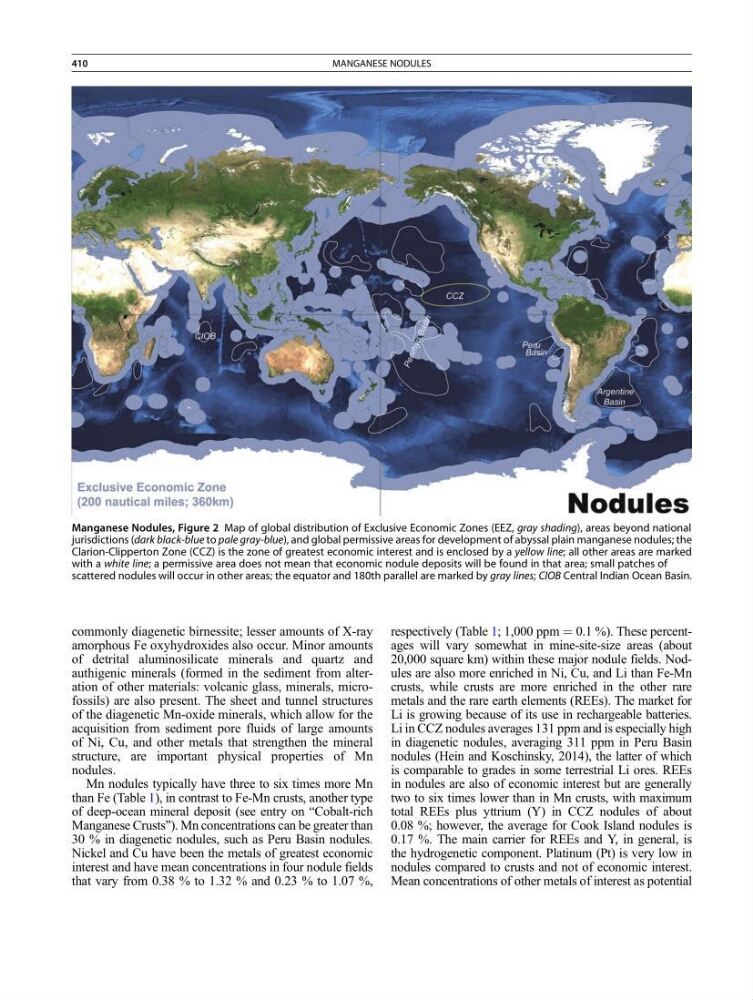
Manganese Nodules, Figure 2 Map of global distribution of Exclusive Economic Zones (EEZ, gray shading), areas beyond national
jurisdictions (dark black-blue to pale gray-blue), and global permissive areas for development of abyssal plain manganese nodules; the
Clarion-Clipperton Zone (CCZ) is the zone of greatest economic interest and is enclosed by a yellow line; all other areas are marked
with a white line; a permissive area does not mean that economic nodule deposits will be found in that area; small patches of
scattered nodules will occur in other areas; the equator and 180th parallel are marked by gray lines; CIOB Central Indian Ocean Basin.
410
MANGANESE NODULES
amorphous Fe oxyhydroxides also occur. Minor amounts
of detrital aluminosilicate minerals and quartz and
authigenic minerals (formed in the sediment from alteration of other materials: volcanic glass, minerals, microfossils) are also present. The sheet and tunnel structures
of the diagenetic Mn-oxide minerals, which allow for the
acquisition from sediment pore fluids of large amounts
of Ni, Cu, and other metals that strengthen the mineral
structure, are important physical properties of Mn
nodules.
Mn nodules typically have three to six times more Mn
than Fe (Table 1), in contrast to Fe-Mn crusts, another type
of deep-ocean mineral deposit (see entry on “Cobalt-rich
Manganese Crusts”). Mn concentrations can be greater than
30 % in diagenetic nodules, such as Peru Basin nodules.
Nickel and Cu have been the metals of greatest economic
interest and have mean concentrations in four nodule fields
that vary from 0.38 % to 1.32 % and 0.23 % to 1.07 %,
respectively (Table 1; 1,000 ppm ¼ 0.1 %). These percentages will vary somewhat in mine-site-size areas (about
20,000 square km) within these major nodule fields. Nodules are also more enriched in Ni, Cu, and Li than Fe-Mn
crusts, while crusts are more enriched in the other rare
metals and the rare earth elements (REEs). The market for
Li is growing because of its use in rechargeable batteries.
Li in CCZ nodules averages 131 ppm and is especially high
in diagenetic nodules, averaging 311 ppm in Peru Basin
nodules (Hein and Koschinsky, 2014), the latter of which
is comparable to grades in some terrestrial Li ores. REEs
in nodules are also of economic interest but are generally
two to six times lower than in Mn crusts, with maximum
total REEs plus yttrium (Y) in CCZ nodules of about
0.08 %; however, the average for Cook Island nodules is
0.17 %. The main carrier for REEs and Y, in general, is
the hydrogenetic component. Platinum (Pt) is very low in
nodules compared to crusts and not of economic interest.
Mean concentrations of other metals of interest as potential
Manganese Nodules, Figure 2 Map of global distribution of Exclusive Economic Zones (EEZ, gray shading), areas beyond national
jurisdictions (dark black-blue to pale gray-blue), and global permissive areas for development of abyssal plain manganese nodules; the
Clarion-Clipperton Zone (CCZ) is the zone of greatest economic interest and is enclosed by a yellow line; all other areas are marked
with a white line; a permissive area does not mean that economic nodule deposits will be found in that area; small patches of
scattered nodules will occur in other areas; the equator and 180th parallel are marked by gray lines; CIOB Central Indian Ocean Basin.
410
MANGANESE NODULES