

surface waters. Most Mn-nodule fields are found in areas
beyond national jurisdictions, with the exception of the
Penrhyn Basin field, which lies predominantly within the
exclusive economic zone (EEZ) of the Cook Islands
(Figure 2). Fewer large abyssal plains occur in the Atlantic
and Indian Oceans compared to the Pacific, which are
dominated topographically by the mid-ocean ridge systems. The large Argentine Basin in the SW Atlantic may
possess nodule fields, but little exploration has occurred
there.
Formation
Mn nodules grow by precipitation of Mn and Fe oxides
around a nucleus that is commonly composed of
a fragment of an older nodule. Unlike Mn crusts, the Mn
and Fe minerals in nodules precipitate from two sources,
cold seawater (hydrogenetic) and sediment pore waters
(diagenetic), which is seawater modified by chemical
reactions within the sediment. Nodules can be solely
hydrogenetic (e.g., Penrhyn Basin and Atlantic Ocean;
Figure 2) or solely diagenetic (such as Peru Basin;
Figure 2), but most nodules acquire metals from both
sources. Hydrogenetic nodules grow remarkably slowly,
at a rate of about 1 to 5 mm per million years, like Mn
crusts, whereas diagenetic nodules grow at rates up to
250 mm per million years. Because most nodules form
by both hydrogenetic and diagenetic precipitation, they
grow at intermediate rates of several tens of mm per
million years. Average nodule growth rates are four orders
of magnitude slower than the sedimentation rates, yet the
nodules remain at the sediment surface. There have been a
number of proposals (e.g., Halbach et al., 1988) as to how
this happens, although the actual cause is still a mystery.
Sediment pore fluids are the predominant source of Ni,
Cu, and Mn, and seawater is the dominant source of cobalt
(Co). Metals in the pore fluid are derived from early diagenetic oxidation-reduction (redox) reactions in upper sediment layers and are incorporated into the Mn-oxide
minerals forming at the seabed.
Composition
Mn nodules are composed predominantly of the minerals
d-MnO 2 (hydrogenetic vernadite), 10 Å manganate
(diagenetic todorokite, buserite, asbolan), and less
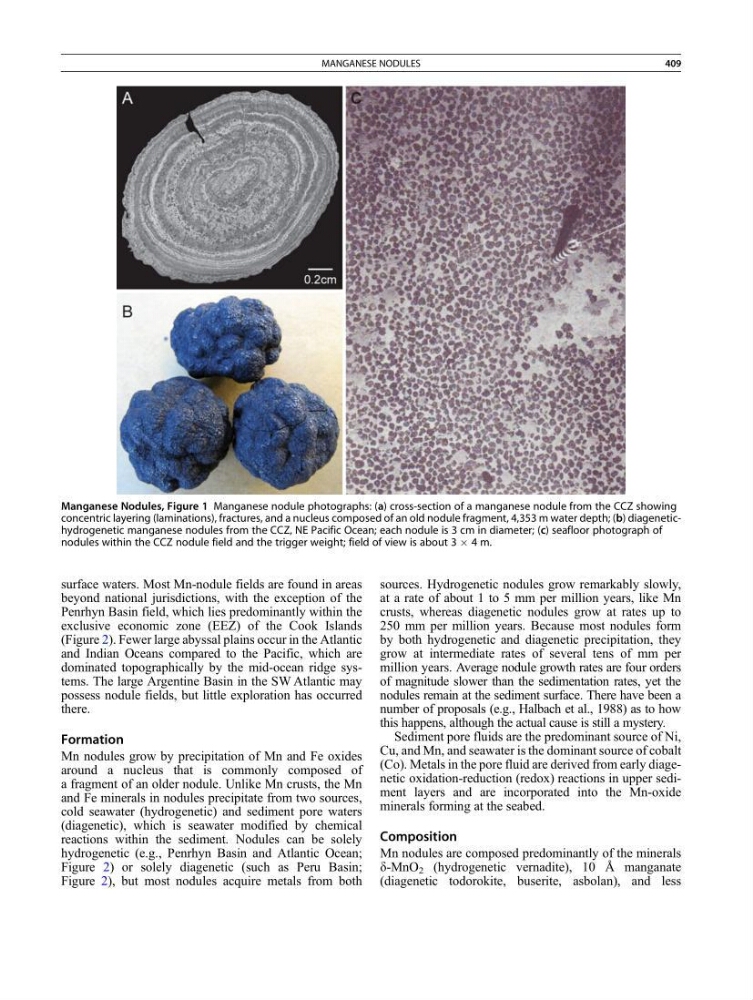
Manganese Nodules, Figure 1 Manganese nodule photographs: (a) cross-section of a manganese nodule from the CCZ showing
concentric layering (laminations), fractures, and a nucleus composed of an old nodule fragment, 4,353 m water depth; (b) diagenetichydrogenetic manganese nodules from the CCZ, NE Pacific Ocean; each nodule is 3 cm in diameter; (c) seafloor photograph of
nodules within the CCZ nodule field and the trigger weight; field of view is about 3 Â 4 m.
MANGANESE NODULES
409
beyond national jurisdictions, with the exception of the
Penrhyn Basin field, which lies predominantly within the
exclusive economic zone (EEZ) of the Cook Islands
(Figure 2). Fewer large abyssal plains occur in the Atlantic
and Indian Oceans compared to the Pacific, which are
dominated topographically by the mid-ocean ridge systems. The large Argentine Basin in the SW Atlantic may
possess nodule fields, but little exploration has occurred
there.
Formation
Mn nodules grow by precipitation of Mn and Fe oxides
around a nucleus that is commonly composed of
a fragment of an older nodule. Unlike Mn crusts, the Mn
and Fe minerals in nodules precipitate from two sources,
cold seawater (hydrogenetic) and sediment pore waters
(diagenetic), which is seawater modified by chemical
reactions within the sediment. Nodules can be solely
hydrogenetic (e.g., Penrhyn Basin and Atlantic Ocean;
Figure 2) or solely diagenetic (such as Peru Basin;
Figure 2), but most nodules acquire metals from both
sources. Hydrogenetic nodules grow remarkably slowly,
at a rate of about 1 to 5 mm per million years, like Mn
crusts, whereas diagenetic nodules grow at rates up to
250 mm per million years. Because most nodules form
by both hydrogenetic and diagenetic precipitation, they
grow at intermediate rates of several tens of mm per
million years. Average nodule growth rates are four orders
of magnitude slower than the sedimentation rates, yet the
nodules remain at the sediment surface. There have been a
number of proposals (e.g., Halbach et al., 1988) as to how
this happens, although the actual cause is still a mystery.
Sediment pore fluids are the predominant source of Ni,
Cu, and Mn, and seawater is the dominant source of cobalt
(Co). Metals in the pore fluid are derived from early diagenetic oxidation-reduction (redox) reactions in upper sediment layers and are incorporated into the Mn-oxide
minerals forming at the seabed.
Composition
Mn nodules are composed predominantly of the minerals
d-MnO 2 (hydrogenetic vernadite), 10 Å manganate
(diagenetic todorokite, buserite, asbolan), and less
Manganese Nodules, Figure 1 Manganese nodule photographs: (a) cross-section of a manganese nodule from the CCZ showing
concentric layering (laminations), fractures, and a nucleus composed of an old nodule fragment, 4,353 m water depth; (b) diagenetichydrogenetic manganese nodules from the CCZ, NE Pacific Ocean; each nodule is 3 cm in diameter; (c) seafloor photograph of
nodules within the CCZ nodule field and the trigger weight; field of view is about 3 Â 4 m.
MANGANESE NODULES
409