

by-products of Ni-Cu-Mn mining include Co
(0.05–0.41 %), Mo (262–600 ppm), and zirconium (Zr;
307–752 ppm).
Resource consideration
The tonnages of nodules and therefore of the amount of
contained metals are moderately well known for the
CCZ and the Central Indian Ocean Basin nodules.
A conservative estimate for the CCZ nodules is about
21,100 million dry tonnes. That tonnage of nodules would
provide nearly 6,000 million tonnes of Mn, more than the
entire land-based reserve base (LBRB) of Mn (Hein et al.,
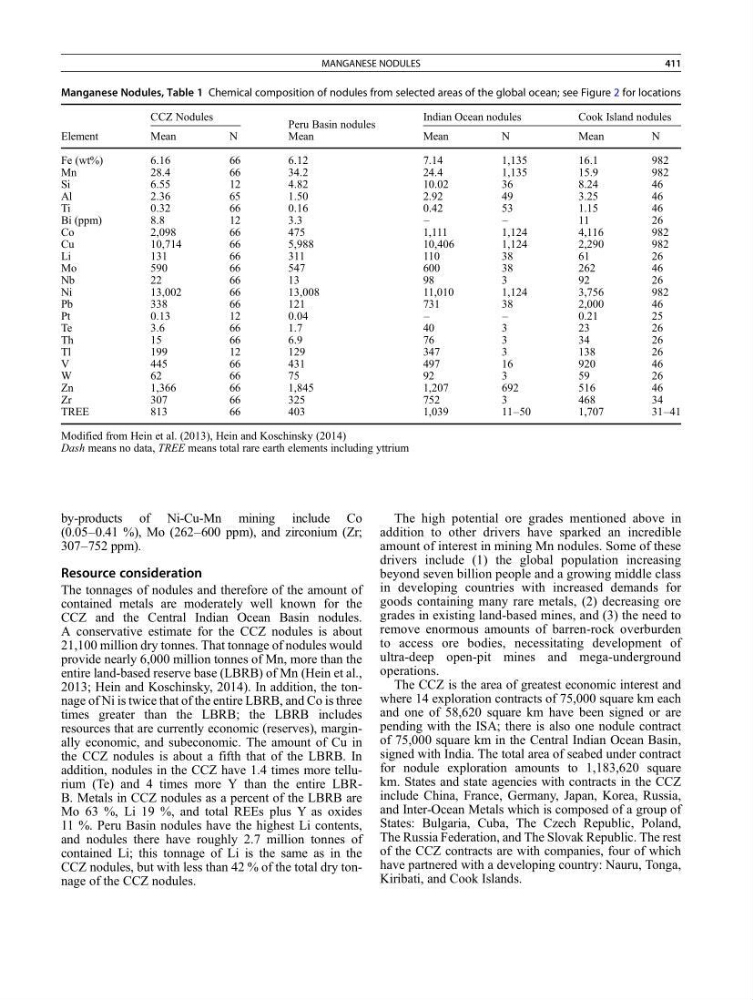
2013; Hein and Koschinsky, 2014). In addition, the tonnage of Ni is twice that of the entire LBRB, and Co is three
times greater than the LBRB; the LBRB includes
resources that are currently economic (reserves), marginally economic, and subeconomic. The amount of Cu in
the CCZ nodules is about a fifth that of the LBRB. In
addition, nodules in the CCZ have 1.4 times more tellurium (Te) and 4 times more Y than the entire LBRB. Metals in CCZ nodules as a percent of the LBRB are
Mo 63 %, Li 19 %, and total REEs plus Y as oxides
11 %. Peru Basin nodules have the highest Li contents,
and nodules there have roughly 2.7 million tonnes of
contained Li; this tonnage of Li is the same as in the
CCZ nodules, but with less than 42 % of the total dry tonnage of the CCZ nodules.
The high potential ore grades mentioned above in
addition to other drivers have sparked an incredible
amount of interest in mining Mn nodules. Some of these
drivers include (1) the global population increasing
beyond seven billion people and a growing middle class
in developing countries with increased demands for
goods containing many rare metals, (2) decreasing ore
grades in existing land-based mines, and (3) the need to
remove enormous amounts of barren-rock overburden
to access ore bodies, necessitating development of
ultra-deep open-pit mines and mega-underground
operations.
The CCZ is the area of greatest economic interest and
where 14 exploration contracts of 75,000 square km each
and one of 58,620 square km have been signed or are
pending with the ISA; there is also one nodule contract
of 75,000 square km in the Central Indian Ocean Basin,
signed with India. The total area of seabed under contract
for nodule exploration amounts to 1,183,620 square
km. States and state agencies with contracts in the CCZ
include China, France, Germany, Japan, Korea, Russia,
and Inter-Ocean Metals which is composed of a group of
States: Bulgaria, Cuba, The Czech Republic, Poland,
The Russia Federation, and The Slovak Republic. The rest
of the CCZ contracts are with companies, four of which
have partnered with a developing country: Nauru, Tonga,
Kiribati, and Cook Islands.
Manganese Nodules, Table 1 Chemical composition of nodules from selected areas of the global ocean; see Figure 2 for locations
CCZ Nodules
Peru Basin nodules
Indian Ocean nodules
Cook Island nodules
Element
Mean
N
Mean
Mean
N
Mean
N
Fe (wt%)
6.16
66
6.12
7.14
1,135
16.1
982
Mn
28.4
66
34.2
24.4
1,135
15.9
982
Si
6.55
12
4.82
10.02
36
8.24
46
Al
2.36
65
1.50
2.92
49
3.25
46
Ti
0.32
66
0.16
0.42
53
1.15
46
Bi (ppm)
8.8
12
3.3
–
–
11
26
Co
2,098
66
475
1,111
1,124
4,116
982
Cu
10,714
66
5,988
10,406
1,124
2,290
982
Li
131
66
311
110
38
61
26
Mo
590
66
547
600
38
262
46
Nb
22
66
13
98
3
92
26
Ni
13,002
66
13,008
11,010
1,124
3,756
982
Pb
338
66
121
731
38
2,000
46
Pt
0.13
12
0.04
–
–
0.21
25
Te
3.6
66
1.7
40
3
23
26
Th
15
66
6.9
76
3
34
26
Tl
199
12
129
347
3
138
26
V
445
66
431
497
16
920
46
W
62
66
75
92
3
59
26
Zn
1,366
66
1,845
1,207
692
516
46
Zr
307
66
325
752
3
468
34
TREE
813
66
403
1,039
11–50
1,707
31–41
Modified from Hein et al. (2013), Hein and Koschinsky (2014)
Dash means no data, TREE means total rare earth elements including yttrium
MANGANESE NODULES
411
(0.05–0.41 %), Mo (262–600 ppm), and zirconium (Zr;
307–752 ppm).
Resource consideration
The tonnages of nodules and therefore of the amount of
contained metals are moderately well known for the
CCZ and the Central Indian Ocean Basin nodules.
A conservative estimate for the CCZ nodules is about
21,100 million dry tonnes. That tonnage of nodules would
provide nearly 6,000 million tonnes of Mn, more than the
entire land-based reserve base (LBRB) of Mn (Hein et al.,
2013; Hein and Koschinsky, 2014). In addition, the tonnage of Ni is twice that of the entire LBRB, and Co is three
times greater than the LBRB; the LBRB includes
resources that are currently economic (reserves), marginally economic, and subeconomic. The amount of Cu in
the CCZ nodules is about a fifth that of the LBRB. In
addition, nodules in the CCZ have 1.4 times more tellurium (Te) and 4 times more Y than the entire LBRB. Metals in CCZ nodules as a percent of the LBRB are
Mo 63 %, Li 19 %, and total REEs plus Y as oxides
11 %. Peru Basin nodules have the highest Li contents,
and nodules there have roughly 2.7 million tonnes of
contained Li; this tonnage of Li is the same as in the
CCZ nodules, but with less than 42 % of the total dry tonnage of the CCZ nodules.
The high potential ore grades mentioned above in
addition to other drivers have sparked an incredible
amount of interest in mining Mn nodules. Some of these
drivers include (1) the global population increasing
beyond seven billion people and a growing middle class
in developing countries with increased demands for
goods containing many rare metals, (2) decreasing ore
grades in existing land-based mines, and (3) the need to
remove enormous amounts of barren-rock overburden
to access ore bodies, necessitating development of
ultra-deep open-pit mines and mega-underground
operations.
The CCZ is the area of greatest economic interest and
where 14 exploration contracts of 75,000 square km each
and one of 58,620 square km have been signed or are
pending with the ISA; there is also one nodule contract
of 75,000 square km in the Central Indian Ocean Basin,
signed with India. The total area of seabed under contract
for nodule exploration amounts to 1,183,620 square
km. States and state agencies with contracts in the CCZ
include China, France, Germany, Japan, Korea, Russia,
and Inter-Ocean Metals which is composed of a group of
States: Bulgaria, Cuba, The Czech Republic, Poland,
The Russia Federation, and The Slovak Republic. The rest
of the CCZ contracts are with companies, four of which
have partnered with a developing country: Nauru, Tonga,
Kiribati, and Cook Islands.
Manganese Nodules, Table 1 Chemical composition of nodules from selected areas of the global ocean; see Figure 2 for locations
CCZ Nodules
Peru Basin nodules
Indian Ocean nodules
Cook Island nodules
Element
Mean
N
Mean
Mean
N
Mean
N
Fe (wt%)
6.16
66
6.12
7.14
1,135
16.1
982
Mn
28.4
66
34.2
24.4
1,135
15.9
982
Si
6.55
12
4.82
10.02
36
8.24
46
Al
2.36
65
1.50
2.92
49
3.25
46
Ti
0.32
66
0.16
0.42
53
1.15
46
Bi (ppm)
8.8
12
3.3
–
–
11
26
Co
2,098
66
475
1,111
1,124
4,116
982
Cu
10,714
66
5,988
10,406
1,124
2,290
982
Li
131
66
311
110
38
61
26
Mo
590
66
547
600
38
262
46
Nb
22
66
13
98
3
92
26
Ni
13,002
66
13,008
11,010
1,124
3,756
982
Pb
338
66
121
731
38
2,000
46
Pt
0.13
12
0.04
–
–
0.21
25
Te
3.6
66
1.7
40
3
23
26
Th
15
66
6.9
76
3
34
26
Tl
199
12
129
347
3
138
26
V
445
66
431
497
16
920
46
W
62
66
75
92
3
59
26
Zn
1,366
66
1,845
1,207
692
516
46
Zr
307
66
325
752
3
468
34
TREE
813
66
403
1,039
11–50
1,707
31–41
Modified from Hein et al. (2013), Hein and Koschinsky (2014)
Dash means no data, TREE means total rare earth elements including yttrium
MANGANESE NODULES
411