

The wet base of the mantle wedge is viscously coupled
with the sinking slab and is also carried down with, releasing more fluids as these descend together (2.2 in Figure 1).
Somehow – the general process is clear but the details
are still being worked out – hydrous fluids, sediment
melts, and (rarely) oceanic crust melts ascend through several tens of kilometers of downward-flowing mantle to
reach mantle that is hot enough to melt when fluxed by
hydrous fluids or sediment melts (3 in Figure 1). This is
because the addition of such liquids reduces the melting
temperature of mantle peridotite by several hundred
C
(Grove et al., 2012). Partial melting of the mantle generally occurs where the subduction zone lies 100–130 km
deep. Mantle melting forms primitive magma, called
“basalt.” Like basalt melts from other tectonic environments, those of convergent margins have low contents of
Si and high contents of Mg. Because of the way they are
generated, primitive convergent margin magmas contain
much higher concentrations of water than primitive
basalts from other tectonic environments, typically
3–4 wt% H 2 O, compared to <0.5 wt% H 2 O in
mid-ocean ridge basalts (Stern, 2002). Arc magmas also
are enriched in trace elements that are transported in fluids
(especially alkali metals and alkaline earths K, Rb, Ba, and
Sr; also U and Pb), sweated out of subducted sediments
and altered oceanic crust.
Crustal processes
Although deep subduction zone processes are everywhere
similar, eruptive products, eruptive style, and mineralization vary widely, largely depending on the crust on the
overriding plate. If this is thick continental crust, then an
active continental margin with towering volcanic mountains like the Andes results; if this is thin oceanic crust,
then chains of mostly submerged volcanoes known as
island arcs develop. These volcanic islands may rise from
bases 2–3 km below sealevel and can be wholly submarine seamounts or partially subaerial if the summits of stratovolcanoes are tall enough to emerge from the sea.
Whether they rise above sealevel or not, arc volcanoes
are typically spaced 20–30 km apart (mean ¼ 27 km; de
Ronde et al., 2003). The total length of island arcs is
~22,000 km (de Ronde et al., 2003], about one third of
the total length of mid-ocean ridges (Baker et al., 2008).
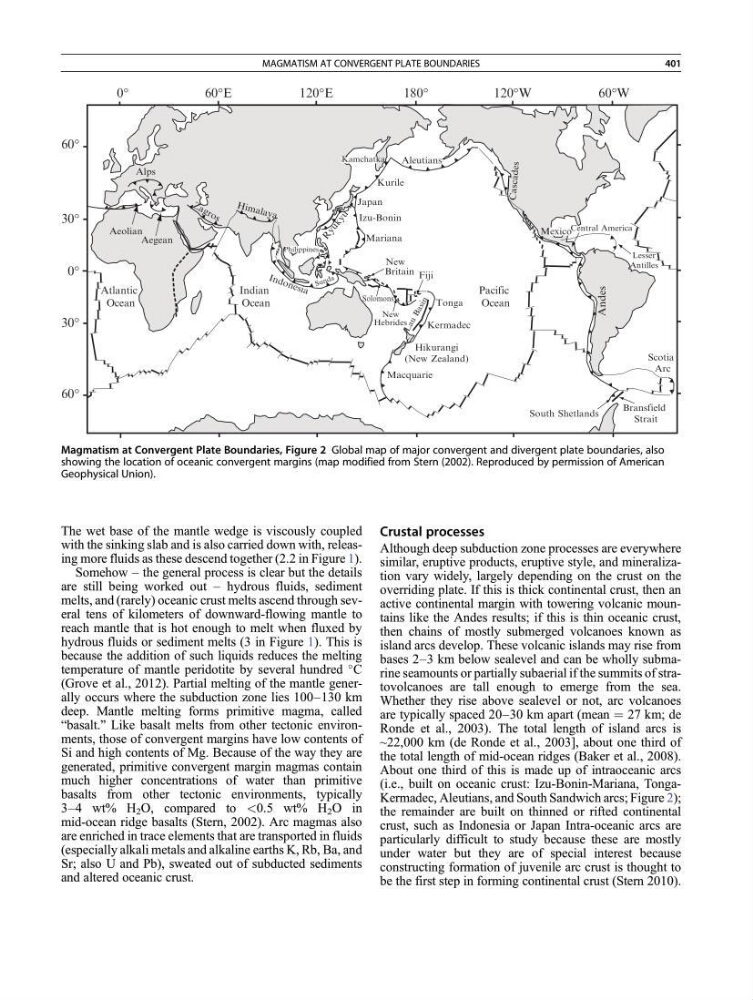
About one third of this is made up of intraoceanic arcs
(i.e., built on oceanic crust: Izu-Bonin-Mariana, TongaKermadec, Aleutians, and South Sandwich arcs; Figure 2);
the remainder are built on thinned or rifted continental
crust, such as Indonesia or Japan Intra-oceanic arcs are
particularly difficult to study because these are mostly
under water but they are of special interest because
constructing formation of juvenile arc crust is thought to
be the first step in forming continental crust (Stern 2010).
Atlantic
Ocean
Indian
Ocean
Pacific
Ocean
H im a la y a
Z a g r o s
Alps
I n d o n e s ia
Tonga
Kermadec
L a u B a s in
Hikurangi
(New Zealand)
New
Hebrides
Fiji
Solomons
New
Mariana
Izu-Bonin
Macquarie
Philippines
Japan
R
y u k y u
Kamchatka
Aleutians
Kurile
Cas cad es
Mexico
Andes
South Shetlands
Scotia
Arc
Bransfield
Strait
Central America
Lesser
Antilles
Aeolian
Aegean
S u n d a
Britain
0°
60°E
60°
30°
0°
30°
60°
120°E
120°W
60°W
180°
Magmatism at Convergent Plate Boundaries, Figure 2 Global map of major convergent and divergent plate boundaries, also
showing the location of oceanic convergent margins (map modified from Stern (2002). Reproduced by permission of American
Geophysical Union).
MAGMATISM AT CONVERGENT PLATE BOUNDARIES
401
with the sinking slab and is also carried down with, releasing more fluids as these descend together (2.2 in Figure 1).
Somehow – the general process is clear but the details
are still being worked out – hydrous fluids, sediment
melts, and (rarely) oceanic crust melts ascend through several tens of kilometers of downward-flowing mantle to
reach mantle that is hot enough to melt when fluxed by
hydrous fluids or sediment melts (3 in Figure 1). This is
because the addition of such liquids reduces the melting
temperature of mantle peridotite by several hundred
C
(Grove et al., 2012). Partial melting of the mantle generally occurs where the subduction zone lies 100–130 km
deep. Mantle melting forms primitive magma, called
“basalt.” Like basalt melts from other tectonic environments, those of convergent margins have low contents of
Si and high contents of Mg. Because of the way they are
generated, primitive convergent margin magmas contain
much higher concentrations of water than primitive
basalts from other tectonic environments, typically
3–4 wt% H 2 O, compared to <0.5 wt% H 2 O in
mid-ocean ridge basalts (Stern, 2002). Arc magmas also
are enriched in trace elements that are transported in fluids
(especially alkali metals and alkaline earths K, Rb, Ba, and
Sr; also U and Pb), sweated out of subducted sediments
and altered oceanic crust.
Crustal processes
Although deep subduction zone processes are everywhere
similar, eruptive products, eruptive style, and mineralization vary widely, largely depending on the crust on the
overriding plate. If this is thick continental crust, then an
active continental margin with towering volcanic mountains like the Andes results; if this is thin oceanic crust,
then chains of mostly submerged volcanoes known as
island arcs develop. These volcanic islands may rise from
bases 2–3 km below sealevel and can be wholly submarine seamounts or partially subaerial if the summits of stratovolcanoes are tall enough to emerge from the sea.
Whether they rise above sealevel or not, arc volcanoes
are typically spaced 20–30 km apart (mean ¼ 27 km; de
Ronde et al., 2003). The total length of island arcs is
~22,000 km (de Ronde et al., 2003], about one third of
the total length of mid-ocean ridges (Baker et al., 2008).
About one third of this is made up of intraoceanic arcs
(i.e., built on oceanic crust: Izu-Bonin-Mariana, TongaKermadec, Aleutians, and South Sandwich arcs; Figure 2);
the remainder are built on thinned or rifted continental
crust, such as Indonesia or Japan Intra-oceanic arcs are
particularly difficult to study because these are mostly
under water but they are of special interest because
constructing formation of juvenile arc crust is thought to
be the first step in forming continental crust (Stern 2010).
Atlantic
Ocean
Indian
Ocean
Pacific
Ocean
H im a la y a
Z a g r o s
Alps
I n d o n e s ia
Tonga
Kermadec
L a u B a s in
Hikurangi
(New Zealand)
New
Hebrides
Fiji
Solomons
New
Mariana
Izu-Bonin
Macquarie
Philippines
Japan
R
y u k y u
Kamchatka
Aleutians
Kurile
Cas cad es
Mexico
Andes
South Shetlands
Scotia
Arc
Bransfield
Strait
Central America
Lesser
Antilles
Aeolian
Aegean
S u n d a
Britain
0°
60°E
60°
30°
0°
30°
60°
120°E
120°W
60°W
180°
Magmatism at Convergent Plate Boundaries, Figure 2 Global map of major convergent and divergent plate boundaries, also
showing the location of oceanic convergent margins (map modified from Stern (2002). Reproduced by permission of American
Geophysical Union).
MAGMATISM AT CONVERGENT PLATE BOUNDARIES
401