

boundaries. There are 55,000 km of convergent plate
boundaries on Earth (Figure 2; Lallemand, 1999). Subduction zones were first recognized by dipping arrays of
earthquakes, called Wadati-Benioff zones (WBZs) after
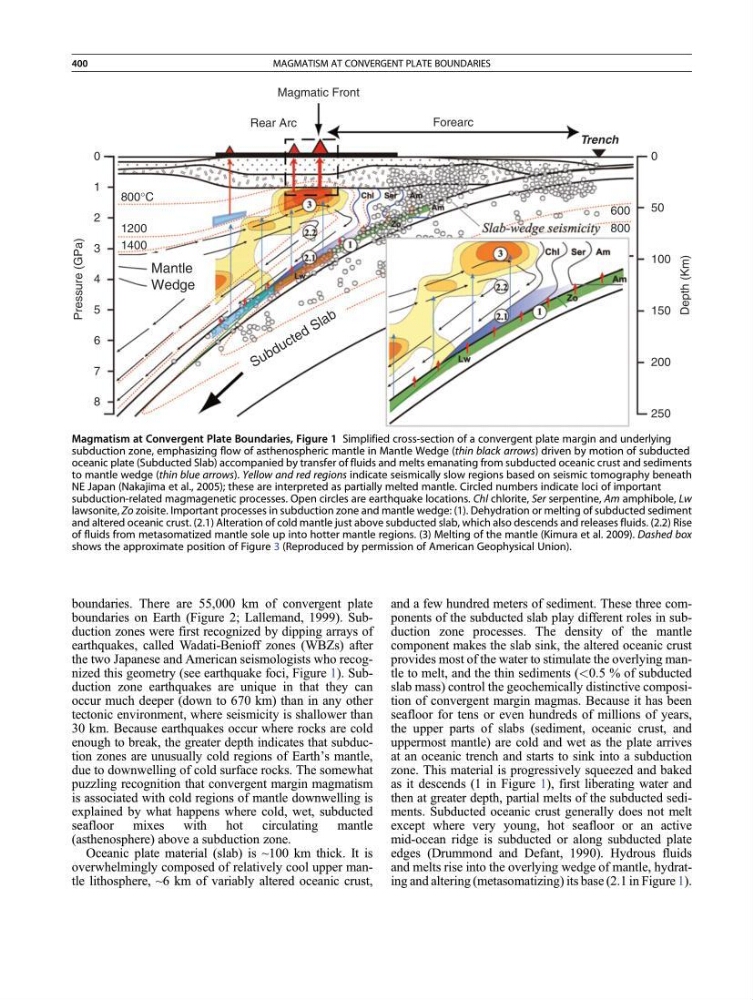
the two Japanese and American seismologists who recognized this geometry (see earthquake foci, Figure 1). Subduction zone earthquakes are unique in that they can
occur much deeper (down to 670 km) than in any other
tectonic environment, where seismicity is shallower than
30 km. Because earthquakes occur where rocks are cold
enough to break, the greater depth indicates that subduction zones are unusually cold regions of Earth’s mantle,
due to downwelling of cold surface rocks. The somewhat
puzzling recognition that convergent margin magmatism
is associated with cold regions of mantle downwelling is
explained by what happens where cold, wet, subducted
seafloor mixes with hot circulating mantle
(asthenosphere) above a subduction zone.
Oceanic plate material (slab) is ~100 km thick. It is
overwhelmingly composed of relatively cool upper mantle lithosphere, ~6 km of variably altered oceanic crust,
and a few hundred meters of sediment. These three components of the subducted slab play different roles in subduction zone processes. The density of the mantle
component makes the slab sink, the altered oceanic crust
provides most of the water to stimulate the overlying mantle to melt, and the thin sediments (<0.5 % of subducted
slab mass) control the geochemically distinctive composition of convergent margin magmas. Because it has been
seafloor for tens or even hundreds of millions of years,
the upper parts of slabs (sediment, oceanic crust, and
uppermost mantle) are cold and wet as the plate arrives
at an oceanic trench and starts to sink into a subduction
zone. This material is progressively squeezed and baked
as it descends (1 in Figure 1), first liberating water and
then at greater depth, partial melts of the subducted sediments. Subducted oceanic crust generally does not melt
except where very young, hot seafloor or an active
mid-ocean ridge is subducted or along subducted plate
edges (Drummond and Defant, 1990). Hydrous fluids
and melts rise into the overlying wedge of mantle, hydrating and altering (metasomatizing) its base (2.1 in Figure 1).
Pressure (GPa)
Depth (Km)
Rear Arc
Magmatic Front
Forearc
Trench
800°C
1200
1400
0
1
2
3
4
5
6
7
8
600
800
0
50
100
150
200
250
Mantle
Wedge
S u b d u c t e d S l a b
Magmatism at Convergent Plate Boundaries, Figure 1 Simplified cross-section of a convergent plate margin and underlying
subduction zone, emphasizing flow of asthenospheric mantle in Mantle Wedge (thin black arrows) driven by motion of subducted
oceanic plate (Subducted Slab) accompanied by transfer of fluids and melts emanating from subducted oceanic crust and sediments
to mantle wedge (thin blue arrows). Yellow and red regions indicate seismically slow regions based on seismic tomography beneath
NE Japan (Nakajima et al., 2005); these are interpreted as partially melted mantle. Circled numbers indicate loci of important
subduction-related magmagenetic processes. Open circles are earthquake locations. Chl chlorite, Ser serpentine, Am amphibole, Lw
lawsonite, Zo zoisite. Important processes in subduction zone and mantle wedge: (1). Dehydration or melting of subducted sediment
and altered oceanic crust. (2.1) Alteration of cold mantle just above subducted slab, which also descends and releases fluids. (2.2) Rise
of fluids from metasomatized mantle sole up into hotter mantle regions. (3) Melting of the mantle (Kimura et al. 2009). Dashed box
shows the approximate position of Figure 3 (Reproduced by permission of American Geophysical Union).
400
MAGMATISM AT CONVERGENT PLATE BOUNDARIES
boundaries on Earth (Figure 2; Lallemand, 1999). Subduction zones were first recognized by dipping arrays of
earthquakes, called Wadati-Benioff zones (WBZs) after
the two Japanese and American seismologists who recognized this geometry (see earthquake foci, Figure 1). Subduction zone earthquakes are unique in that they can
occur much deeper (down to 670 km) than in any other
tectonic environment, where seismicity is shallower than
30 km. Because earthquakes occur where rocks are cold
enough to break, the greater depth indicates that subduction zones are unusually cold regions of Earth’s mantle,
due to downwelling of cold surface rocks. The somewhat
puzzling recognition that convergent margin magmatism
is associated with cold regions of mantle downwelling is
explained by what happens where cold, wet, subducted
seafloor mixes with hot circulating mantle
(asthenosphere) above a subduction zone.
Oceanic plate material (slab) is ~100 km thick. It is
overwhelmingly composed of relatively cool upper mantle lithosphere, ~6 km of variably altered oceanic crust,
and a few hundred meters of sediment. These three components of the subducted slab play different roles in subduction zone processes. The density of the mantle
component makes the slab sink, the altered oceanic crust
provides most of the water to stimulate the overlying mantle to melt, and the thin sediments (<0.5 % of subducted
slab mass) control the geochemically distinctive composition of convergent margin magmas. Because it has been
seafloor for tens or even hundreds of millions of years,
the upper parts of slabs (sediment, oceanic crust, and
uppermost mantle) are cold and wet as the plate arrives
at an oceanic trench and starts to sink into a subduction
zone. This material is progressively squeezed and baked
as it descends (1 in Figure 1), first liberating water and
then at greater depth, partial melts of the subducted sediments. Subducted oceanic crust generally does not melt
except where very young, hot seafloor or an active
mid-ocean ridge is subducted or along subducted plate
edges (Drummond and Defant, 1990). Hydrous fluids
and melts rise into the overlying wedge of mantle, hydrating and altering (metasomatizing) its base (2.1 in Figure 1).
Pressure (GPa)
Depth (Km)
Rear Arc
Magmatic Front
Forearc
Trench
800°C
1200
1400
0
1
2
3
4
5
6
7
8
600
800
0
50
100
150
200
250
Mantle
Wedge
S u b d u c t e d S l a b
Magmatism at Convergent Plate Boundaries, Figure 1 Simplified cross-section of a convergent plate margin and underlying
subduction zone, emphasizing flow of asthenospheric mantle in Mantle Wedge (thin black arrows) driven by motion of subducted
oceanic plate (Subducted Slab) accompanied by transfer of fluids and melts emanating from subducted oceanic crust and sediments
to mantle wedge (thin blue arrows). Yellow and red regions indicate seismically slow regions based on seismic tomography beneath
NE Japan (Nakajima et al., 2005); these are interpreted as partially melted mantle. Circled numbers indicate loci of important
subduction-related magmagenetic processes. Open circles are earthquake locations. Chl chlorite, Ser serpentine, Am amphibole, Lw
lawsonite, Zo zoisite. Important processes in subduction zone and mantle wedge: (1). Dehydration or melting of subducted sediment
and altered oceanic crust. (2.1) Alteration of cold mantle just above subducted slab, which also descends and releases fluids. (2.2) Rise
of fluids from metasomatized mantle sole up into hotter mantle regions. (3) Melting of the mantle (Kimura et al. 2009). Dashed box
shows the approximate position of Figure 3 (Reproduced by permission of American Geophysical Union).
400
MAGMATISM AT CONVERGENT PLATE BOUNDARIES