

Primitive basaltic melt is typically ~1,300
C as it rises
out of the mantle wedge but such hot, primitive melt rarely
erupts without interacting with and being changed by the
crust that it has to pass through. Some rising primitive
melts heat the crust and cause it to melt, yielding secondary “anatectic” magmas, which form at much lower temperatures of ~800
C. Other primitive basaltic melts pool
in crustal magma chambers, fractionating as the cooling
magma forms crystals that settle out, changing the composition of the residual melt. Both secondary melting and
fractional crystallization yield melts that are significantly
enriched in silica. These are felsic magmas, akin to granite, and known by their volcanic names: dacite and rhyolite. Felsic igneous rocks are important components of
island arcs and are even more important parts of plutonic
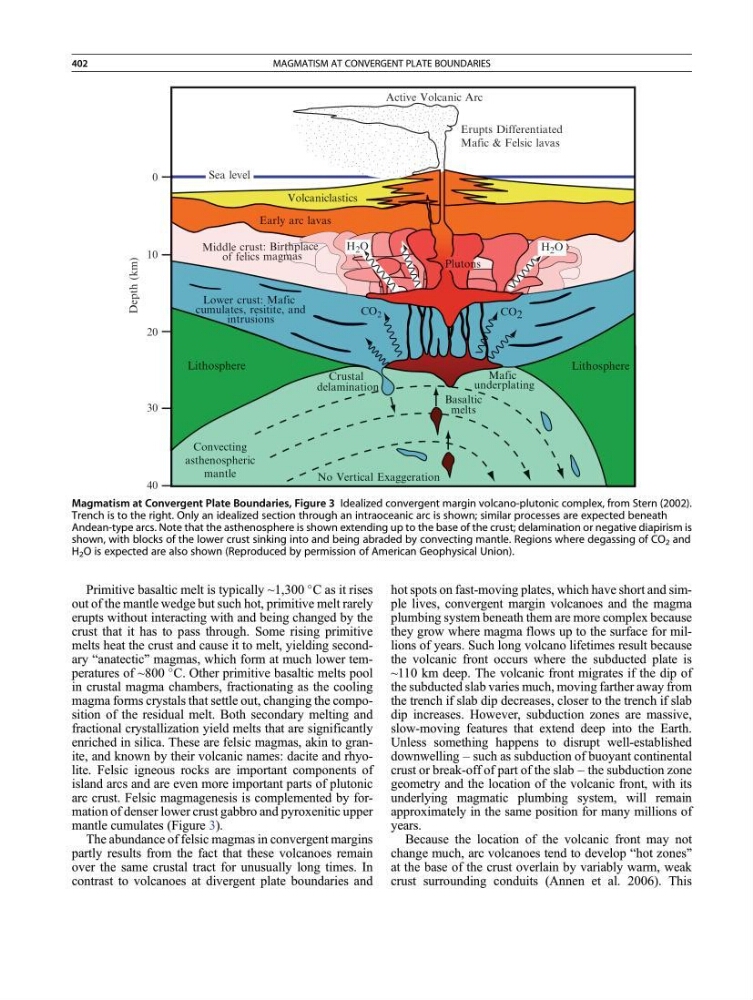
arc crust. Felsic magmagenesis is complemented by formation of denser lower crust gabbro and pyroxenitic upper
mantle cumulates (Figure 3).
The abundance of felsic magmas in convergent margins
partly results from the fact that these volcanoes remain
over the same crustal tract for unusually long times. In
contrast to volcanoes at divergent plate boundaries and
hot spots on fast-moving plates, which have short and simple lives, convergent margin volcanoes and the magma
plumbing system beneath them are more complex because
they grow where magma flows up to the surface for millions of years. Such long volcano lifetimes result because
the volcanic front occurs where the subducted plate is
~110 km deep. The volcanic front migrates if the dip of
the subducted slab varies much, moving farther away from
the trench if slab dip decreases, closer to the trench if slab
dip increases. However, subduction zones are massive,
slow-moving features that extend deep into the Earth.
Unless something happens to disrupt well-established
downwelling – such as subduction of buoyant continental
crust or break-off of part of the slab – the subduction zone
geometry and the location of the volcanic front, with its
underlying magmatic plumbing system, will remain
approximately in the same position for many millions of
years.
Because the location of the volcanic front may not
change much, arc volcanoes tend to develop “hot zones”
at the base of the crust overlain by variably warm, weak
crust surrounding conduits (Annen et al. 2006). This
Convecting
asthenospheric
mantle
Lithosphere
Lithosphere
Active Volcanic Arc
Crustal
delamination
Mafic
underplating
0
30
40
20
10
Depth (km)
No Vertical Exaggeration
Erupts Differentiated
Mafic & Felsic lavas
CO 2
H 2 O
Middle crust: Birthplace
of felics magmas
Volcaniclastics
Sea level
H 2 O
Plutons
Basaltic
melts
CO 2
Lower crust: Mafic
cumulates, resitite, and
intrusions
Early arc lavas
Magmatism at Convergent Plate Boundaries, Figure 3 Idealized convergent margin volcano-plutonic complex, from Stern (2002).
Trench is to the right. Only an idealized section through an intraoceanic arc is shown; similar processes are expected beneath
Andean-type arcs. Note that the asthenosphere is shown extending up to the base of the crust; delamination or negative diapirism is
shown, with blocks of the lower crust sinking into and being abraded by convecting mantle. Regions where degassing of CO 2 and
H 2 O is expected are also shown (Reproduced by permission of American Geophysical Union).
402
MAGMATISM AT CONVERGENT PLATE BOUNDARIES
C as it rises
out of the mantle wedge but such hot, primitive melt rarely
erupts without interacting with and being changed by the
crust that it has to pass through. Some rising primitive
melts heat the crust and cause it to melt, yielding secondary “anatectic” magmas, which form at much lower temperatures of ~800
C. Other primitive basaltic melts pool
in crustal magma chambers, fractionating as the cooling
magma forms crystals that settle out, changing the composition of the residual melt. Both secondary melting and
fractional crystallization yield melts that are significantly
enriched in silica. These are felsic magmas, akin to granite, and known by their volcanic names: dacite and rhyolite. Felsic igneous rocks are important components of
island arcs and are even more important parts of plutonic
arc crust. Felsic magmagenesis is complemented by formation of denser lower crust gabbro and pyroxenitic upper
mantle cumulates (Figure 3).
The abundance of felsic magmas in convergent margins
partly results from the fact that these volcanoes remain
over the same crustal tract for unusually long times. In
contrast to volcanoes at divergent plate boundaries and
hot spots on fast-moving plates, which have short and simple lives, convergent margin volcanoes and the magma
plumbing system beneath them are more complex because
they grow where magma flows up to the surface for millions of years. Such long volcano lifetimes result because
the volcanic front occurs where the subducted plate is
~110 km deep. The volcanic front migrates if the dip of
the subducted slab varies much, moving farther away from
the trench if slab dip decreases, closer to the trench if slab
dip increases. However, subduction zones are massive,
slow-moving features that extend deep into the Earth.
Unless something happens to disrupt well-established
downwelling – such as subduction of buoyant continental
crust or break-off of part of the slab – the subduction zone
geometry and the location of the volcanic front, with its
underlying magmatic plumbing system, will remain
approximately in the same position for many millions of
years.
Because the location of the volcanic front may not
change much, arc volcanoes tend to develop “hot zones”
at the base of the crust overlain by variably warm, weak
crust surrounding conduits (Annen et al. 2006). This
Convecting
asthenospheric
mantle
Lithosphere
Lithosphere
Active Volcanic Arc
Crustal
delamination
Mafic
underplating
0
30
40
20
10
Depth (km)
No Vertical Exaggeration
Erupts Differentiated
Mafic & Felsic lavas
CO 2
H 2 O
Middle crust: Birthplace
of felics magmas
Volcaniclastics
Sea level
H 2 O
Plutons
Basaltic
melts
CO 2
Lower crust: Mafic
cumulates, resitite, and
intrusions
Early arc lavas
Magmatism at Convergent Plate Boundaries, Figure 3 Idealized convergent margin volcano-plutonic complex, from Stern (2002).
Trench is to the right. Only an idealized section through an intraoceanic arc is shown; similar processes are expected beneath
Andean-type arcs. Note that the asthenosphere is shown extending up to the base of the crust; delamination or negative diapirism is
shown, with blocks of the lower crust sinking into and being abraded by convecting mantle. Regions where degassing of CO 2 and
H 2 O is expected are also shown (Reproduced by permission of American Geophysical Union).
402
MAGMATISM AT CONVERGENT PLATE BOUNDARIES