

the thickening of the continental lithosphere to more than
200 km and a doubling of the crustal part of the lithosphere
which may sum up to more than 75 km in maximum
(Figure 1). This yields an isostatically instable situation
which over long periods of time will be compensated by
surface erosion and isostatic rebound until the average
thickness of continental crust of 30–35 km is restored.
Composition
The lithosphere is the most rigid layer of the Earth. It
behaves far less ductile than the asthenosphere, which is
partially molten (from 1 % to 5 %, higher percentage
underneath mid-oceanic spreading ridges) and thus able
to provide the mobility necessary for the tectonic movement of the lithospheric plates. However, the exact composition of the mantle is not known with certainty. For
the upper mantle, it is inferred from rock material found
as xenoliths in volcanic lavas originating from deep
magma sources of up to 300 km depth and from ophiolites
which are considered to represent lithospheric mantle and
oceanic crust material. The mean composition of the upper
mantle rocks is geochemically determined as 45 % SiO 2 ,
38 % MgO, 8 % FeO, 4.5 % Al 2 O 3 , 3.5 % CaO, and
1 % other additional compounds (Schubert et al., 2001).
In terms of mineralogic composition, it consists mostly
of olivine (~58 %), a magnesium-silicate undersaturated
in silica ((Mg,Fe) 2 [SiO 4 ]), of two different pyroxenes,
the orthopyroxene enstatite (Mg 2 [Si 2 O 6 ]; ~14 %) and the
clinopyroxene diopside (CaMg[Si 2 O 6 ]; ~16 %), and garnet (~12 %). Because of increasing pressure in deeper
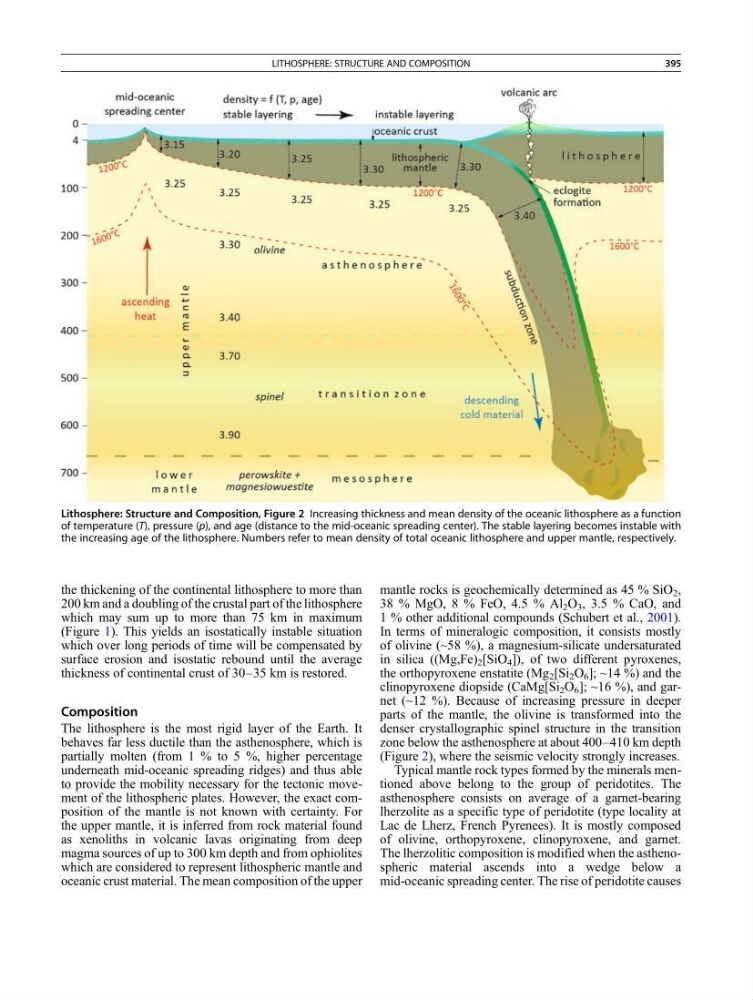
parts of the mantle, the olivine is transformed into the
denser crystallographic spinel structure in the transition
zone below the asthenosphere at about 400–410 km depth
(Figure 2), where the seismic velocity strongly increases.
Typical mantle rock types formed by the minerals mentioned above belong to the group of peridotites. The
asthenosphere consists on average of a garnet-bearing
lherzolite as a specific type of peridotite (type locality at
Lac de Lherz, French Pyrenees). It is mostly composed
of olivine, orthopyroxene, clinopyroxene, and garnet.
The lherzolitic composition is modified when the asthenospheric material ascends into a wedge below a
mid-oceanic spreading center. The rise of peridotite causes
Lithosphere: Structure and Composition, Figure 2 Increasing thickness and mean density of the oceanic lithosphere as a function
of temperature (T), pressure (p), and age (distance to the mid-oceanic spreading center). The stable layering becomes instable with
the increasing age of the lithosphere. Numbers refer to mean density of total oceanic lithosphere and upper mantle, respectively.
LITHOSPHERE: STRUCTURE AND COMPOSITION
395
200 km and a doubling of the crustal part of the lithosphere
which may sum up to more than 75 km in maximum
(Figure 1). This yields an isostatically instable situation
which over long periods of time will be compensated by
surface erosion and isostatic rebound until the average
thickness of continental crust of 30–35 km is restored.
Composition
The lithosphere is the most rigid layer of the Earth. It
behaves far less ductile than the asthenosphere, which is
partially molten (from 1 % to 5 %, higher percentage
underneath mid-oceanic spreading ridges) and thus able
to provide the mobility necessary for the tectonic movement of the lithospheric plates. However, the exact composition of the mantle is not known with certainty. For
the upper mantle, it is inferred from rock material found
as xenoliths in volcanic lavas originating from deep
magma sources of up to 300 km depth and from ophiolites
which are considered to represent lithospheric mantle and
oceanic crust material. The mean composition of the upper
mantle rocks is geochemically determined as 45 % SiO 2 ,
38 % MgO, 8 % FeO, 4.5 % Al 2 O 3 , 3.5 % CaO, and
1 % other additional compounds (Schubert et al., 2001).
In terms of mineralogic composition, it consists mostly
of olivine (~58 %), a magnesium-silicate undersaturated
in silica ((Mg,Fe) 2 [SiO 4 ]), of two different pyroxenes,
the orthopyroxene enstatite (Mg 2 [Si 2 O 6 ]; ~14 %) and the
clinopyroxene diopside (CaMg[Si 2 O 6 ]; ~16 %), and garnet (~12 %). Because of increasing pressure in deeper
parts of the mantle, the olivine is transformed into the
denser crystallographic spinel structure in the transition
zone below the asthenosphere at about 400–410 km depth
(Figure 2), where the seismic velocity strongly increases.
Typical mantle rock types formed by the minerals mentioned above belong to the group of peridotites. The
asthenosphere consists on average of a garnet-bearing
lherzolite as a specific type of peridotite (type locality at
Lac de Lherz, French Pyrenees). It is mostly composed
of olivine, orthopyroxene, clinopyroxene, and garnet.
The lherzolitic composition is modified when the asthenospheric material ascends into a wedge below a
mid-oceanic spreading center. The rise of peridotite causes
Lithosphere: Structure and Composition, Figure 2 Increasing thickness and mean density of the oceanic lithosphere as a function
of temperature (T), pressure (p), and age (distance to the mid-oceanic spreading center). The stable layering becomes instable with
the increasing age of the lithosphere. Numbers refer to mean density of total oceanic lithosphere and upper mantle, respectively.
LITHOSPHERE: STRUCTURE AND COMPOSITION
395