

an increase in partial melting because of pressure reduction. This melt has a basaltic composition and forms the
new oceanic crust at spreading centers. The original
lherzolitic peridotite of the asthenosphere changes into a
harzburgite composition (type locality at Bad Harzburg,
Germany) which is mainly composed of olivine and
orthopyroxene and dunite (mostly olivine). The
clinopyroxene predominantly migrates into the basaltic
melt at the spreading centers. Eclogites with omphacite
(a pyroxene) and garnet as main compounds develop at
subduction zones when gabbroic/basaltic rocks reach hightemperature/low-pressure metamorphic conditions with the
descending slab of oceanic lithosphere (Figure 2). All
observed mantle material, which is today exposed, for
instance, in ophiolitic assemblages, is not primary but has
had a liquid fraction removed by partial melting. The
removed material is of basaltic composition. To reconstruct
the original composition, Ringwood (1962) assumed that
the upper part of the lithospheric mantle consists mainly
of dunite and peridotite. More primitive material follows
further downward. Chemically, these rocks correspond to
a mixture of one part of basalt to four parts of dunite. He
named this hypothetical primitive material “pyrolite” which
is taken as an equivalent for primitive fertile mantle.
Strength
Depending on loading conditions and time scale, the lithosphere exhibits elastic, brittle, or ductile properties
(Kirby, 1983; Turcotte and Schubert, 2002). At relatively
low temperatures near the surface, rocks tend to break
under stress. This is called brittle deformation. At greater
depth, as temperature and pressure increase, it is more
likely that rocks will accommodate stress by changing
shape or deforming (compression, stretching, bending),
rather than breaking. This is called ductile deformation
which means the ability of a solid material to deform under
stress without breaking. The strength of the lithosphere
(i.e., the total force per unit width necessary to deform a
lithospheric section at a given strain rate) is a function of
temperature, composition, and crustal thickness. Confining pressure increases the rock strength but, on the other
hand, increasing temperature weakens the rocks. At low
temperatures frictional processes dominate and brittle
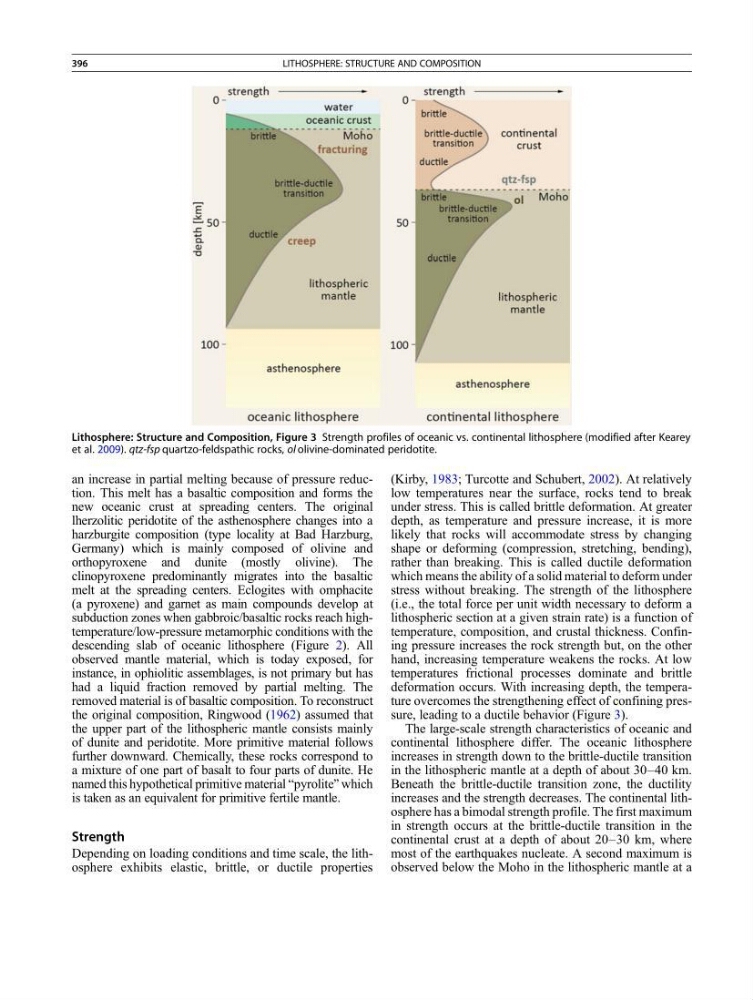
deformation occurs. With increasing depth, the temperature overcomes the strengthening effect of confining pressure, leading to a ductile behavior (Figure 3).
The large-scale strength characteristics of oceanic and
continental lithosphere differ. The oceanic lithosphere
increases in strength down to the brittle-ductile transition
in the lithospheric mantle at a depth of about 30–40 km.
Beneath the brittle-ductile transition zone, the ductility
increases and the strength decreases. The continental lithosphere has a bimodal strength profile. The first maximum
in strength occurs at the brittle-ductile transition in the
continental crust at a depth of about 20–30 km, where
most of the earthquakes nucleate. A second maximum is
observed below the Moho in the lithospheric mantle at a
Lithosphere: Structure and Composition, Figure 3 Strength profiles of oceanic vs. continental lithosphere (modified after Kearey
et al. 2009). qtz-fsp quartzo-feldspathic rocks, ol olivine-dominated peridotite.
396
LITHOSPHERE: STRUCTURE AND COMPOSITION
new oceanic crust at spreading centers. The original
lherzolitic peridotite of the asthenosphere changes into a
harzburgite composition (type locality at Bad Harzburg,
Germany) which is mainly composed of olivine and
orthopyroxene and dunite (mostly olivine). The
clinopyroxene predominantly migrates into the basaltic
melt at the spreading centers. Eclogites with omphacite
(a pyroxene) and garnet as main compounds develop at
subduction zones when gabbroic/basaltic rocks reach hightemperature/low-pressure metamorphic conditions with the
descending slab of oceanic lithosphere (Figure 2). All
observed mantle material, which is today exposed, for
instance, in ophiolitic assemblages, is not primary but has
had a liquid fraction removed by partial melting. The
removed material is of basaltic composition. To reconstruct
the original composition, Ringwood (1962) assumed that
the upper part of the lithospheric mantle consists mainly
of dunite and peridotite. More primitive material follows
further downward. Chemically, these rocks correspond to
a mixture of one part of basalt to four parts of dunite. He
named this hypothetical primitive material “pyrolite” which
is taken as an equivalent for primitive fertile mantle.
Strength
Depending on loading conditions and time scale, the lithosphere exhibits elastic, brittle, or ductile properties
(Kirby, 1983; Turcotte and Schubert, 2002). At relatively
low temperatures near the surface, rocks tend to break
under stress. This is called brittle deformation. At greater
depth, as temperature and pressure increase, it is more
likely that rocks will accommodate stress by changing
shape or deforming (compression, stretching, bending),
rather than breaking. This is called ductile deformation
which means the ability of a solid material to deform under
stress without breaking. The strength of the lithosphere
(i.e., the total force per unit width necessary to deform a
lithospheric section at a given strain rate) is a function of
temperature, composition, and crustal thickness. Confining pressure increases the rock strength but, on the other
hand, increasing temperature weakens the rocks. At low
temperatures frictional processes dominate and brittle
deformation occurs. With increasing depth, the temperature overcomes the strengthening effect of confining pressure, leading to a ductile behavior (Figure 3).
The large-scale strength characteristics of oceanic and
continental lithosphere differ. The oceanic lithosphere
increases in strength down to the brittle-ductile transition
in the lithospheric mantle at a depth of about 30–40 km.
Beneath the brittle-ductile transition zone, the ductility
increases and the strength decreases. The continental lithosphere has a bimodal strength profile. The first maximum
in strength occurs at the brittle-ductile transition in the
continental crust at a depth of about 20–30 km, where
most of the earthquakes nucleate. A second maximum is
observed below the Moho in the lithospheric mantle at a
Lithosphere: Structure and Composition, Figure 3 Strength profiles of oceanic vs. continental lithosphere (modified after Kearey
et al. 2009). qtz-fsp quartzo-feldspathic rocks, ol olivine-dominated peridotite.
396
LITHOSPHERE: STRUCTURE AND COMPOSITION