

continental lithosphere are represented by cratons which
are composed of billions of years old mostly metamorphic
and/or magmatic rocks. The lithosphere of cratons is
thicker and less dense than typical lithosphere and acts
as a stabilizer for these regions.
Structure
The oceanic lithosphere is composed of the lithospheric
mantle and the oceanic crust with mainly gabbroic and
basaltic rocks formed at the oceanic spreading centers.
The thickness of the oceanic lithosphere increases with
increasing distance to the spreading center because new
lithospheric material is continuously added at the base of
the lithosphere by conductive cooling (Figure 2). At about
1200
C, the partially molten asthenospheric material gets
completely solid and is converted into lithospheric mantle.
The density of the solid material increases a little
from 3.25 g/cm
3 for the asthenosphere to about
3.30 g/cm
3 since thermal contraction makes it denser than
the asthenospheric material. As a consequence the mean
density of the oceanic lithosphere as an entirety
(lithospheric mantle plus oceanic crust) increases with
the thickness of the lithospheric mantle. At a certain point
depending on the spreading velocity and the distance from
the spreading center, the stable layering changes into
instability with a slightly denser lithosphere on top of the
lighter asthenosphere (Figure 2). This configuration
applies for lithosphere older than 80–90 myrs in relation
to the onset of spreading at a mid-oceanic ridge. With an
instable layering, a new subduction zone may be initiated
spontaneously by gravitational downwelling of old oceanic lithosphere.
The continental lithosphere is composed of the lithospheric mantle and the continental crust with a large variety of rocks formed during the entire Earth’s history.
Continental crust is unsubductable because of its little
density. Although the lower part is made up of gabbroic/
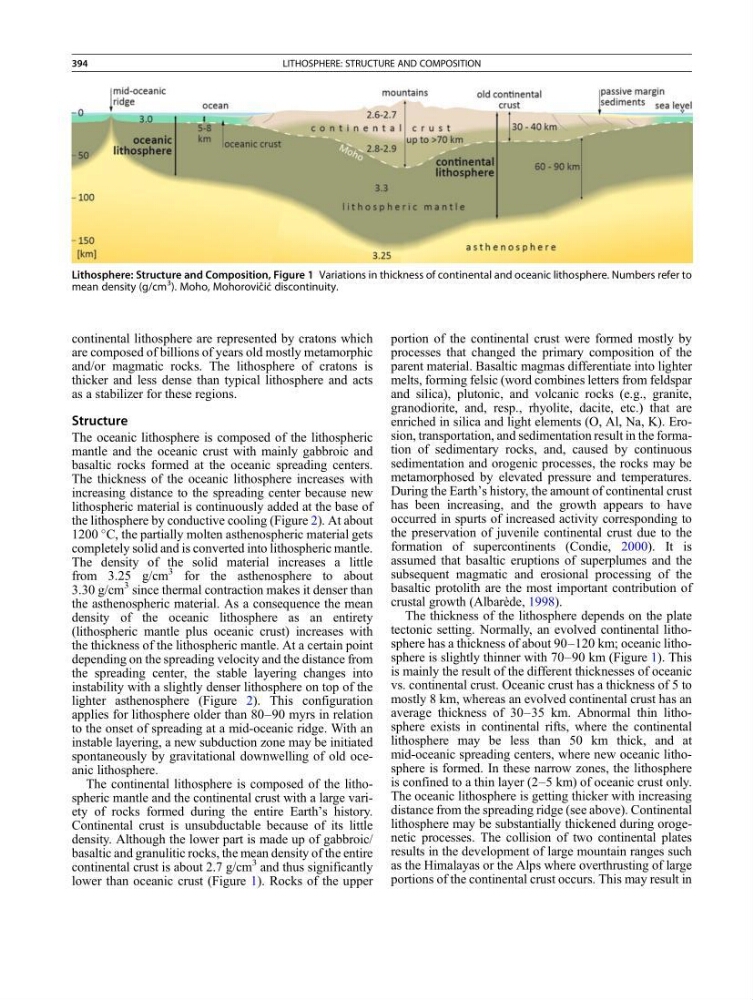
basaltic and granulitic rocks, the mean density of the entire
continental crust is about 2.7 g/cm
3 and thus significantly
lower than oceanic crust (Figure 1). Rocks of the upper
portion of the continental crust were formed mostly by
processes that changed the primary composition of the
parent material. Basaltic magmas differentiate into lighter
melts, forming felsic (word combines letters from feldspar
and silica), plutonic, and volcanic rocks (e.g., granite,
granodiorite, and, resp., rhyolite, dacite, etc.) that are
enriched in silica and light elements (O, Al, Na, K). Erosion, transportation, and sedimentation result in the formation of sedimentary rocks, and, caused by continuous
sedimentation and orogenic processes, the rocks may be
metamorphosed by elevated pressure and temperatures.
During the Earth’s history, the amount of continental crust
has been increasing, and the growth appears to have
occurred in spurts of increased activity corresponding to
the preservation of juvenile continental crust due to the
formation of supercontinents (Condie, 2000). It is
assumed that basaltic eruptions of superplumes and the
subsequent magmatic and erosional processing of the
basaltic protolith are the most important contribution of
crustal growth (Albarède, 1998).
The thickness of the lithosphere depends on the plate
tectonic setting. Normally, an evolved continental lithosphere has a thickness of about 90–120 km; oceanic lithosphere is slightly thinner with 70–90 km (Figure 1). This
is mainly the result of the different thicknesses of oceanic
vs. continental crust. Oceanic crust has a thickness of 5 to
mostly 8 km, whereas an evolved continental crust has an
average thickness of 30–35 km. Abnormal thin lithosphere exists in continental rifts, where the continental
lithosphere may be less than 50 km thick, and at
mid-oceanic spreading centers, where new oceanic lithosphere is formed. In these narrow zones, the lithosphere
is confined to a thin layer (2–5 km) of oceanic crust only.
The oceanic lithosphere is getting thicker with increasing
distance from the spreading ridge (see above). Continental
lithosphere may be substantially thickened during orogenetic processes. The collision of two continental plates
results in the development of large mountain ranges such
as the Himalayas or the Alps where overthrusting of large
portions of the continental crust occurs. This may result in
Lithosphere: Structure and Composition, Figure 1 Variations in thickness of continental and oceanic lithosphere. Numbers refer to
mean density (g/cm
3 ). Moho, Mohorovic ˇic ´ discontinuity.
394
LITHOSPHERE: STRUCTURE AND COMPOSITION
are composed of billions of years old mostly metamorphic
and/or magmatic rocks. The lithosphere of cratons is
thicker and less dense than typical lithosphere and acts
as a stabilizer for these regions.
Structure
The oceanic lithosphere is composed of the lithospheric
mantle and the oceanic crust with mainly gabbroic and
basaltic rocks formed at the oceanic spreading centers.
The thickness of the oceanic lithosphere increases with
increasing distance to the spreading center because new
lithospheric material is continuously added at the base of
the lithosphere by conductive cooling (Figure 2). At about
1200
C, the partially molten asthenospheric material gets
completely solid and is converted into lithospheric mantle.
The density of the solid material increases a little
from 3.25 g/cm
3 for the asthenosphere to about
3.30 g/cm
3 since thermal contraction makes it denser than
the asthenospheric material. As a consequence the mean
density of the oceanic lithosphere as an entirety
(lithospheric mantle plus oceanic crust) increases with
the thickness of the lithospheric mantle. At a certain point
depending on the spreading velocity and the distance from
the spreading center, the stable layering changes into
instability with a slightly denser lithosphere on top of the
lighter asthenosphere (Figure 2). This configuration
applies for lithosphere older than 80–90 myrs in relation
to the onset of spreading at a mid-oceanic ridge. With an
instable layering, a new subduction zone may be initiated
spontaneously by gravitational downwelling of old oceanic lithosphere.
The continental lithosphere is composed of the lithospheric mantle and the continental crust with a large variety of rocks formed during the entire Earth’s history.
Continental crust is unsubductable because of its little
density. Although the lower part is made up of gabbroic/
basaltic and granulitic rocks, the mean density of the entire
continental crust is about 2.7 g/cm
3 and thus significantly
lower than oceanic crust (Figure 1). Rocks of the upper
portion of the continental crust were formed mostly by
processes that changed the primary composition of the
parent material. Basaltic magmas differentiate into lighter
melts, forming felsic (word combines letters from feldspar
and silica), plutonic, and volcanic rocks (e.g., granite,
granodiorite, and, resp., rhyolite, dacite, etc.) that are
enriched in silica and light elements (O, Al, Na, K). Erosion, transportation, and sedimentation result in the formation of sedimentary rocks, and, caused by continuous
sedimentation and orogenic processes, the rocks may be
metamorphosed by elevated pressure and temperatures.
During the Earth’s history, the amount of continental crust
has been increasing, and the growth appears to have
occurred in spurts of increased activity corresponding to
the preservation of juvenile continental crust due to the
formation of supercontinents (Condie, 2000). It is
assumed that basaltic eruptions of superplumes and the
subsequent magmatic and erosional processing of the
basaltic protolith are the most important contribution of
crustal growth (Albarède, 1998).
The thickness of the lithosphere depends on the plate
tectonic setting. Normally, an evolved continental lithosphere has a thickness of about 90–120 km; oceanic lithosphere is slightly thinner with 70–90 km (Figure 1). This
is mainly the result of the different thicknesses of oceanic
vs. continental crust. Oceanic crust has a thickness of 5 to
mostly 8 km, whereas an evolved continental crust has an
average thickness of 30–35 km. Abnormal thin lithosphere exists in continental rifts, where the continental
lithosphere may be less than 50 km thick, and at
mid-oceanic spreading centers, where new oceanic lithosphere is formed. In these narrow zones, the lithosphere
is confined to a thin layer (2–5 km) of oceanic crust only.
The oceanic lithosphere is getting thicker with increasing
distance from the spreading ridge (see above). Continental
lithosphere may be substantially thickened during orogenetic processes. The collision of two continental plates
results in the development of large mountain ranges such
as the Himalayas or the Alps where overthrusting of large
portions of the continental crust occurs. This may result in
Lithosphere: Structure and Composition, Figure 1 Variations in thickness of continental and oceanic lithosphere. Numbers refer to
mean density (g/cm
3 ). Moho, Mohorovic ˇic ´ discontinuity.
394
LITHOSPHERE: STRUCTURE AND COMPOSITION