

occur concurrently and incrementally throughout the evolution of the system. The ongoing process causes the most
devastating earthquakes on Earth, in some cases of magnitudes more than 9.0 (moment magnitude scale). The earthquakes are concentrated in the seismogenic zone, which in
general is situated in the accretionary wedge.
A detachment surface, or décollement, separates the
upper part of the accreted section (i.e., zone of
offscraping) from material that is underthrust beyond the
base of the slope. Above the décollement, scraped-off sediment is transferred to the accretionary prism, and this
prism displays a rugged and irregular seafloor morphology governed by numerous tectonic ridges that form by
folding and fault dislocation (Figure 1). As the subducting
plate transports its sedimentary fill from the trench toward
the arc, some portion of the sediment is subducted and
transported within the subduction channel down to great
depths where it becomes an important factor in the feeding
of subduction-related magmas. The remaining portion, or
in some cases the entire sedimentary layer and parts of the
oceanic crustal basement, can be scraped off forming the
accretionary wedge on the upper plate.
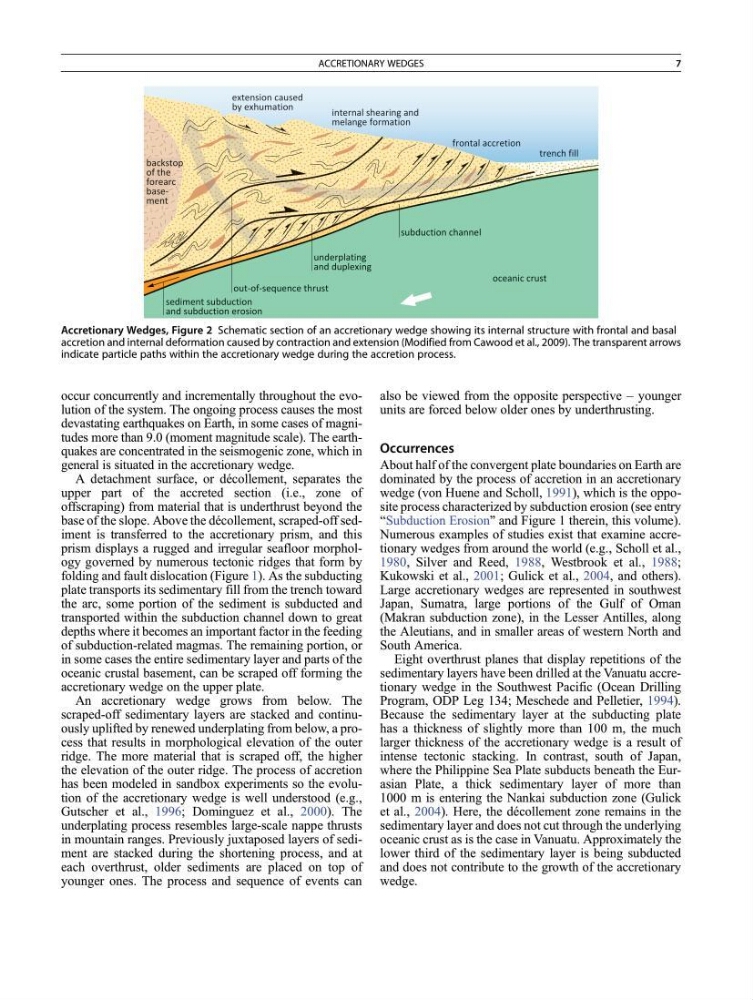
An accretionary wedge grows from below. The
scraped-off sedimentary layers are stacked and continuously uplifted by renewed underplating from below, a process that results in morphological elevation of the outer
ridge. The more material that is scraped off, the higher
the elevation of the outer ridge. The process of accretion
has been modeled in sandbox experiments so the evolution of the accretionary wedge is well understood (e.g.,
Gutscher et al., 1996; Dominguez et al., 2000). The
underplating process resembles large-scale nappe thrusts
in mountain ranges. Previously juxtaposed layers of sediment are stacked during the shortening process, and at
each overthrust, older sediments are placed on top of
younger ones. The process and sequence of events can
also be viewed from the opposite perspective – younger
units are forced below older ones by underthrusting.
Occurrences
About half of the convergent plate boundaries on Earth are
dominated by the process of accretion in an accretionary
wedge (von Huene and Scholl, 1991), which is the opposite process characterized by subduction erosion (see entry
“Subduction Erosion” and Figure 1 therein, this volume).
Numerous examples of studies exist that examine accretionary wedges from around the world (e.g., Scholl et al.,
1980, Silver and Reed, 1988, Westbrook et al., 1988;
Kukowski et al., 2001; Gulick et al., 2004, and others).
Large accretionary wedges are represented in southwest
Japan, Sumatra, large portions of the Gulf of Oman
(Makran subduction zone), in the Lesser Antilles, along
the Aleutians, and in smaller areas of western North and
South America.
Eight overthrust planes that display repetitions of the
sedimentary layers have been drilled at the Vanuatu accretionary wedge in the Southwest Pacific (Ocean Drilling
Program, ODP Leg 134; Meschede and Pelletier, 1994).
Because the sedimentary layer at the subducting plate
has a thickness of slightly more than 100 m, the much
larger thickness of the accretionary wedge is a result of
intense tectonic stacking. In contrast, south of Japan,
where the Philippine Sea Plate subducts beneath the Eurasian Plate, a thick sedimentary layer of more than
1000 m is entering the Nankai subduction zone (Gulick
et al., 2004). Here, the décollement zone remains in the
sedimentary layer and does not cut through the underlying
oceanic crust as is the case in Vanuatu. Approximately the
lower third of the sedimentary layer is being subducted
and does not contribute to the growth of the accretionary
wedge.
underplating
and duplexing
out-of-sequence thrust
sediment subduction
and subduction erosion
extension caused
by exhumation
backstop
of the
forearc
basement
internal shearing and
melange formation
frontal accretion
trench fill
subduction channel
oceanic crust
Accretionary Wedges, Figure 2 Schematic section of an accretionary wedge showing its internal structure with frontal and basal
accretion and internal deformation caused by contraction and extension (Modified from Cawood et al., 2009). The transparent arrows
indicate particle paths within the accretionary wedge during the accretion process.
ACCRETIONARY WEDGES
7
devastating earthquakes on Earth, in some cases of magnitudes more than 9.0 (moment magnitude scale). The earthquakes are concentrated in the seismogenic zone, which in
general is situated in the accretionary wedge.
A detachment surface, or décollement, separates the
upper part of the accreted section (i.e., zone of
offscraping) from material that is underthrust beyond the
base of the slope. Above the décollement, scraped-off sediment is transferred to the accretionary prism, and this
prism displays a rugged and irregular seafloor morphology governed by numerous tectonic ridges that form by
folding and fault dislocation (Figure 1). As the subducting
plate transports its sedimentary fill from the trench toward
the arc, some portion of the sediment is subducted and
transported within the subduction channel down to great
depths where it becomes an important factor in the feeding
of subduction-related magmas. The remaining portion, or
in some cases the entire sedimentary layer and parts of the
oceanic crustal basement, can be scraped off forming the
accretionary wedge on the upper plate.
An accretionary wedge grows from below. The
scraped-off sedimentary layers are stacked and continuously uplifted by renewed underplating from below, a process that results in morphological elevation of the outer
ridge. The more material that is scraped off, the higher
the elevation of the outer ridge. The process of accretion
has been modeled in sandbox experiments so the evolution of the accretionary wedge is well understood (e.g.,
Gutscher et al., 1996; Dominguez et al., 2000). The
underplating process resembles large-scale nappe thrusts
in mountain ranges. Previously juxtaposed layers of sediment are stacked during the shortening process, and at
each overthrust, older sediments are placed on top of
younger ones. The process and sequence of events can
also be viewed from the opposite perspective – younger
units are forced below older ones by underthrusting.
Occurrences
About half of the convergent plate boundaries on Earth are
dominated by the process of accretion in an accretionary
wedge (von Huene and Scholl, 1991), which is the opposite process characterized by subduction erosion (see entry
“Subduction Erosion” and Figure 1 therein, this volume).
Numerous examples of studies exist that examine accretionary wedges from around the world (e.g., Scholl et al.,
1980, Silver and Reed, 1988, Westbrook et al., 1988;
Kukowski et al., 2001; Gulick et al., 2004, and others).
Large accretionary wedges are represented in southwest
Japan, Sumatra, large portions of the Gulf of Oman
(Makran subduction zone), in the Lesser Antilles, along
the Aleutians, and in smaller areas of western North and
South America.
Eight overthrust planes that display repetitions of the
sedimentary layers have been drilled at the Vanuatu accretionary wedge in the Southwest Pacific (Ocean Drilling
Program, ODP Leg 134; Meschede and Pelletier, 1994).
Because the sedimentary layer at the subducting plate
has a thickness of slightly more than 100 m, the much
larger thickness of the accretionary wedge is a result of
intense tectonic stacking. In contrast, south of Japan,
where the Philippine Sea Plate subducts beneath the Eurasian Plate, a thick sedimentary layer of more than
1000 m is entering the Nankai subduction zone (Gulick
et al., 2004). Here, the décollement zone remains in the
sedimentary layer and does not cut through the underlying
oceanic crust as is the case in Vanuatu. Approximately the
lower third of the sedimentary layer is being subducted
and does not contribute to the growth of the accretionary
wedge.
underplating
and duplexing
out-of-sequence thrust
sediment subduction
and subduction erosion
extension caused
by exhumation
backstop
of the
forearc
basement
internal shearing and
melange formation
frontal accretion
trench fill
subduction channel
oceanic crust
Accretionary Wedges, Figure 2 Schematic section of an accretionary wedge showing its internal structure with frontal and basal
accretion and internal deformation caused by contraction and extension (Modified from Cawood et al., 2009). The transparent arrows
indicate particle paths within the accretionary wedge during the accretion process.
ACCRETIONARY WEDGES
7