

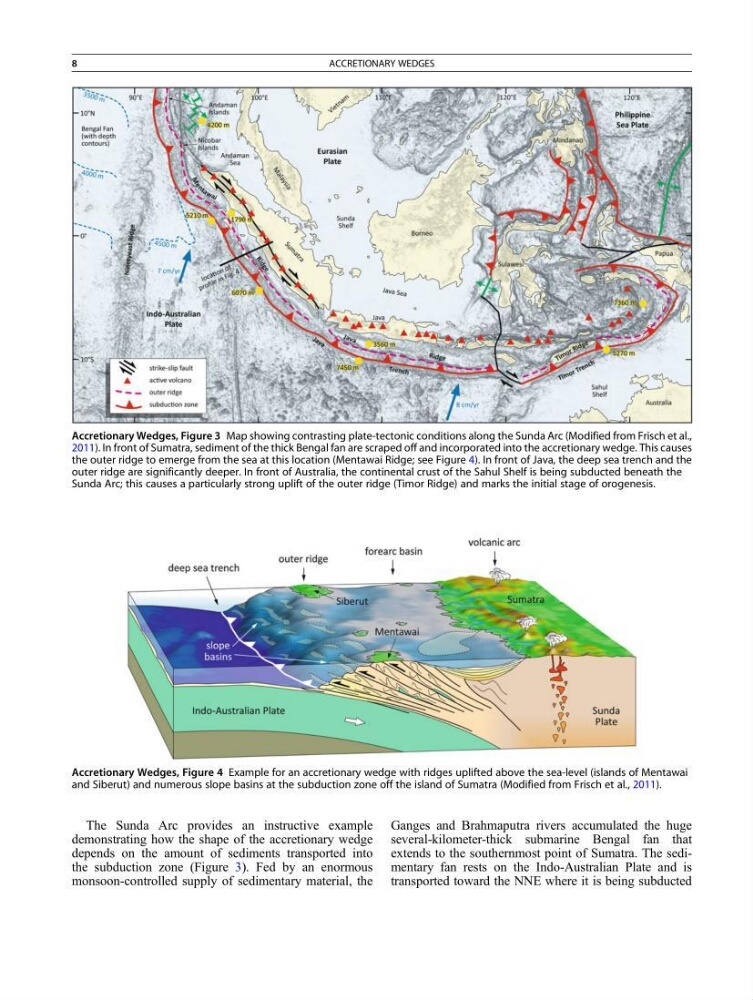
The Sunda Arc provides an instructive example
demonstrating how the shape of the accretionary wedge
depends on the amount of sediments transported into
the subduction zone (Figure 3). Fed by an enormous
monsoon-controlled supply of sedimentary material, the
Ganges and Brahmaputra rivers accumulated the huge
several-kilometer-thick submarine Bengal fan that
extends to the southernmost point of Sumatra. The sedimentary fan rests on the Indo-Australian Plate and is
transported toward the NNE where it is being subducted
Accretionary Wedges, Figure 3 Map showing contrasting plate-tectonic conditions along the Sunda Arc (Modified from Frisch et al.,
2011). In front of Sumatra, sediment of the thick Bengal fan are scraped off and incorporated into the accretionary wedge. This causes
the outer ridge to emerge from the sea at this location (Mentawai Ridge; see Figure 4). In front of Java, the deep sea trench and the
outer ridge are significantly deeper. In front of Australia, the continental crust of the Sahul Shelf is being subducted beneath the
Sunda Arc; this causes a particularly strong uplift of the outer ridge (Timor Ridge) and marks the initial stage of orogenesis.
Accretionary Wedges, Figure 4 Example for an accretionary wedge with ridges uplifted above the sea-level (islands of Mentawai
and Siberut) and numerous slope basins at the subduction zone off the island of Sumatra (Modified from Frisch et al., 2011).
8
ACCRETIONARY WEDGES
demonstrating how the shape of the accretionary wedge
depends on the amount of sediments transported into
the subduction zone (Figure 3). Fed by an enormous
monsoon-controlled supply of sedimentary material, the
Ganges and Brahmaputra rivers accumulated the huge
several-kilometer-thick submarine Bengal fan that
extends to the southernmost point of Sumatra. The sedimentary fan rests on the Indo-Australian Plate and is
transported toward the NNE where it is being subducted
Accretionary Wedges, Figure 3 Map showing contrasting plate-tectonic conditions along the Sunda Arc (Modified from Frisch et al.,
2011). In front of Sumatra, sediment of the thick Bengal fan are scraped off and incorporated into the accretionary wedge. This causes
the outer ridge to emerge from the sea at this location (Mentawai Ridge; see Figure 4). In front of Java, the deep sea trench and the
outer ridge are significantly deeper. In front of Australia, the continental crust of the Sahul Shelf is being subducted beneath the
Sunda Arc; this causes a particularly strong uplift of the outer ridge (Timor Ridge) and marks the initial stage of orogenesis.
Accretionary Wedges, Figure 4 Example for an accretionary wedge with ridges uplifted above the sea-level (islands of Mentawai
and Siberut) and numerous slope basins at the subduction zone off the island of Sumatra (Modified from Frisch et al., 2011).
8
ACCRETIONARY WEDGES