

ACCRETIONARY WEDGES
Martin Meschede
Institute of Geography and Geology, Ernst-Moritz-Arndt
University, Greifswald, Germany
Synonyms
Accretionary complex; Accretionary prism
Definition
Accretion defines a process at a convergent plate margin
above a subduction zone where material of the subducting
lower plate is scraped off and transferred to the overriding
upper plate. The offscraped material is accumulated in a
wedge-shaped stack of sedimentary layers sometimes
containing also offscraped material from the oceanic crust
of the subducting plate. It is located directly at the boundary between the two converging plates. This region is
called the forearc region of the convergent plate boundary
(see entry “Morphology Across Convergent Plate
Boundaries” and Figure 3 therein, this volume).
Formation
Accretionary wedges essentially develop as compressional fold-and-thrust belts which are composed primarily
of oceanic-plate deposits and, in many cases, continentally
derived trench-floor sediment from a nearby continental
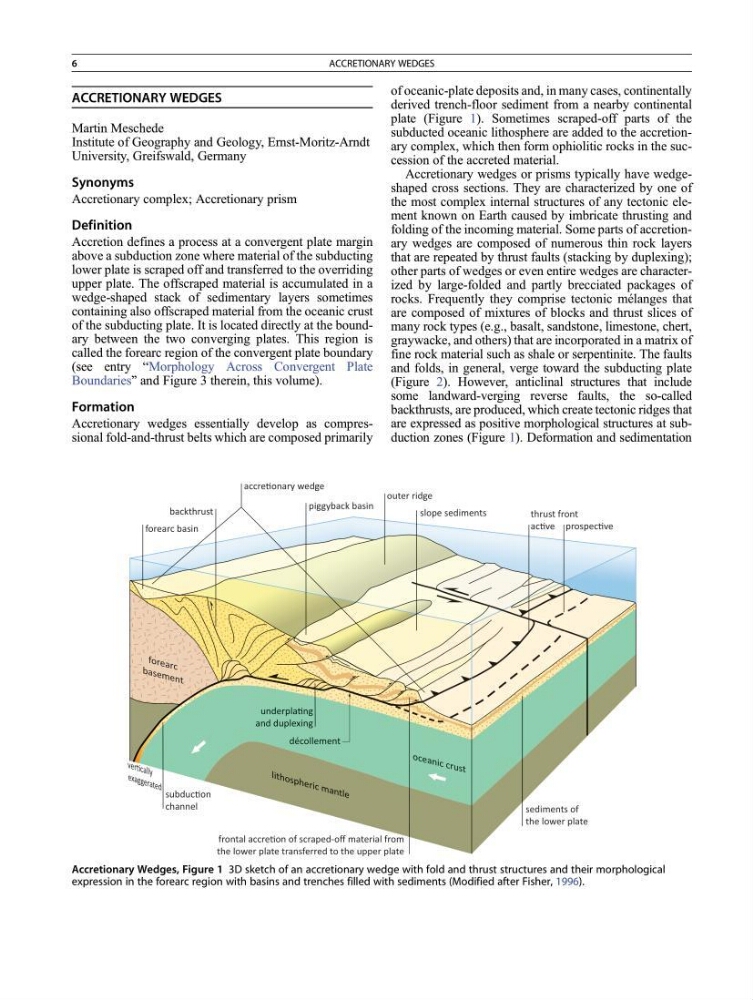
plate (Figure 1). Sometimes scraped-off parts of the
subducted oceanic lithosphere are added to the accretionary complex, which then form ophiolitic rocks in the succession of the accreted material.
Accretionary wedges or prisms typically have wedgeshaped cross sections. They are characterized by one of
the most complex internal structures of any tectonic element known on Earth caused by imbricate thrusting and
folding of the incoming material. Some parts of accretionary wedges are composed of numerous thin rock layers
that are repeated by thrust faults (stacking by duplexing);
other parts of wedges or even entire wedges are characterized by large-folded and partly brecciated packages of
rocks. Frequently they comprise tectonic mélanges that
are composed of mixtures of blocks and thrust slices of
many rock types (e.g., basalt, sandstone, limestone, chert,
graywacke, and others) that are incorporated in a matrix of
fine rock material such as shale or serpentinite. The faults
and folds, in general, verge toward the subducting plate
(Figure 2). However, anticlinal structures that include
some landward-verging reverse faults, the so-called
backthrusts, are produced, which create tectonic ridges that
are expressed as positive morphological structures at subduction zones (Figure 1). Deformation and sedimentation
sediments of
the lower plate
ve rƟ ca lly
ex ag ge ra te d
forearc basin
backthrust
fo re ar c
b as e m e n t
accreƟonary wedge
piggyback basin
o ce an ic cr u st
lit h o sp h e ri c m an tl e
subducƟon
channel
frontal accreƟon of scraped-off material from
the lower plate transferred to the upper plate
décollement
underplaƟng
and duplexing
slope sediments
outer ridge
thrust front
acƟve prospecƟve
Accretionary Wedges, Figure 1 3D sketch of an accretionary wedge with fold and thrust structures and their morphological
expression in the forearc region with basins and trenches filled with sediments (Modified after Fisher, 1996).
6
ACCRETIONARY WEDGES
Martin Meschede
Institute of Geography and Geology, Ernst-Moritz-Arndt
University, Greifswald, Germany
Synonyms
Accretionary complex; Accretionary prism
Definition
Accretion defines a process at a convergent plate margin
above a subduction zone where material of the subducting
lower plate is scraped off and transferred to the overriding
upper plate. The offscraped material is accumulated in a
wedge-shaped stack of sedimentary layers sometimes
containing also offscraped material from the oceanic crust
of the subducting plate. It is located directly at the boundary between the two converging plates. This region is
called the forearc region of the convergent plate boundary
(see entry “Morphology Across Convergent Plate
Boundaries” and Figure 3 therein, this volume).
Formation
Accretionary wedges essentially develop as compressional fold-and-thrust belts which are composed primarily
of oceanic-plate deposits and, in many cases, continentally
derived trench-floor sediment from a nearby continental
plate (Figure 1). Sometimes scraped-off parts of the
subducted oceanic lithosphere are added to the accretionary complex, which then form ophiolitic rocks in the succession of the accreted material.
Accretionary wedges or prisms typically have wedgeshaped cross sections. They are characterized by one of
the most complex internal structures of any tectonic element known on Earth caused by imbricate thrusting and
folding of the incoming material. Some parts of accretionary wedges are composed of numerous thin rock layers
that are repeated by thrust faults (stacking by duplexing);
other parts of wedges or even entire wedges are characterized by large-folded and partly brecciated packages of
rocks. Frequently they comprise tectonic mélanges that
are composed of mixtures of blocks and thrust slices of
many rock types (e.g., basalt, sandstone, limestone, chert,
graywacke, and others) that are incorporated in a matrix of
fine rock material such as shale or serpentinite. The faults
and folds, in general, verge toward the subducting plate
(Figure 2). However, anticlinal structures that include
some landward-verging reverse faults, the so-called
backthrusts, are produced, which create tectonic ridges that
are expressed as positive morphological structures at subduction zones (Figure 1). Deformation and sedimentation
sediments of
the lower plate
ve rƟ ca lly
ex ag ge ra te d
forearc basin
backthrust
fo re ar c
b as e m e n t
accreƟonary wedge
piggyback basin
o ce an ic cr u st
lit h o sp h e ri c m an tl e
subducƟon
channel
frontal accreƟon of scraped-off material from
the lower plate transferred to the upper plate
décollement
underplaƟng
and duplexing
slope sediments
outer ridge
thrust front
acƟve prospecƟve
Accretionary Wedges, Figure 1 3D sketch of an accretionary wedge with fold and thrust structures and their morphological
expression in the forearc region with basins and trenches filled with sediments (Modified after Fisher, 1996).
6
ACCRETIONARY WEDGES