

In short, deep-sea sedimentation is sparse and relatively
evenly distributed (no local sources), depending mostly on
the thin fallout of particles from the photic zone, the
so-called pelagic rain of particles, wind transport of dust,
and distal turbidites from higher areas. Over time, this
kind of sedimentation blankets the oceanic crust and levels
its topography resulting in the very smooth and even abyssal plains. The thickness of sediments that rest on the oceanic basement can be mapped in the form of contour lines
(isopachs). Global isopach maps (Whittaker et al., 2013)
show that the major trend in sediment thickness is from
absent close to the mid-ocean ridges where the oceanic
crust is young and the distance to the continental sources
of sediments is large to some hundred meters close to the
foot of continental slopes, where the oceanic crust is oldest
and continents are close. This trend is locally overprinted
by other effects such as high bioproductivity belts around
the equator and bottom current transport of sediments but
general to all oceans (Figure 4).
Life in the abyssal plains
New observation systems employed in the last decades
give evidence for numerous life forms in the deep sea
and on abyssal plains. One of the fundamental conditions
for higher life forms, the constant supply of oxygen is provided for by deep ocean currents that are part of the
so-called global conveyor belt of ocean currents. Still, life
in the abyssal plains meets very specific challenges,
because of which sometimes they are termed “ocean
deserts,” indicating the low diversity and low density of
life forms. First, autotrophic (plant) life is impossible in
the lightless depth of the oceans. Therefore practically
every life form here depends on the “import” of nutrients
from the photic (uppermost) zone of the water column in
the form of a rain of particles (dead plants and animals,
fecal pellets) from above. Second, this rain is very thin
over most of the abyssal plains. Only few ocean surface
regions (the so-called upwelling zones) have a high primary production and associated food web to produce a
constant export of nutrients to the deep sea that can nourish a dense population of animals on the deep seafloor.
Third, this rain is variable in time and space. This is exemplified by whale falls. Dead whale bodies that sink to the
bottom of the ocean provide food for years for a very specialized group of bacteria and animals. Yet whale falls are
so irregular in time and the cadavers are so small in relation to the vast dimensions of abyssal plains that it is a
question yet unresolved, how those animals actually find
the prey and what they do “in between” the next lucky
strike. Fourth, the abyssal plain is covered by relatively
soft mud. This is an unfavorable situation for animals that
are attached to the ground, preventing them to settle and
build colonies. This fact becomes striking when seamounts are considered. Seamounts are solid rock bodies
that rise from the abyssal plains. If abyssal plains are
termed deserts in terms of biological activity, then
seamounts are the oasis.
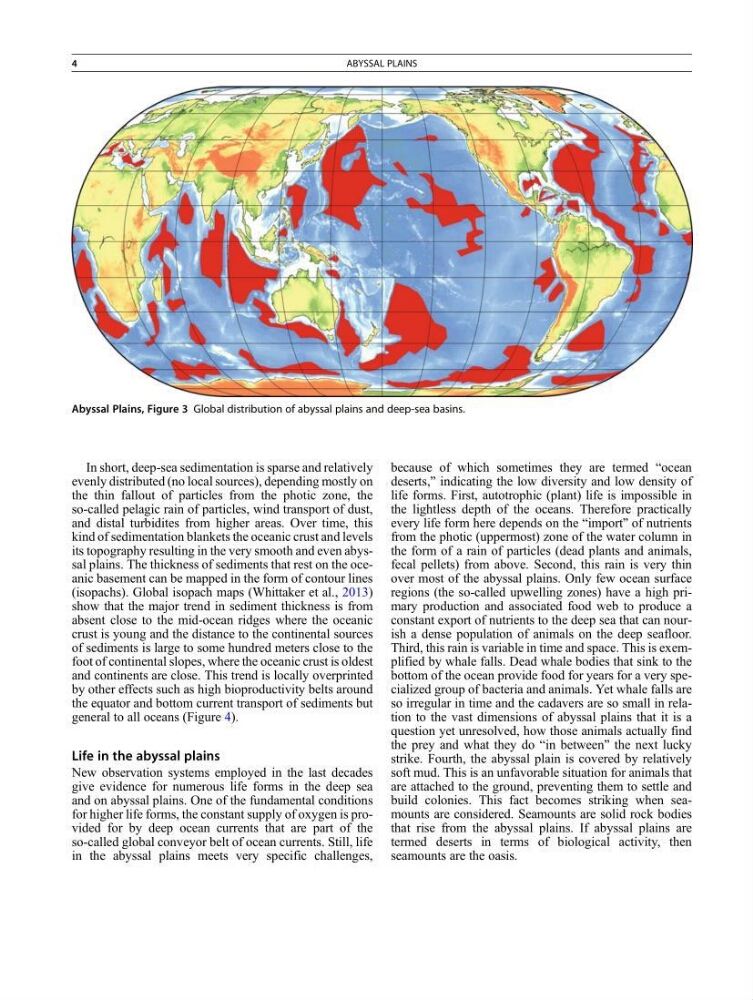
Abyssal Plains, Figure 3 Global distribution of abyssal plains and deep-sea basins.
4
ABYSSAL PLAINS
evenly distributed (no local sources), depending mostly on
the thin fallout of particles from the photic zone, the
so-called pelagic rain of particles, wind transport of dust,
and distal turbidites from higher areas. Over time, this
kind of sedimentation blankets the oceanic crust and levels
its topography resulting in the very smooth and even abyssal plains. The thickness of sediments that rest on the oceanic basement can be mapped in the form of contour lines
(isopachs). Global isopach maps (Whittaker et al., 2013)
show that the major trend in sediment thickness is from
absent close to the mid-ocean ridges where the oceanic
crust is young and the distance to the continental sources
of sediments is large to some hundred meters close to the
foot of continental slopes, where the oceanic crust is oldest
and continents are close. This trend is locally overprinted
by other effects such as high bioproductivity belts around
the equator and bottom current transport of sediments but
general to all oceans (Figure 4).
Life in the abyssal plains
New observation systems employed in the last decades
give evidence for numerous life forms in the deep sea
and on abyssal plains. One of the fundamental conditions
for higher life forms, the constant supply of oxygen is provided for by deep ocean currents that are part of the
so-called global conveyor belt of ocean currents. Still, life
in the abyssal plains meets very specific challenges,
because of which sometimes they are termed “ocean
deserts,” indicating the low diversity and low density of
life forms. First, autotrophic (plant) life is impossible in
the lightless depth of the oceans. Therefore practically
every life form here depends on the “import” of nutrients
from the photic (uppermost) zone of the water column in
the form of a rain of particles (dead plants and animals,
fecal pellets) from above. Second, this rain is very thin
over most of the abyssal plains. Only few ocean surface
regions (the so-called upwelling zones) have a high primary production and associated food web to produce a
constant export of nutrients to the deep sea that can nourish a dense population of animals on the deep seafloor.
Third, this rain is variable in time and space. This is exemplified by whale falls. Dead whale bodies that sink to the
bottom of the ocean provide food for years for a very specialized group of bacteria and animals. Yet whale falls are
so irregular in time and the cadavers are so small in relation to the vast dimensions of abyssal plains that it is a
question yet unresolved, how those animals actually find
the prey and what they do “in between” the next lucky
strike. Fourth, the abyssal plain is covered by relatively
soft mud. This is an unfavorable situation for animals that
are attached to the ground, preventing them to settle and
build colonies. This fact becomes striking when seamounts are considered. Seamounts are solid rock bodies
that rise from the abyssal plains. If abyssal plains are
termed deserts in terms of biological activity, then
seamounts are the oasis.
Abyssal Plains, Figure 3 Global distribution of abyssal plains and deep-sea basins.
4
ABYSSAL PLAINS