

smokers, although the notion of massive sulfide deposits
forming at submarine volcanoes existed among economic
geologists long before then. By the late 1970s, many of the
details of ore formation in the submarine environment had
already been established from the study of fossil hydrothermal sulfide deposits on land. A significant metal
enrichment had also been identified in sediments flanking
the East Pacific Rise mid-ocean ridge, which was attributed to, as yet undiscovered, hydrothermal activity along
the nearby ridge (Boström, 1966). Thus, the discovery of
seafloor hydrothermal vents and the associated massive
sulfide deposits came about not only because of technological advances that allowed deep diving to the
mid-ocean ridges but also because of existing ideas about
the likelihood that some form of hydrothermal activity
should exist on the seafloor. However, those who participated on the discovery cruises did not foresee the spectacular “black smoker” chimneys that formed at the vents or
the unusual biological communities that were found thriving in such extreme environments.
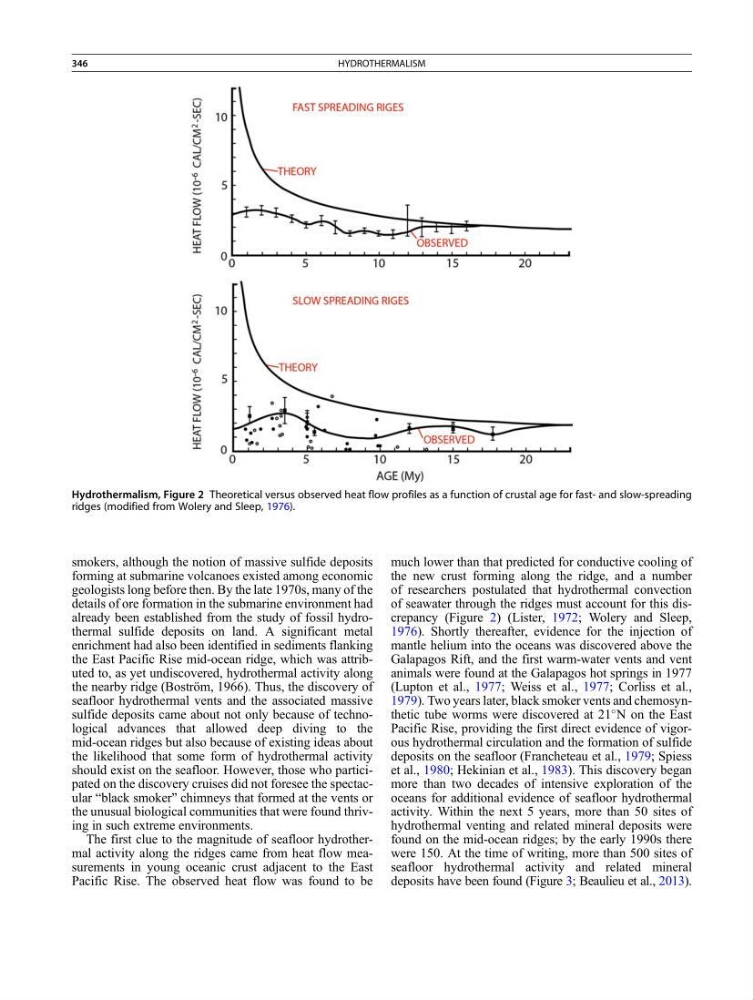
The first clue to the magnitude of seafloor hydrothermal activity along the ridges came from heat flow measurements in young oceanic crust adjacent to the East
Pacific Rise. The observed heat flow was found to be
much lower than that predicted for conductive cooling of
the new crust forming along the ridge, and a number
of researchers postulated that hydrothermal convection
of seawater through the ridges must account for this discrepancy (Figure 2) (Lister, 1972; Wolery and Sleep,
1976). Shortly thereafter, evidence for the injection of
mantle helium into the oceans was discovered above the
Galapagos Rift, and the first warm-water vents and vent
animals were found at the Galapagos hot springs in 1977
(Lupton et al., 1977; Weiss et al., 1977; Corliss et al.,
1979). Two years later, black smoker vents and chemosynthetic tube worms were discovered at 21
N on the East
Pacific Rise, providing the first direct evidence of vigorous hydrothermal circulation and the formation of sulfide
deposits on the seafloor (Francheteau et al., 1979; Spiess
et al., 1980; Hekinian et al., 1983). This discovery began
more than two decades of intensive exploration of the
oceans for additional evidence of seafloor hydrothermal
activity. Within the next 5 years, more than 50 sites of
hydrothermal venting and related mineral deposits were
found on the mid-ocean ridges; by the early 1990s there
were 150. At the time of writing, more than 500 sites of
seafloor hydrothermal activity and related mineral
deposits have been found (Figure 3; Beaulieu et al., 2013).
Hydrothermalism, Figure 2 Theoretical versus observed heat flow profiles as a function of crustal age for fast- and slow-spreading
ridges (modified from Wolery and Sleep, 1976).
346
HYDROTHERMALISM
forming at submarine volcanoes existed among economic
geologists long before then. By the late 1970s, many of the
details of ore formation in the submarine environment had
already been established from the study of fossil hydrothermal sulfide deposits on land. A significant metal
enrichment had also been identified in sediments flanking
the East Pacific Rise mid-ocean ridge, which was attributed to, as yet undiscovered, hydrothermal activity along
the nearby ridge (Boström, 1966). Thus, the discovery of
seafloor hydrothermal vents and the associated massive
sulfide deposits came about not only because of technological advances that allowed deep diving to the
mid-ocean ridges but also because of existing ideas about
the likelihood that some form of hydrothermal activity
should exist on the seafloor. However, those who participated on the discovery cruises did not foresee the spectacular “black smoker” chimneys that formed at the vents or
the unusual biological communities that were found thriving in such extreme environments.
The first clue to the magnitude of seafloor hydrothermal activity along the ridges came from heat flow measurements in young oceanic crust adjacent to the East
Pacific Rise. The observed heat flow was found to be
much lower than that predicted for conductive cooling of
the new crust forming along the ridge, and a number
of researchers postulated that hydrothermal convection
of seawater through the ridges must account for this discrepancy (Figure 2) (Lister, 1972; Wolery and Sleep,
1976). Shortly thereafter, evidence for the injection of
mantle helium into the oceans was discovered above the
Galapagos Rift, and the first warm-water vents and vent
animals were found at the Galapagos hot springs in 1977
(Lupton et al., 1977; Weiss et al., 1977; Corliss et al.,
1979). Two years later, black smoker vents and chemosynthetic tube worms were discovered at 21
N on the East
Pacific Rise, providing the first direct evidence of vigorous hydrothermal circulation and the formation of sulfide
deposits on the seafloor (Francheteau et al., 1979; Spiess
et al., 1980; Hekinian et al., 1983). This discovery began
more than two decades of intensive exploration of the
oceans for additional evidence of seafloor hydrothermal
activity. Within the next 5 years, more than 50 sites of
hydrothermal venting and related mineral deposits were
found on the mid-ocean ridges; by the early 1990s there
were 150. At the time of writing, more than 500 sites of
seafloor hydrothermal activity and related mineral
deposits have been found (Figure 3; Beaulieu et al., 2013).
Hydrothermalism, Figure 2 Theoretical versus observed heat flow profiles as a function of crustal age for fast- and slow-spreading
ridges (modified from Wolery and Sleep, 1976).
346
HYDROTHERMALISM