

detection of hydrothermal plumes, historically, has been
the primary method for the discovery of hydrothermal
venting on the seafloor.
The massive sulfide deposits that form on the seafloor
are composed primarily of sulfide minerals, as well as sulfates (anhydrite and barite) and amorphous silica. The
deposits can contain economically significant concentrations of Cu, Zn, Pb, Au, and Ag, and massive sulfide
deposits that have been discovered in ancient oceanic crust
now obducted on land (referred to as volcanogenic massive sulfide deposits) have been mined for their precious
and base metal content and continue to be an important
source for these metals. With the increasing global
demand for metal resources and the decreasing rate of discovery of large ore deposits on land to satisfy this demand,
modern hydrothermal sulfide deposits on the seafloor are
increasingly being considered as a viable future source
for metals (see “Marine Mineral Resources”). Although,
at the time of writing, no modern seafloor massive sulfide
deposits have been exploited, several companies and
national governments are actively exploring the seafloor
for massive sulfide deposits that are sufficiently large
and exhibit sufficiently high metal concentrations to be
exploited.
The following sections provide an overview of the
physical and chemical characteristics of typical submarine
hydrothermal systems. Many aspects of hydrothermal systems (e.g., black and white smokers, hydrothermal fluids,
hydrothermal plumes, volcanogenic massive sulfides, chemosynthetic life) are covered in more detail in their own
separate entries, and the reader is directed to those entries
for further details.
Discovery
The discovery of active hydrothermal venting on the seafloor, and especially their link to chemosynthetic life,
was among the most significant scientific advances of
the twentieth century. The link between seafloor volcanism and hydrothermalism in the oceans was first articulated as an outgrowth of plate tectonic theory in the
1960s, about 20 years before the discovery of black
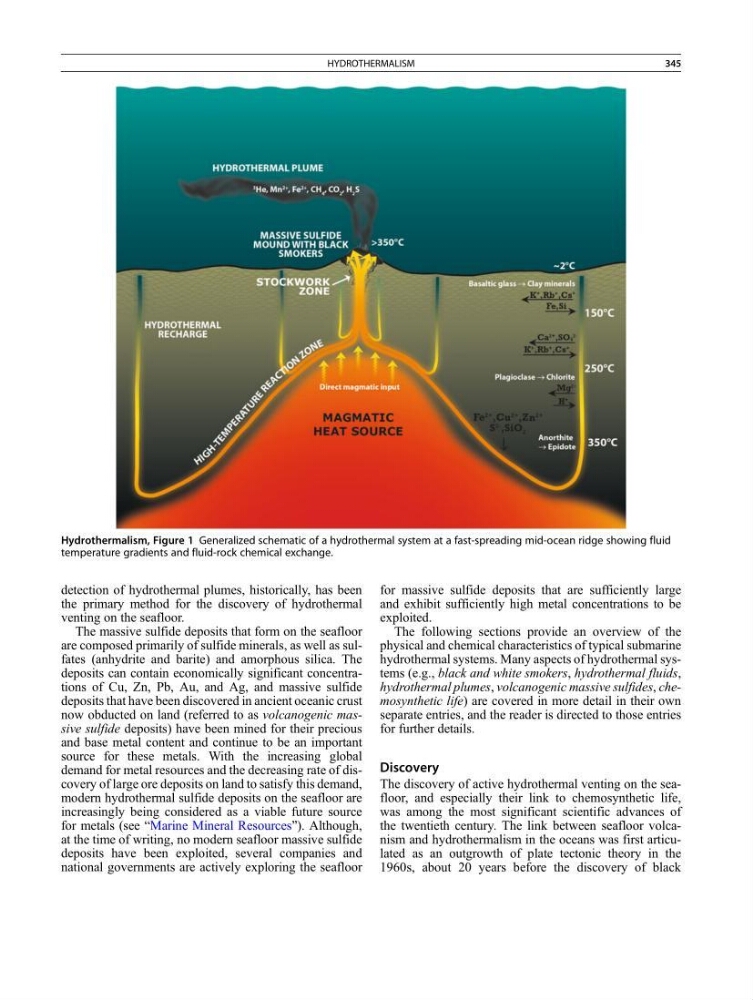
Hydrothermalism, Figure 1 Generalized schematic of a hydrothermal system at a fast-spreading mid-ocean ridge showing fluid
temperature gradients and fluid-rock chemical exchange.
HYDROTHERMALISM
345
the primary method for the discovery of hydrothermal
venting on the seafloor.
The massive sulfide deposits that form on the seafloor
are composed primarily of sulfide minerals, as well as sulfates (anhydrite and barite) and amorphous silica. The
deposits can contain economically significant concentrations of Cu, Zn, Pb, Au, and Ag, and massive sulfide
deposits that have been discovered in ancient oceanic crust
now obducted on land (referred to as volcanogenic massive sulfide deposits) have been mined for their precious
and base metal content and continue to be an important
source for these metals. With the increasing global
demand for metal resources and the decreasing rate of discovery of large ore deposits on land to satisfy this demand,
modern hydrothermal sulfide deposits on the seafloor are
increasingly being considered as a viable future source
for metals (see “Marine Mineral Resources”). Although,
at the time of writing, no modern seafloor massive sulfide
deposits have been exploited, several companies and
national governments are actively exploring the seafloor
for massive sulfide deposits that are sufficiently large
and exhibit sufficiently high metal concentrations to be
exploited.
The following sections provide an overview of the
physical and chemical characteristics of typical submarine
hydrothermal systems. Many aspects of hydrothermal systems (e.g., black and white smokers, hydrothermal fluids,
hydrothermal plumes, volcanogenic massive sulfides, chemosynthetic life) are covered in more detail in their own
separate entries, and the reader is directed to those entries
for further details.
Discovery
The discovery of active hydrothermal venting on the seafloor, and especially their link to chemosynthetic life,
was among the most significant scientific advances of
the twentieth century. The link between seafloor volcanism and hydrothermalism in the oceans was first articulated as an outgrowth of plate tectonic theory in the
1960s, about 20 years before the discovery of black
Hydrothermalism, Figure 1 Generalized schematic of a hydrothermal system at a fast-spreading mid-ocean ridge showing fluid
temperature gradients and fluid-rock chemical exchange.
HYDROTHERMALISM
345