

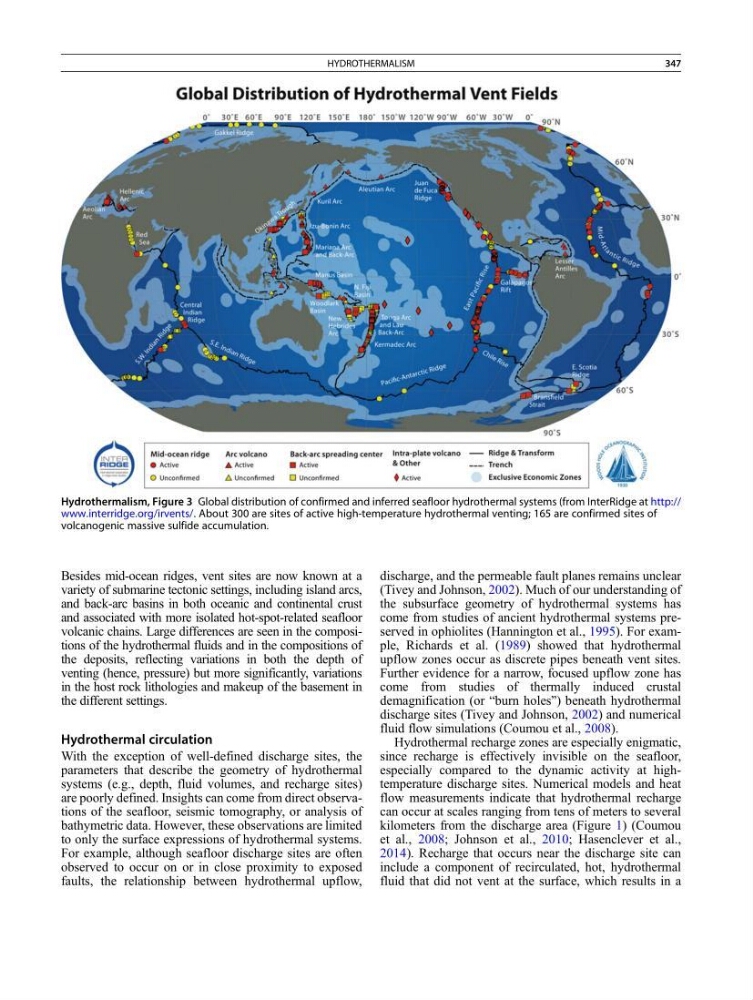
Besides mid-ocean ridges, vent sites are now known at a
variety of submarine tectonic settings, including island arcs,
and back-arc basins in both oceanic and continental crust
and associated with more isolated hot-spot-related seafloor
volcanic chains. Large differences are seen in the compositions of the hydrothermal fluids and in the compositions of
the deposits, reflecting variations in both the depth of
venting (hence, pressure) but more significantly, variations
in the host rock lithologies and makeup of the basement in
the different settings.
Hydrothermal circulation
With the exception of well-defined discharge sites, the
parameters that describe the geometry of hydrothermal
systems (e.g., depth, fluid volumes, and recharge sites)
are poorly defined. Insights can come from direct observations of the seafloor, seismic tomography, or analysis of
bathymetric data. However, these observations are limited
to only the surface expressions of hydrothermal systems.
For example, although seafloor discharge sites are often
observed to occur on or in close proximity to exposed
faults, the relationship between hydrothermal upflow,
discharge, and the permeable fault planes remains unclear
(Tivey and Johnson, 2002). Much of our understanding of
the subsurface geometry of hydrothermal systems has
come from studies of ancient hydrothermal systems preserved in ophiolites (Hannington et al., 1995). For example, Richards et al. (1989) showed that hydrothermal
upflow zones occur as discrete pipes beneath vent sites.
Further evidence for a narrow, focused upflow zone has
come from studies of thermally induced crustal
demagnification (or “burn holes”) beneath hydrothermal
discharge sites (Tivey and Johnson, 2002) and numerical
fluid flow simulations (Coumou et al., 2008).
Hydrothermal recharge zones are especially enigmatic,
since recharge is effectively invisible on the seafloor,
especially compared to the dynamic activity at hightemperature discharge sites. Numerical models and heat
flow measurements indicate that hydrothermal recharge
can occur at scales ranging from tens of meters to several
kilometers from the discharge area (Figure 1) (Coumou
et al., 2008; Johnson et al., 2010; Hasenclever et al.,
2014). Recharge that occurs near the discharge site can
include a component of recirculated, hot, hydrothermal
fluid that did not vent at the surface, which results in a
Hydrothermalism, Figure 3 Global distribution of confirmed and inferred seafloor hydrothermal systems (from InterRidge at http://
www.interridge.org/irvents/. About 300 are sites of active high-temperature hydrothermal venting; 165 are confirmed sites of
volcanogenic massive sulfide accumulation.
HYDROTHERMALISM
347
variety of submarine tectonic settings, including island arcs,
and back-arc basins in both oceanic and continental crust
and associated with more isolated hot-spot-related seafloor
volcanic chains. Large differences are seen in the compositions of the hydrothermal fluids and in the compositions of
the deposits, reflecting variations in both the depth of
venting (hence, pressure) but more significantly, variations
in the host rock lithologies and makeup of the basement in
the different settings.
Hydrothermal circulation
With the exception of well-defined discharge sites, the
parameters that describe the geometry of hydrothermal
systems (e.g., depth, fluid volumes, and recharge sites)
are poorly defined. Insights can come from direct observations of the seafloor, seismic tomography, or analysis of
bathymetric data. However, these observations are limited
to only the surface expressions of hydrothermal systems.
For example, although seafloor discharge sites are often
observed to occur on or in close proximity to exposed
faults, the relationship between hydrothermal upflow,
discharge, and the permeable fault planes remains unclear
(Tivey and Johnson, 2002). Much of our understanding of
the subsurface geometry of hydrothermal systems has
come from studies of ancient hydrothermal systems preserved in ophiolites (Hannington et al., 1995). For example, Richards et al. (1989) showed that hydrothermal
upflow zones occur as discrete pipes beneath vent sites.
Further evidence for a narrow, focused upflow zone has
come from studies of thermally induced crustal
demagnification (or “burn holes”) beneath hydrothermal
discharge sites (Tivey and Johnson, 2002) and numerical
fluid flow simulations (Coumou et al., 2008).
Hydrothermal recharge zones are especially enigmatic,
since recharge is effectively invisible on the seafloor,
especially compared to the dynamic activity at hightemperature discharge sites. Numerical models and heat
flow measurements indicate that hydrothermal recharge
can occur at scales ranging from tens of meters to several
kilometers from the discharge area (Figure 1) (Coumou
et al., 2008; Johnson et al., 2010; Hasenclever et al.,
2014). Recharge that occurs near the discharge site can
include a component of recirculated, hot, hydrothermal
fluid that did not vent at the surface, which results in a
Hydrothermalism, Figure 3 Global distribution of confirmed and inferred seafloor hydrothermal systems (from InterRidge at http://
www.interridge.org/irvents/. About 300 are sites of active high-temperature hydrothermal venting; 165 are confirmed sites of
volcanogenic massive sulfide accumulation.
HYDROTHERMALISM
347