

increasing their concentration on Fe and Mn
oxyhydroxides as scavenging continues during plume dispersal. For many of the above elements, hydrothermal
removal rates exceed or roughly equal their oceanic input
by rivers (Rudnicki and Elderfield, 1993).
Hydrothermal flux measurements
Estimates of hydrothermal heat and chemical fluxes from
entire vent fields are important for geophysical, chemical,
and ecological studies. Such measurements are difficult,
and only about 30 have been reported (Ramondenc
et al., 2006). Almost all have used some form of plume
observations, either of the rising buoyant plume or of the
dispersing nonbuoyant plume. At an individual vent, the
heat flux has been calculated by measuring the temperature, salinity, and velocity of the rising plume at multiple
depths above the seafloor (e.g., Bemis et al., 1993) and
by direct measurements of flow at the vent orifice (e.g.,
Ramondenc et al., 2006). The heat flux from hightemperature vent structures typically ranges between ~1
and ~50 MW. Heat flux estimates from an entire vent field
are commonly made by measuring the net current flow
through a two-dimensional transect of the hydrothermal
heat anomaly down current from a vent field (e.g., Thomson et al., 1992). A geochemical approach, determining
the plume inventory of a short-lived isotope, such as
222
Rn,
emitted at the plume source, has also been employed (e.g.,
Rosenberg et al., 1988). Published estimates of vent field
heat fluxes vary widely, ranging from ~0.1 to 4 GW.
Global ocean tracers
Understanding patterns of mixing and transport in the
deep ocean requires knowledge of the circulation patterns
on the scale of decades to centuries. Measurements at this
scale are impractical, but hydrothermal venting provides
a tracer that can image flow at scales from regional to
ocean basin (Lupton et al., 2003). Helium is stable,
completely conservative, and injected into the deep ocean
only by hydrothermal venting along mid-ocean ridges,
volcanic arcs, and a few intraplate volcanoes. Hydrothermal plumes are highly enriched in the isotope
3
He, which
can be very precisely measured. Ocean-basin scale sampling, such as by the Geochemical Ocean Section Study
(GEOSECS) and World Ocean Circulation Experiment
(WOCE) programs, has produced images of
3 He-enriched
plumes, typically centered between 2,000 and 3,000 m,
that span the meridional and zonal extents of the Pacific,
Indian, and Atlantic Oceans (http://cchdo.ucsd.edu/). For
example, the abundance of fast-spreading ridges in the
Pacific creates intense
3
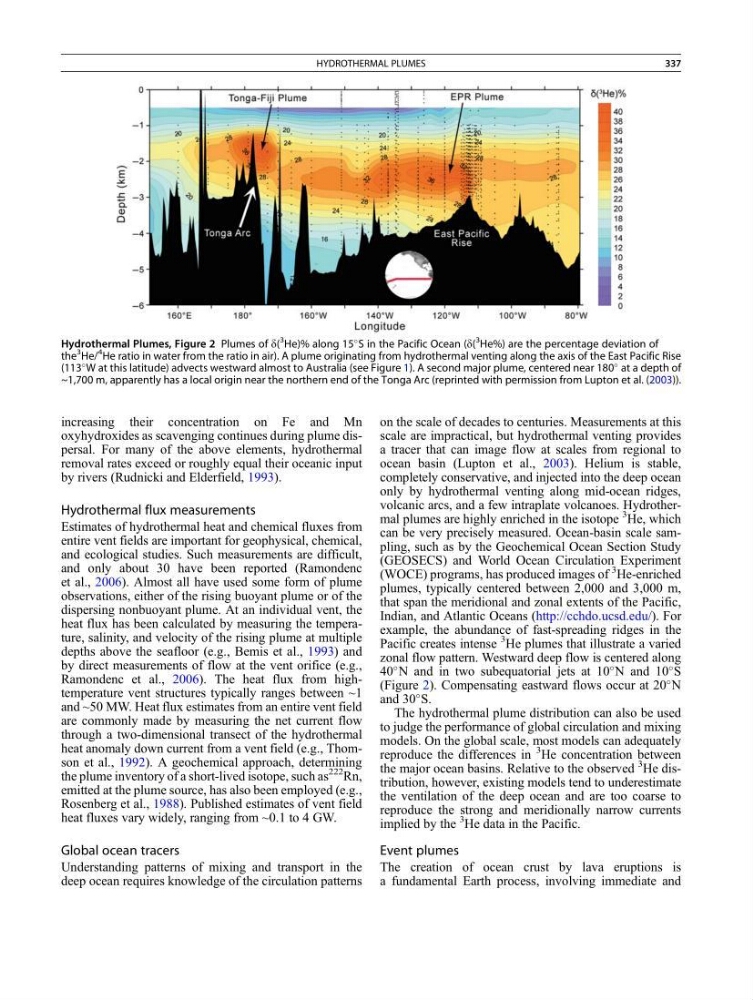
He plumes that illustrate a varied
zonal flow pattern. Westward deep flow is centered along
40
N and in two subequatorial jets at 10
N and 10
S
(Figure 2). Compensating eastward flows occur at 20
N
and 30
S.
The hydrothermal plume distribution can also be used
to judge the performance of global circulation and mixing
models. On the global scale, most models can adequately
reproduce the differences in
3
He concentration between
the major ocean basins. Relative to the observed
3
He distribution, however, existing models tend to underestimate
the ventilation of the deep ocean and are too coarse to
reproduce the strong and meridionally narrow currents
implied by the
3
He data in the Pacific.
Event plumes
The creation of ocean crust by lava eruptions is
a fundamental Earth process, involving immediate and
Hydrothermal Plumes, Figure 2 Plumes of d(
3 He)% along 15
S in the Pacific Ocean (d(
3
He%) are the percentage deviation of
the
3 He/
4 He ratio in water from the ratio in air). A plume originating from hydrothermal venting along the axis of the East Pacific Rise
(113
W at this latitude) advects westward almost to Australia (see Figure 1). A second major plume, centered near 180
at a depth of
~1,700 m, apparently has a local origin near the northern end of the Tonga Arc (reprinted with permission from Lupton et al. (2003)).
HYDROTHERMAL PLUMES
337
oxyhydroxides as scavenging continues during plume dispersal. For many of the above elements, hydrothermal
removal rates exceed or roughly equal their oceanic input
by rivers (Rudnicki and Elderfield, 1993).
Hydrothermal flux measurements
Estimates of hydrothermal heat and chemical fluxes from
entire vent fields are important for geophysical, chemical,
and ecological studies. Such measurements are difficult,
and only about 30 have been reported (Ramondenc
et al., 2006). Almost all have used some form of plume
observations, either of the rising buoyant plume or of the
dispersing nonbuoyant plume. At an individual vent, the
heat flux has been calculated by measuring the temperature, salinity, and velocity of the rising plume at multiple
depths above the seafloor (e.g., Bemis et al., 1993) and
by direct measurements of flow at the vent orifice (e.g.,
Ramondenc et al., 2006). The heat flux from hightemperature vent structures typically ranges between ~1
and ~50 MW. Heat flux estimates from an entire vent field
are commonly made by measuring the net current flow
through a two-dimensional transect of the hydrothermal
heat anomaly down current from a vent field (e.g., Thomson et al., 1992). A geochemical approach, determining
the plume inventory of a short-lived isotope, such as
222
Rn,
emitted at the plume source, has also been employed (e.g.,
Rosenberg et al., 1988). Published estimates of vent field
heat fluxes vary widely, ranging from ~0.1 to 4 GW.
Global ocean tracers
Understanding patterns of mixing and transport in the
deep ocean requires knowledge of the circulation patterns
on the scale of decades to centuries. Measurements at this
scale are impractical, but hydrothermal venting provides
a tracer that can image flow at scales from regional to
ocean basin (Lupton et al., 2003). Helium is stable,
completely conservative, and injected into the deep ocean
only by hydrothermal venting along mid-ocean ridges,
volcanic arcs, and a few intraplate volcanoes. Hydrothermal plumes are highly enriched in the isotope
3
He, which
can be very precisely measured. Ocean-basin scale sampling, such as by the Geochemical Ocean Section Study
(GEOSECS) and World Ocean Circulation Experiment
(WOCE) programs, has produced images of
3 He-enriched
plumes, typically centered between 2,000 and 3,000 m,
that span the meridional and zonal extents of the Pacific,
Indian, and Atlantic Oceans (http://cchdo.ucsd.edu/). For
example, the abundance of fast-spreading ridges in the
Pacific creates intense
3
He plumes that illustrate a varied
zonal flow pattern. Westward deep flow is centered along
40
N and in two subequatorial jets at 10
N and 10
S
(Figure 2). Compensating eastward flows occur at 20
N
and 30
S.
The hydrothermal plume distribution can also be used
to judge the performance of global circulation and mixing
models. On the global scale, most models can adequately
reproduce the differences in
3
He concentration between
the major ocean basins. Relative to the observed
3
He distribution, however, existing models tend to underestimate
the ventilation of the deep ocean and are too coarse to
reproduce the strong and meridionally narrow currents
implied by the
3
He data in the Pacific.
Event plumes
The creation of ocean crust by lava eruptions is
a fundamental Earth process, involving immediate and
Hydrothermal Plumes, Figure 2 Plumes of d(
3 He)% along 15
S in the Pacific Ocean (d(
3
He%) are the percentage deviation of
the
3 He/
4 He ratio in water from the ratio in air). A plume originating from hydrothermal venting along the axis of the East Pacific Rise
(113
W at this latitude) advects westward almost to Australia (see Figure 1). A second major plume, centered near 180
at a depth of
~1,700 m, apparently has a local origin near the northern end of the Tonga Arc (reprinted with permission from Lupton et al. (2003)).
HYDROTHERMAL PLUMES
337