

These hydrothermal plume mapping strategies pursued
over the last 30 years have allowed researchers to
build maps of vent distributions on scales from local
to global. As of 2011, a quarter of all oceanic spreading
centers have been systematically explored for hydrothermal plumes, more than 11,000 km in detail and another
6,500 km with sparser sampling by vertical profiles alone
(http://www.pmel.noaa.gov/eoi/PlumeStudies/global-vents/
index.html). This effort has been instrumental in accumulating a global inventory of almost 600 active vent
fields (http://www.interridge.org/IRvents). This distribution demonstrates that the spatial density of vent fields
on mid-ocean ridges increases roughly linearly with
increasing spreading rate. Because the rate of magma supply also increases with spreading rate, the presence of
a magmatic heat source, not tectonically controlled crustal
permeability, is thus shown to be the first-order control on
the global distribution of vents (Baker and German, 2004).
More recently, the advent of Autonomous Underwater
Vehicles (AUVs) has improved synchronous sampling of
hydrothermal plumes even further. Hydrothermal plumes
mapped by sensor tow-yos can typically locate seafloor
vent sites to within a few kilometers to a few hundred
meters. That precision can then be improved by
a detailed AUV search, using observations of near-bottom
maxima in physical and chemical anomalies to pinpoint
a vent site (German et al., 2008).
Ocean chemistry
Because buoyant hydrothermal plumes entrain a volume
of seawater ~10
4 times greater than the discharging vent
fluids, a volume equivalent to the entire ocean cycles
through hydrothermal plumes every 4–8 kyr (Elderfield
and Schultz, 1996), similar to the ~1 kyr mixing time of
the global deep ocean. Thus vent fluids, with concentrations of Fe and Mn often enriched ~10
6 :1 relative to normal seawater, influence ocean chemistry to a surprising
degree (German and Von Damm, 2003). In buoyant
plumes, metals such as Cu, Zn, and Pb coprecipitate with
Fe as sulfide phases and settle rapidly to the seafloor. In
the near-vent nonbuoyant plume, P, K, V, As, Cr, U, and
others are rapidly scavenged by fine-grained Fe
oxyhydroxides and, under oxic conditions, maintain constant Fe/metal ratios. The Fe/metal ratios reflect the concentration of the dissolved species in local seawater. The
Fe/P ratios in near-ridge sediments, for example, might
prove useful in paleoceanographic studies of ancient
ocean P concentrations (Feely et al., 1998). Elements such
as the rare earths show a different behavior, progressively
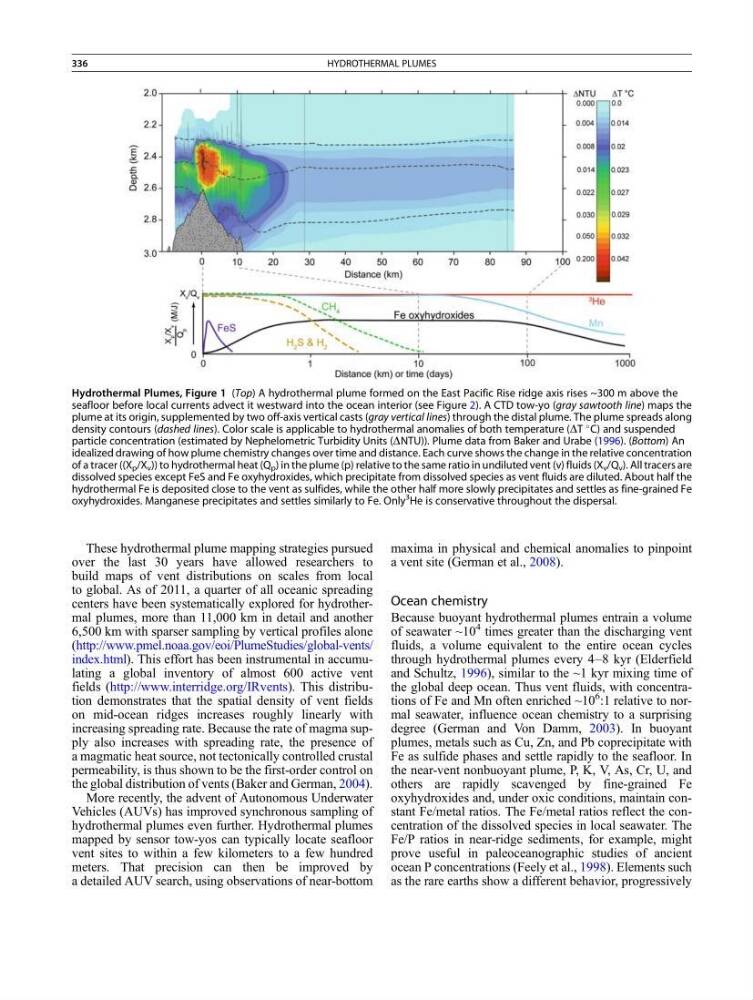
Hydrothermal Plumes, Figure 1 (Top) A hydrothermal plume formed on the East Pacific Rise ridge axis rises ~300 m above the
seafloor before local currents advect it westward into the ocean interior (see Figure 2). A CTD tow-yo (gray sawtooth line) maps the
plume at its origin, supplemented by two off-axis vertical casts (gray vertical lines) through the distal plume. The plume spreads along
density contours (dashed lines). Color scale is applicable to hydrothermal anomalies of both temperature (DT
C) and suspended
particle concentration (estimated by Nephelometric Turbidity Units (DNTU)). Plume data from Baker and Urabe (1996). (Bottom) An
idealized drawing of how plume chemistry changes over time and distance. Each curve shows the change in the relative concentration
of a tracer ((X p /X v )) to hydrothermal heat (Q p ) in the plume (p) relative to the same ratio in undiluted vent (v) fluids (X v /Q v ). All tracers are
dissolved species except FeS and Fe oxyhydroxides, which precipitate from dissolved species as vent fluids are diluted. About half the
hydrothermal Fe is deposited close to the vent as sulfides, while the other half more slowly precipitates and settles as fine-grained Fe
oxyhydroxides. Manganese precipitates and settles similarly to Fe. Only
3
He is conservative throughout the dispersal.
336
HYDROTHERMAL PLUMES
over the last 30 years have allowed researchers to
build maps of vent distributions on scales from local
to global. As of 2011, a quarter of all oceanic spreading
centers have been systematically explored for hydrothermal plumes, more than 11,000 km in detail and another
6,500 km with sparser sampling by vertical profiles alone
(http://www.pmel.noaa.gov/eoi/PlumeStudies/global-vents/
index.html). This effort has been instrumental in accumulating a global inventory of almost 600 active vent
fields (http://www.interridge.org/IRvents). This distribution demonstrates that the spatial density of vent fields
on mid-ocean ridges increases roughly linearly with
increasing spreading rate. Because the rate of magma supply also increases with spreading rate, the presence of
a magmatic heat source, not tectonically controlled crustal
permeability, is thus shown to be the first-order control on
the global distribution of vents (Baker and German, 2004).
More recently, the advent of Autonomous Underwater
Vehicles (AUVs) has improved synchronous sampling of
hydrothermal plumes even further. Hydrothermal plumes
mapped by sensor tow-yos can typically locate seafloor
vent sites to within a few kilometers to a few hundred
meters. That precision can then be improved by
a detailed AUV search, using observations of near-bottom
maxima in physical and chemical anomalies to pinpoint
a vent site (German et al., 2008).
Ocean chemistry
Because buoyant hydrothermal plumes entrain a volume
of seawater ~10
4 times greater than the discharging vent
fluids, a volume equivalent to the entire ocean cycles
through hydrothermal plumes every 4–8 kyr (Elderfield
and Schultz, 1996), similar to the ~1 kyr mixing time of
the global deep ocean. Thus vent fluids, with concentrations of Fe and Mn often enriched ~10
6 :1 relative to normal seawater, influence ocean chemistry to a surprising
degree (German and Von Damm, 2003). In buoyant
plumes, metals such as Cu, Zn, and Pb coprecipitate with
Fe as sulfide phases and settle rapidly to the seafloor. In
the near-vent nonbuoyant plume, P, K, V, As, Cr, U, and
others are rapidly scavenged by fine-grained Fe
oxyhydroxides and, under oxic conditions, maintain constant Fe/metal ratios. The Fe/metal ratios reflect the concentration of the dissolved species in local seawater. The
Fe/P ratios in near-ridge sediments, for example, might
prove useful in paleoceanographic studies of ancient
ocean P concentrations (Feely et al., 1998). Elements such
as the rare earths show a different behavior, progressively
Hydrothermal Plumes, Figure 1 (Top) A hydrothermal plume formed on the East Pacific Rise ridge axis rises ~300 m above the
seafloor before local currents advect it westward into the ocean interior (see Figure 2). A CTD tow-yo (gray sawtooth line) maps the
plume at its origin, supplemented by two off-axis vertical casts (gray vertical lines) through the distal plume. The plume spreads along
density contours (dashed lines). Color scale is applicable to hydrothermal anomalies of both temperature (DT
C) and suspended
particle concentration (estimated by Nephelometric Turbidity Units (DNTU)). Plume data from Baker and Urabe (1996). (Bottom) An
idealized drawing of how plume chemistry changes over time and distance. Each curve shows the change in the relative concentration
of a tracer ((X p /X v )) to hydrothermal heat (Q p ) in the plume (p) relative to the same ratio in undiluted vent (v) fluids (X v /Q v ). All tracers are
dissolved species except FeS and Fe oxyhydroxides, which precipitate from dissolved species as vent fluids are diluted. About half the
hydrothermal Fe is deposited close to the vent as sulfides, while the other half more slowly precipitates and settles as fine-grained Fe
oxyhydroxides. Manganese precipitates and settles similarly to Fe. Only
3
He is conservative throughout the dispersal.
336
HYDROTHERMAL PLUMES