

immense transfers of heat and chemicals from crust to
ocean (see “Explosive Volcanism in the Deep Sea”). This
transfer creates unique hydrothermal plumes called “event
plumes” (or “megaplumes”). First observed in 1986, event
plumes are massive ellipsoidal eddies with distinctive and
consistent chemical signatures (reviewed in Baker et al.,
2011). Confirmed diameters range from ~1 to 20 km
(and perhaps up to 70 km) and thicknesses from ~0.05 to
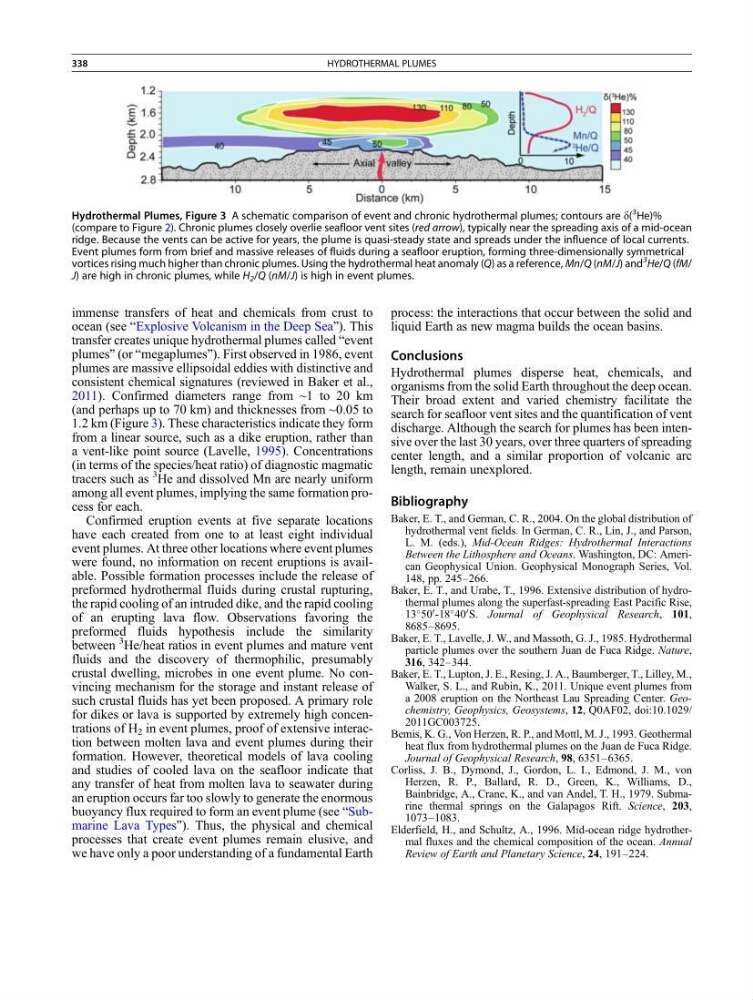
1.2 km (Figure 3). These characteristics indicate they form
from a linear source, such as a dike eruption, rather than
a vent-like point source (Lavelle, 1995). Concentrations
(in terms of the species/heat ratio) of diagnostic magmatic
tracers such as
3
He and dissolved Mn are nearly uniform
among all event plumes, implying the same formation process for each.
Confirmed eruption events at five separate locations
have each created from one to at least eight individual
event plumes. At three other locations where event plumes
were found, no information on recent eruptions is available. Possible formation processes include the release of
preformed hydrothermal fluids during crustal rupturing,
the rapid cooling of an intruded dike, and the rapid cooling
of an erupting lava flow. Observations favoring the
preformed fluids hypothesis include the similarity
between
3
He/heat ratios in event plumes and mature vent
fluids and the discovery of thermophilic, presumably
crustal dwelling, microbes in one event plume. No convincing mechanism for the storage and instant release of
such crustal fluids has yet been proposed. A primary role
for dikes or lava is supported by extremely high concentrations of H 2 in event plumes, proof of extensive interaction between molten lava and event plumes during their
formation. However, theoretical models of lava cooling
and studies of cooled lava on the seafloor indicate that
any transfer of heat from molten lava to seawater during
an eruption occurs far too slowly to generate the enormous
buoyancy flux required to form an event plume (see “Submarine Lava Types”). Thus, the physical and chemical
processes that create event plumes remain elusive, and
we have only a poor understanding of a fundamental Earth
process: the interactions that occur between the solid and
liquid Earth as new magma builds the ocean basins.
Conclusions
Hydrothermal plumes disperse heat, chemicals, and
organisms from the solid Earth throughout the deep ocean.
Their broad extent and varied chemistry facilitate the
search for seafloor vent sites and the quantification of vent
discharge. Although the search for plumes has been intensive over the last 30 years, over three quarters of spreading
center length, and a similar proportion of volcanic arc
length, remain unexplored.
Bibliography
Baker, E. T., and German, C. R., 2004. On the global distribution of
hydrothermal vent fields. In German, C. R., Lin, J., and Parson,
L. M. (eds.), Mid-Ocean Ridges: Hydrothermal Interactions
Between the Lithosphere and Oceans. Washington, DC: American Geophysical Union. Geophysical Monograph Series, Vol.
148, pp. 245–266.
Baker, E. T., and Urabe, T., 1996. Extensive distribution of hydrothermal plumes along the superfast-spreading East Pacific Rise,
13
50
0 -18
40
0 S. Journal of Geophysical Research, 101,
8685–8695.
Baker, E. T., Lavelle, J. W., and Massoth, G. J., 1985. Hydrothermal
particle plumes over the southern Juan de Fuca Ridge. Nature,
316, 342–344.
Baker, E. T., Lupton, J. E., Resing, J. A., Baumberger, T., Lilley, M.,
Walker, S. L., and Rubin, K., 2011. Unique event plumes from
a 2008 eruption on the Northeast Lau Spreading Center. Geochemistry, Geophysics, Geosystems, 12, Q0AF02, doi:10.1029/
2011GC003725.
Bemis, K. G., Von Herzen, R. P., and Mottl, M. J., 1993. Geothermal
heat flux from hydrothermal plumes on the Juan de Fuca Ridge.
Journal of Geophysical Research, 98, 6351–6365.
Corliss, J. B., Dymond, J., Gordon, L. I., Edmond, J. M., von
Herzen, R. P., Ballard, R. D., Green, K., Williams, D.,
Bainbridge, A., Crane, K., and van Andel, T. H., 1979. Submarine thermal springs on the Galapagos Rift. Science, 203,
1073–1083.
Elderfield, H., and Schultz, A., 1996. Mid-ocean ridge hydrothermal fluxes and the chemical composition of the ocean. Annual
Review of Earth and Planetary Science, 24, 191–224.
Hydrothermal Plumes, Figure 3 A schematic comparison of event and chronic hydrothermal plumes; contours are d(
3 He)%
(compare to Figure 2). Chronic plumes closely overlie seafloor vent sites (red arrow), typically near the spreading axis of a mid-ocean
ridge. Because the vents can be active for years, the plume is quasi-steady state and spreads under the influence of local currents.
Event plumes form from brief and massive releases of fluids during a seafloor eruption, forming three-dimensionally symmetrical
vortices rising much higher than chronic plumes. Using the hydrothermal heat anomaly (Q) as a reference, Mn/Q (nM/J) and
3
He/Q (fM/
J) are high in chronic plumes, while H 2 /Q (nM/J) is high in event plumes.
338
HYDROTHERMAL PLUMES
ocean (see “Explosive Volcanism in the Deep Sea”). This
transfer creates unique hydrothermal plumes called “event
plumes” (or “megaplumes”). First observed in 1986, event
plumes are massive ellipsoidal eddies with distinctive and
consistent chemical signatures (reviewed in Baker et al.,
2011). Confirmed diameters range from ~1 to 20 km
(and perhaps up to 70 km) and thicknesses from ~0.05 to
1.2 km (Figure 3). These characteristics indicate they form
from a linear source, such as a dike eruption, rather than
a vent-like point source (Lavelle, 1995). Concentrations
(in terms of the species/heat ratio) of diagnostic magmatic
tracers such as
3
He and dissolved Mn are nearly uniform
among all event plumes, implying the same formation process for each.
Confirmed eruption events at five separate locations
have each created from one to at least eight individual
event plumes. At three other locations where event plumes
were found, no information on recent eruptions is available. Possible formation processes include the release of
preformed hydrothermal fluids during crustal rupturing,
the rapid cooling of an intruded dike, and the rapid cooling
of an erupting lava flow. Observations favoring the
preformed fluids hypothesis include the similarity
between
3
He/heat ratios in event plumes and mature vent
fluids and the discovery of thermophilic, presumably
crustal dwelling, microbes in one event plume. No convincing mechanism for the storage and instant release of
such crustal fluids has yet been proposed. A primary role
for dikes or lava is supported by extremely high concentrations of H 2 in event plumes, proof of extensive interaction between molten lava and event plumes during their
formation. However, theoretical models of lava cooling
and studies of cooled lava on the seafloor indicate that
any transfer of heat from molten lava to seawater during
an eruption occurs far too slowly to generate the enormous
buoyancy flux required to form an event plume (see “Submarine Lava Types”). Thus, the physical and chemical
processes that create event plumes remain elusive, and
we have only a poor understanding of a fundamental Earth
process: the interactions that occur between the solid and
liquid Earth as new magma builds the ocean basins.
Conclusions
Hydrothermal plumes disperse heat, chemicals, and
organisms from the solid Earth throughout the deep ocean.
Their broad extent and varied chemistry facilitate the
search for seafloor vent sites and the quantification of vent
discharge. Although the search for plumes has been intensive over the last 30 years, over three quarters of spreading
center length, and a similar proportion of volcanic arc
length, remain unexplored.
Bibliography
Baker, E. T., and German, C. R., 2004. On the global distribution of
hydrothermal vent fields. In German, C. R., Lin, J., and Parson,
L. M. (eds.), Mid-Ocean Ridges: Hydrothermal Interactions
Between the Lithosphere and Oceans. Washington, DC: American Geophysical Union. Geophysical Monograph Series, Vol.
148, pp. 245–266.
Baker, E. T., and Urabe, T., 1996. Extensive distribution of hydrothermal plumes along the superfast-spreading East Pacific Rise,
13
50
0 -18
40
0 S. Journal of Geophysical Research, 101,
8685–8695.
Baker, E. T., Lavelle, J. W., and Massoth, G. J., 1985. Hydrothermal
particle plumes over the southern Juan de Fuca Ridge. Nature,
316, 342–344.
Baker, E. T., Lupton, J. E., Resing, J. A., Baumberger, T., Lilley, M.,
Walker, S. L., and Rubin, K., 2011. Unique event plumes from
a 2008 eruption on the Northeast Lau Spreading Center. Geochemistry, Geophysics, Geosystems, 12, Q0AF02, doi:10.1029/
2011GC003725.
Bemis, K. G., Von Herzen, R. P., and Mottl, M. J., 1993. Geothermal
heat flux from hydrothermal plumes on the Juan de Fuca Ridge.
Journal of Geophysical Research, 98, 6351–6365.
Corliss, J. B., Dymond, J., Gordon, L. I., Edmond, J. M., von
Herzen, R. P., Ballard, R. D., Green, K., Williams, D.,
Bainbridge, A., Crane, K., and van Andel, T. H., 1979. Submarine thermal springs on the Galapagos Rift. Science, 203,
1073–1083.
Elderfield, H., and Schultz, A., 1996. Mid-ocean ridge hydrothermal fluxes and the chemical composition of the ocean. Annual
Review of Earth and Planetary Science, 24, 191–224.
Hydrothermal Plumes, Figure 3 A schematic comparison of event and chronic hydrothermal plumes; contours are d(
3 He)%
(compare to Figure 2). Chronic plumes closely overlie seafloor vent sites (red arrow), typically near the spreading axis of a mid-ocean
ridge. Because the vents can be active for years, the plume is quasi-steady state and spreads under the influence of local currents.
Event plumes form from brief and massive releases of fluids during a seafloor eruption, forming three-dimensionally symmetrical
vortices rising much higher than chronic plumes. Using the hydrothermal heat anomaly (Q) as a reference, Mn/Q (nM/J) and
3
He/Q (fM/
J) are high in chronic plumes, while H 2 /Q (nM/J) is high in event plumes.
338
HYDROTHERMAL PLUMES