

that the cost of coastal disasters in terms of both economic
impacts and loss of life will continue to rise, making the
study of these storms a critical priority within scientific,
engineering, and planning communities.
Formation of a tropical cyclone
Tropical cyclones derive their energy from rising air above
warm ocean waters, coupled with the earth’s rotation. Key
factors contributing to cyclone formation include (Gray,
1968, 1979; Emanuel, 1991):
1. Ocean water must contain abundant heat to compensate for heat loss via evaporation at the air-sea interface
(typically above 26
C, to a depth of about 50 m).
2. The atmosphere must cool sufficiently with height to
retain potential instability in the rising air, otherwise
the density of the rising air will approach that of the
surrounding air and its vertical motion will dissipate.
3. Relatively high atmospheric water content in the
mid-tropospheric level is needed since condensation
of water vapor fuels continued development of thunderstorms at this level and condensation rates depend
on relative humidity.
4. A horizontal displacement of the circulation center at
least 500 km from the equator is needed to enable
Coriolis acceleration (the effect of the earth’s rotation
on motions in an inertial frame of reference) to force
horizontal air paths toward a closed circulation via a
quasi-gradient balance before the winds and pressure
differential within the storm become sufficiently large
to shift toward a cyclostrophic balance.
Hurricanes and Typhoons, Table 1 Common terms used to
reference tropical cyclones around the World
Region
Term Definition
North America
Tropical depression: maximum 1-min wind
speed < 39 mph (62 km/h)
Tropical storm: maximum 1-min wind speed
>39mph (62 km/h)
Hurricane: maximum 1-min winds
speed > 74 mph (120 km/h)
Southern
Hemisphere and
Fiji
Tropical low: maximum sustained wind
speed < 90 km/h
Tropical cyclone: maximum sustained wind
speed > 90 km/h
Severe tropical cyclone: > 165 km/h
Western Pacific
Tropical depression: maximum sustained
wind speed < 61 km/h
Tropical storm: maximum sustained wind
speed > 61 km/h
Severe tropical storm: maximum sustained
wind speed > 89 km/h
Typhoon: maximum sustained wind
speed > 118 km/h
Super typhoon: maximum sustained wind
speed > 252 km/h
India
Tropical depression: maximum sustained
wind speed < 62 km/h
Tropical storm: maximum sustained wind
speed > 63 km/h
Tropical cyclone: maximum sustained
wind > 118 km/h
Intense tropical cyclone: maximum sustained
wind speed > 166 km/h
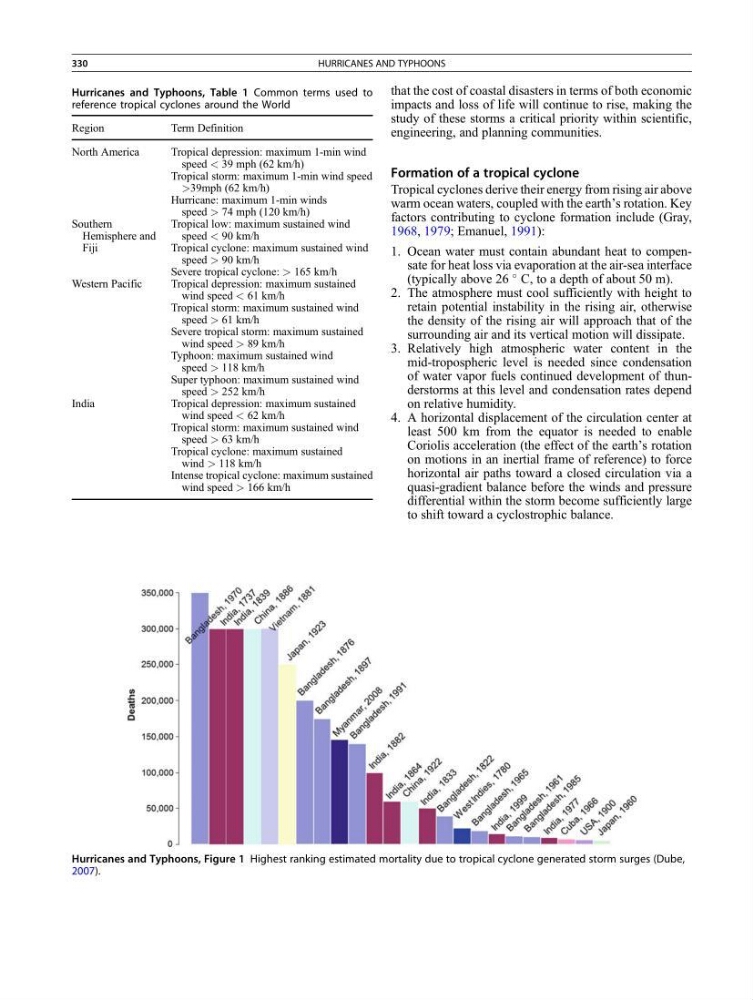
Hurricanes and Typhoons, Figure 1 Highest ranking estimated mortality due to tropical cyclone generated storm surges (Dube,
2007).
330
HURRICANES AND TYPHOONS
impacts and loss of life will continue to rise, making the
study of these storms a critical priority within scientific,
engineering, and planning communities.
Formation of a tropical cyclone
Tropical cyclones derive their energy from rising air above
warm ocean waters, coupled with the earth’s rotation. Key
factors contributing to cyclone formation include (Gray,
1968, 1979; Emanuel, 1991):
1. Ocean water must contain abundant heat to compensate for heat loss via evaporation at the air-sea interface
(typically above 26
C, to a depth of about 50 m).
2. The atmosphere must cool sufficiently with height to
retain potential instability in the rising air, otherwise
the density of the rising air will approach that of the
surrounding air and its vertical motion will dissipate.
3. Relatively high atmospheric water content in the
mid-tropospheric level is needed since condensation
of water vapor fuels continued development of thunderstorms at this level and condensation rates depend
on relative humidity.
4. A horizontal displacement of the circulation center at
least 500 km from the equator is needed to enable
Coriolis acceleration (the effect of the earth’s rotation
on motions in an inertial frame of reference) to force
horizontal air paths toward a closed circulation via a
quasi-gradient balance before the winds and pressure
differential within the storm become sufficiently large
to shift toward a cyclostrophic balance.
Hurricanes and Typhoons, Table 1 Common terms used to
reference tropical cyclones around the World
Region
Term Definition
North America
Tropical depression: maximum 1-min wind
speed < 39 mph (62 km/h)
Tropical storm: maximum 1-min wind speed
>39mph (62 km/h)
Hurricane: maximum 1-min winds
speed > 74 mph (120 km/h)
Southern
Hemisphere and
Fiji
Tropical low: maximum sustained wind
speed < 90 km/h
Tropical cyclone: maximum sustained wind
speed > 90 km/h
Severe tropical cyclone: > 165 km/h
Western Pacific
Tropical depression: maximum sustained
wind speed < 61 km/h
Tropical storm: maximum sustained wind
speed > 61 km/h
Severe tropical storm: maximum sustained
wind speed > 89 km/h
Typhoon: maximum sustained wind
speed > 118 km/h
Super typhoon: maximum sustained wind
speed > 252 km/h
India
Tropical depression: maximum sustained
wind speed < 62 km/h
Tropical storm: maximum sustained wind
speed > 63 km/h
Tropical cyclone: maximum sustained
wind > 118 km/h
Intense tropical cyclone: maximum sustained
wind speed > 166 km/h
Hurricanes and Typhoons, Figure 1 Highest ranking estimated mortality due to tropical cyclone generated storm surges (Dube,
2007).
330
HURRICANES AND TYPHOONS