

230 Th/
234 U and
231
Pa/
235 U dating methods
Both the
230
Th/U and
231
Pa/U methods play an important
role in dating marine carbonates (corals, mollusk shells)
as well as the
230
Th/U method which is most widely
applied in dating seafloor massive sulfide (SMS)
deposits in the ocean hydrothermal zones.
230
Th/U dating
involves calculating ages from radioactive decay and accumulation relationships among
238
U,
234
U, and
230
Th,
whereas
231
Pa/U dating involves calculating ages from the
ingrowth of
231
Pa from its grandparent
235
U. The age range
for these methods is the same as for
230
Th xs and
231
Pa xs (see
above).
The
230
Th (and
231
Pa) content in seawater is negligible,
while the average concentration of U is about $3 mg/l
(Chen et al., 1986). The biogenic precipitation of calcium
carbonate from seawater (e.g., when coralline skeleton is
formed) is accompanied by the incorporation of uranium,
which occurs in the soluble uranyl carbonate complexes
in seawater, while the
230
Th (and
231
Pa) is strongly
absorbed onto suspended matter. As a result, the carbonate
radiometric system contains a deficiency of
230
Th
(and
231
Pa) in comparison with parent
234 U (
235
U). The
first applications of both the
230
Th/U and
231
Pa/U methods
in dating marine carbonates were demonstrated in the second half of the last century by Barnes et al. (1956), Rosholt
and Antal (1962), Veeh (1966), Sakanoue et al. (1967), Ku
(1968), Broecker et al. (1968), Kaufman et al. (1971), and
others.
The SMS deposits (or sulfide ores, elsewhere in the
publications) were formed from hydrothermal fluids originated from the seawater circulated in the basalts of the
oceanic crust. The reduced hydrothermal fluids contain
two orders of magnitude less uranium than the seawater
(Michard et al., 1983). The hydrothermal fluids mix with
seawater which results locally in reducing conditions. By
this, easily soluble uranyl carbonate complexes dissolved
in seawater become transformed into absorbable uranyl
or poorly soluble U
IV ions. The latter coprecipitates with
transitional sulfides discharged with the fluid. As a result,
uranium (without its daughter nuclide
230
Th) is accumulated in the SMS deposits on the seafloor. Common uranium concentrations in the SMS deposits range up to
10 ppm (parts per million) or more (Lalou et al., 1996;
Kuznetsov et al., 2002; Kuznetsov et al., 2006; Kuznetsov
et al., 2007). First
230
Th/U ages of sulfide ores from the
East Pacific Rise (EPR) and Mid-Atlantic Ridge (MAR)
were obtained at the end of the last century by Lalou and
Brichet (1982, 1987) and Lalou et al. (1988, 1993, 1995,
1996, 1998).
There are two main prerequisites for
230 Th/U (and
231
Pa/U) dating of both marine carbonates and sulfide ores
(Ivanovich and Harmon, 1992; Lalou et al., 1996; Geyh,
2001; Kuznetsov, 2008; Kuznetsov et al., 2011): (1) sulfides/carbonates contain uranium without thorium immediately after deposition, and (2) during their aging,
sulfides/carbonates were under conditions of chemically
closed system with regard to uranium and thorium.
A thorough check whether the
230 Th/U (and
231
Pa/U)
method is applicable is necessary in order to obtain reliable
230
Th/U (and
231
Pa/U) ages of both marine carbonates
and sulfide ores. Different approaches to testing the theoretical positions of these methods are described by
Edwards et al. (2003) for dating carbonates and by Lalou
et al. (1996) and Kuznetsov et al. (2011) for dating SMS
deposits.
The
230
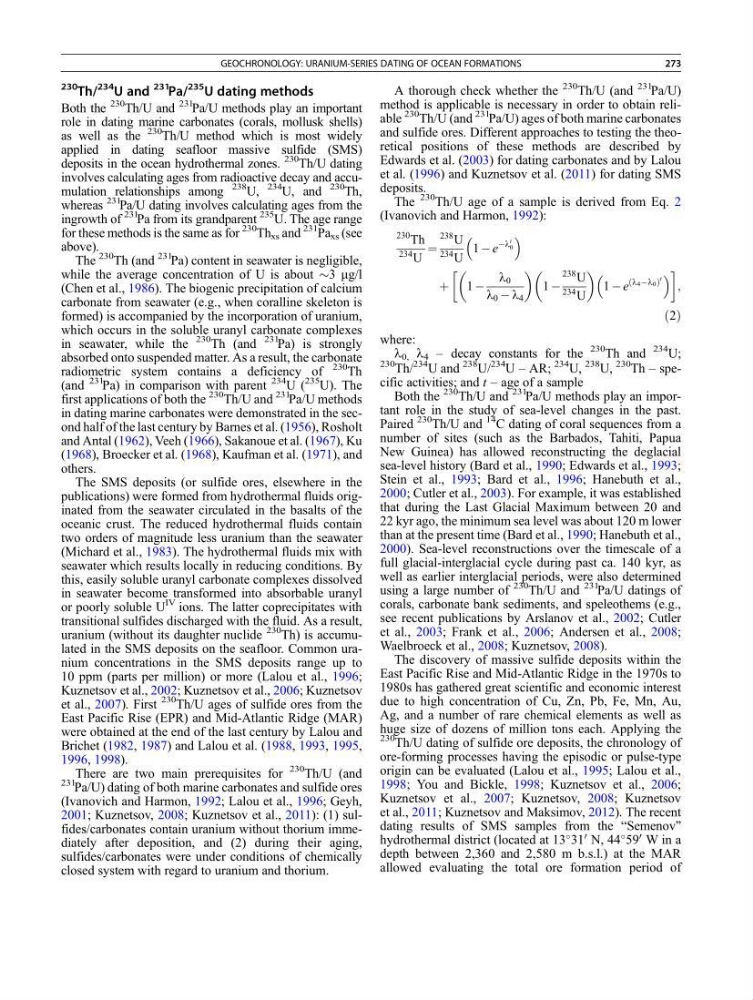
Th/U age of a sample is derived from Eq. 2
(Ivanovich and Harmon, 1992):
230 Th
234 U
¼
238 U
234 U
1 À e
Àl
t
0
þ 1 À
l 0
l 0 À l 4
1 À
238 U
234 U
1 À e
l 4 Àl 0
ð
Þ
t
!
;
ð2Þ
where:
l 0, l 4 – decay constants for the
230 Th and
234 U;
230
Th/
234
U and
238 U/
234
U – AR;
234
U,
238
U,
230
Th – specific activities; and t – age of a sample
Both the
230
Th/U and
231
Pa/U methods play an important role in the study of sea-level changes in the past.
Paired
230
Th/U and
14 C dating of coral sequences from a
number of sites (such as the Barbados, Tahiti, Papua
New Guinea) has allowed reconstructing the deglacial
sea-level history (Bard et al., 1990; Edwards et al., 1993;
Stein et al., 1993; Bard et al., 1996; Hanebuth et al.,
2000; Cutler et al., 2003). For example, it was established
that during the Last Glacial Maximum between 20 and
22 kyr ago, the minimum sea level was about 120 m lower
than at the present time (Bard et al., 1990; Hanebuth et al.,
2000). Sea-level reconstructions over the timescale of a
full glacial-interglacial cycle during past ca. 140 kyr, as
well as earlier interglacial periods, were also determined
using a large number of
230 Th/U and
231
Pa/U datings of
corals, carbonate bank sediments, and speleothems (e.g.,
see recent publications by Arslanov et al., 2002; Cutler
et al., 2003; Frank et al., 2006; Andersen et al., 2008;
Waelbroeck et al., 2008; Kuznetsov, 2008).
The discovery of massive sulfide deposits within the
East Pacific Rise and Mid-Atlantic Ridge in the 1970s to
1980s has gathered great scientific and economic interest
due to high concentration of Cu, Zn, Pb, Fe, Mn, Au,
Ag, and a number of rare chemical elements as well as
huge size of dozens of million tons each. Applying the
230
Th/U dating of sulfide ore deposits, the chronology of
ore-forming processes having the episodic or pulse-type
origin can be evaluated (Lalou et al., 1995; Lalou et al.,
1998; You and Bickle, 1998; Kuznetsov et al., 2006;
Kuznetsov et al., 2007; Kuznetsov, 2008; Kuznetsov
et al., 2011; Kuznetsov and Maksimov, 2012). The recent
dating results of SMS samples from the “Semenov”
hydrothermal district (located at 13
31
0 N, 44
59
0 W in a
depth between 2,360 and 2,580 m b.s.l.) at the MAR
allowed evaluating the total ore formation period of
GEOCHRONOLOGY: URANIUM-SERIES DATING OF OCEAN FORMATIONS
273
234 U and
231
Pa/
235 U dating methods
Both the
230
Th/U and
231
Pa/U methods play an important
role in dating marine carbonates (corals, mollusk shells)
as well as the
230
Th/U method which is most widely
applied in dating seafloor massive sulfide (SMS)
deposits in the ocean hydrothermal zones.
230
Th/U dating
involves calculating ages from radioactive decay and accumulation relationships among
238
U,
234
U, and
230
Th,
whereas
231
Pa/U dating involves calculating ages from the
ingrowth of
231
Pa from its grandparent
235
U. The age range
for these methods is the same as for
230
Th xs and
231
Pa xs (see
above).
The
230
Th (and
231
Pa) content in seawater is negligible,
while the average concentration of U is about $3 mg/l
(Chen et al., 1986). The biogenic precipitation of calcium
carbonate from seawater (e.g., when coralline skeleton is
formed) is accompanied by the incorporation of uranium,
which occurs in the soluble uranyl carbonate complexes
in seawater, while the
230
Th (and
231
Pa) is strongly
absorbed onto suspended matter. As a result, the carbonate
radiometric system contains a deficiency of
230
Th
(and
231
Pa) in comparison with parent
234 U (
235
U). The
first applications of both the
230
Th/U and
231
Pa/U methods
in dating marine carbonates were demonstrated in the second half of the last century by Barnes et al. (1956), Rosholt
and Antal (1962), Veeh (1966), Sakanoue et al. (1967), Ku
(1968), Broecker et al. (1968), Kaufman et al. (1971), and
others.
The SMS deposits (or sulfide ores, elsewhere in the
publications) were formed from hydrothermal fluids originated from the seawater circulated in the basalts of the
oceanic crust. The reduced hydrothermal fluids contain
two orders of magnitude less uranium than the seawater
(Michard et al., 1983). The hydrothermal fluids mix with
seawater which results locally in reducing conditions. By
this, easily soluble uranyl carbonate complexes dissolved
in seawater become transformed into absorbable uranyl
or poorly soluble U
IV ions. The latter coprecipitates with
transitional sulfides discharged with the fluid. As a result,
uranium (without its daughter nuclide
230
Th) is accumulated in the SMS deposits on the seafloor. Common uranium concentrations in the SMS deposits range up to
10 ppm (parts per million) or more (Lalou et al., 1996;
Kuznetsov et al., 2002; Kuznetsov et al., 2006; Kuznetsov
et al., 2007). First
230
Th/U ages of sulfide ores from the
East Pacific Rise (EPR) and Mid-Atlantic Ridge (MAR)
were obtained at the end of the last century by Lalou and
Brichet (1982, 1987) and Lalou et al. (1988, 1993, 1995,
1996, 1998).
There are two main prerequisites for
230 Th/U (and
231
Pa/U) dating of both marine carbonates and sulfide ores
(Ivanovich and Harmon, 1992; Lalou et al., 1996; Geyh,
2001; Kuznetsov, 2008; Kuznetsov et al., 2011): (1) sulfides/carbonates contain uranium without thorium immediately after deposition, and (2) during their aging,
sulfides/carbonates were under conditions of chemically
closed system with regard to uranium and thorium.
A thorough check whether the
230 Th/U (and
231
Pa/U)
method is applicable is necessary in order to obtain reliable
230
Th/U (and
231
Pa/U) ages of both marine carbonates
and sulfide ores. Different approaches to testing the theoretical positions of these methods are described by
Edwards et al. (2003) for dating carbonates and by Lalou
et al. (1996) and Kuznetsov et al. (2011) for dating SMS
deposits.
The
230
Th/U age of a sample is derived from Eq. 2
(Ivanovich and Harmon, 1992):
230 Th
234 U
¼
238 U
234 U
1 À e
Àl
t
0
þ 1 À
l 0
l 0 À l 4
1 À
238 U
234 U
1 À e
l 4 Àl 0
ð
Þ
t
!
;
ð2Þ
where:
l 0, l 4 – decay constants for the
230 Th and
234 U;
230
Th/
234
U and
238 U/
234
U – AR;
234
U,
238
U,
230
Th – specific activities; and t – age of a sample
Both the
230
Th/U and
231
Pa/U methods play an important role in the study of sea-level changes in the past.
Paired
230
Th/U and
14 C dating of coral sequences from a
number of sites (such as the Barbados, Tahiti, Papua
New Guinea) has allowed reconstructing the deglacial
sea-level history (Bard et al., 1990; Edwards et al., 1993;
Stein et al., 1993; Bard et al., 1996; Hanebuth et al.,
2000; Cutler et al., 2003). For example, it was established
that during the Last Glacial Maximum between 20 and
22 kyr ago, the minimum sea level was about 120 m lower
than at the present time (Bard et al., 1990; Hanebuth et al.,
2000). Sea-level reconstructions over the timescale of a
full glacial-interglacial cycle during past ca. 140 kyr, as
well as earlier interglacial periods, were also determined
using a large number of
230 Th/U and
231
Pa/U datings of
corals, carbonate bank sediments, and speleothems (e.g.,
see recent publications by Arslanov et al., 2002; Cutler
et al., 2003; Frank et al., 2006; Andersen et al., 2008;
Waelbroeck et al., 2008; Kuznetsov, 2008).
The discovery of massive sulfide deposits within the
East Pacific Rise and Mid-Atlantic Ridge in the 1970s to
1980s has gathered great scientific and economic interest
due to high concentration of Cu, Zn, Pb, Fe, Mn, Au,
Ag, and a number of rare chemical elements as well as
huge size of dozens of million tons each. Applying the
230
Th/U dating of sulfide ore deposits, the chronology of
ore-forming processes having the episodic or pulse-type
origin can be evaluated (Lalou et al., 1995; Lalou et al.,
1998; You and Bickle, 1998; Kuznetsov et al., 2006;
Kuznetsov et al., 2007; Kuznetsov, 2008; Kuznetsov
et al., 2011; Kuznetsov and Maksimov, 2012). The recent
dating results of SMS samples from the “Semenov”
hydrothermal district (located at 13
31
0 N, 44
59
0 W in a
depth between 2,360 and 2,580 m b.s.l.) at the MAR
allowed evaluating the total ore formation period of
GEOCHRONOLOGY: URANIUM-SERIES DATING OF OCEAN FORMATIONS
273