

for the
231 Pa xs method. Modern mass spectrometric analysis allowed extending the age ranges for both methods. It
is now possible to determine
230 Th xs ages from several
decades to ca. 500 kyr and
231
Pa xs ages up to 250 kyr
(Chen et al., 1986; Edwards et al., 1986; Edwards et al.,
1987; Edwards et al., 1997). Mass spectrometric methods
for measuring Th, Pa, and U isotopes have greatly reduced
sample size requirements and improved analytical
precision.
Theoretical prerequisites for the application of both the
methods are:
1.
230 Th and
231
Pa as well as parent uranium may not
migrate in the sedimentary stratum. A lot of data support the point of view that Th and Pa are always immobile in aqueous conditions (Kuznetsov, 1976; Huh and
Ku, 1984; Cochran, 1992; Henderson and Anderson,
2003). Possible migration of U as a mobile element
may not significantly affect the vertical distribution of
the daughter nuclides due to its low concentration in
sediments compared with
230 Th and
231
Pa
(Kuznetsov, 1976).
2. The concentration of U producing
230
Th and
231
Pa in
ocean water must remain constant during aging, i.e.,
for the last 300–350 kyr. Seawater U concentration
does not change during at least for the last
ca. 400 kyr according to Kuznetsov (1976), Chen
et al. (1986), Rosenthal et al. (1995), and Henderson
and Anderson (2003).
3. The
230
Th and
231
Pa sedimentation rate must be constant through time. However, fluctuations in sedimentation rate are often observed due to biogenic and/or
terrigenous supply changes. These variations can be
corrected by applying normalization of
230 Th ex
(
231
Pa ex ) specific activities to carbonate-free material
of sediments (Kuznetsov, 1976, 2008; Ivanovich and
Harmon, 1992).
4. There are no any disturbances in sediment stratigraphy.
If these assumptions are fulfilled, the vertical distribution of both nuclides in sediments becomes close to their
theoretical exponential decrease from the surface layers
to the lower layers.
After deposition, the
230
Th xs and
231 Pa xs decay and tend
to come to equilibrium with the parent uranium. The age
of individual sediment layer (i) can be calculated from
230
Th xs and
231 Pa xs values as
230 Th xs 0
ð Þ ¼
230 Th xs i
ð ÞÁe
Àl 230
ð Þt and
231 Pa xs 0
ð Þ ¼
230 Pa xs i
ð ÞÁe
Àl 231
ð Þt
;
ð1Þ
where:
•
230
Th xs (0),
231
Pa xs (0) ¼ specific activities of the
nuclides in the outer surface layer
•
230
Th xs (i),
231
Pa xs (i) ¼ specific activities of the nuclides
in the underlying layer i
• l ¼ ln2/T 1/2 , where T 1/2 is the nuclide half-life
These two methods are widely used in the determination of deep-sea sedimentation rates during the Holocene
and Late and Middle Neopleistocene as well as age accumulation rates of Fe-Mn nodules and crusts (Ku and
Broecker, 1967; Ku and Broecker, 1969; Kuznetsov,
2008). For example, the recent determinations of Fe-Mn
nodule and crust time formation showed their ancient ages
of several Myr and accumulation rates being in the wide
range from millimeters to centimeters per million years
(Finney et al., 1984; Huh and Ku, 1984; Claude-Ivanaj
et al., 2001; Kuznetsov, 2008). Eisenhauer et al. (1992)
used
230
Th xs method to determine the growth rates of
Mn crusts from the Pacific Ocean. The study showed that
the Mn crusts grew faster during the warm climatic
periods compared to the cold periods. Both the
230
Th xs
and
231 Pa xs are applied to determine the age boundaries
of marine isotope stages (MIS) reflecting global climate
changes in the past. These data have played an important
role in building the timescale of changes in the isotopic
composition of oxygen in the foraminiferal shells from
the ocean sedimentary columns (Broecker and Van Donk,
1970). For instance, the boundary between MIS 6 and
MIS 5 detected in the foraminiferal shells by d
18
O analysis
shows astronomical date about 127 Kyr and agrees well
with the age range of 127–128 Kyr obtained by the
U-series dating methods (Edwards et al., 1986; Edwards
et al., 1987; Zhu et al., 1993). Currently, both the methods
are widely used in the study of the sedimentation processes and paleoclimate changes in the Arctic (Not and
Hillaire-Marcel, 2010).
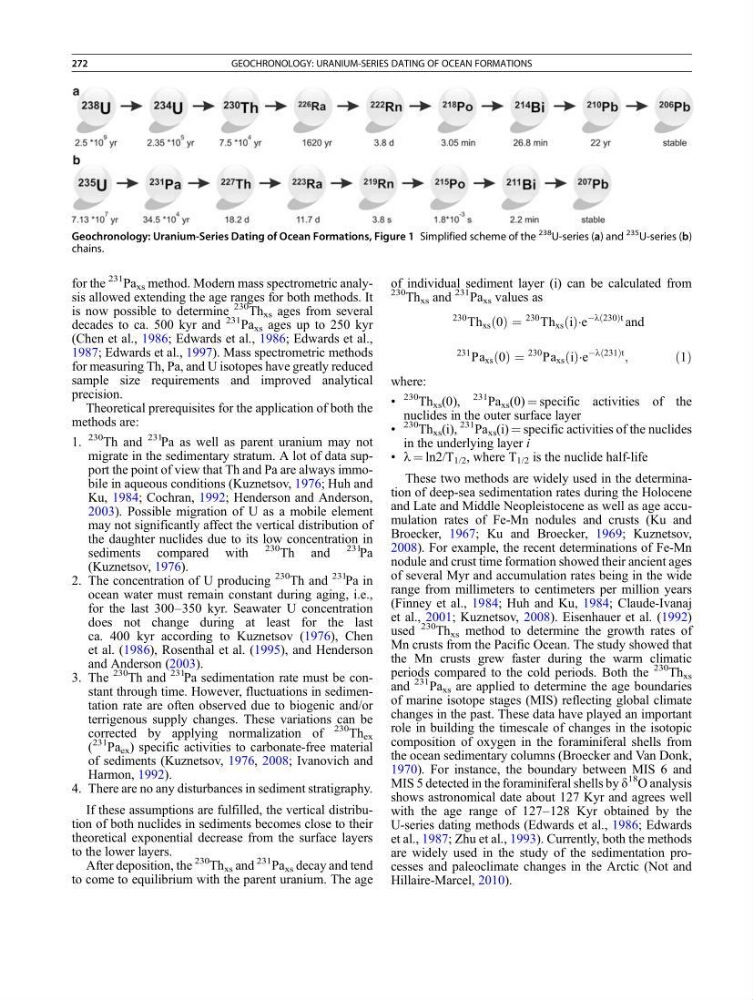
Geochronology: Uranium-Series Dating of Ocean Formations, Figure 1 Simplified scheme of the
238 U-series (a) and
235 U-series (b)
chains.
272
GEOCHRONOLOGY: URANIUM-SERIES DATING OF OCEAN FORMATIONS
231 Pa xs method. Modern mass spectrometric analysis allowed extending the age ranges for both methods. It
is now possible to determine
230 Th xs ages from several
decades to ca. 500 kyr and
231
Pa xs ages up to 250 kyr
(Chen et al., 1986; Edwards et al., 1986; Edwards et al.,
1987; Edwards et al., 1997). Mass spectrometric methods
for measuring Th, Pa, and U isotopes have greatly reduced
sample size requirements and improved analytical
precision.
Theoretical prerequisites for the application of both the
methods are:
1.
230 Th and
231
Pa as well as parent uranium may not
migrate in the sedimentary stratum. A lot of data support the point of view that Th and Pa are always immobile in aqueous conditions (Kuznetsov, 1976; Huh and
Ku, 1984; Cochran, 1992; Henderson and Anderson,
2003). Possible migration of U as a mobile element
may not significantly affect the vertical distribution of
the daughter nuclides due to its low concentration in
sediments compared with
230 Th and
231
Pa
(Kuznetsov, 1976).
2. The concentration of U producing
230
Th and
231
Pa in
ocean water must remain constant during aging, i.e.,
for the last 300–350 kyr. Seawater U concentration
does not change during at least for the last
ca. 400 kyr according to Kuznetsov (1976), Chen
et al. (1986), Rosenthal et al. (1995), and Henderson
and Anderson (2003).
3. The
230
Th and
231
Pa sedimentation rate must be constant through time. However, fluctuations in sedimentation rate are often observed due to biogenic and/or
terrigenous supply changes. These variations can be
corrected by applying normalization of
230 Th ex
(
231
Pa ex ) specific activities to carbonate-free material
of sediments (Kuznetsov, 1976, 2008; Ivanovich and
Harmon, 1992).
4. There are no any disturbances in sediment stratigraphy.
If these assumptions are fulfilled, the vertical distribution of both nuclides in sediments becomes close to their
theoretical exponential decrease from the surface layers
to the lower layers.
After deposition, the
230
Th xs and
231 Pa xs decay and tend
to come to equilibrium with the parent uranium. The age
of individual sediment layer (i) can be calculated from
230
Th xs and
231 Pa xs values as
230 Th xs 0
ð Þ ¼
230 Th xs i
ð ÞÁe
Àl 230
ð Þt and
231 Pa xs 0
ð Þ ¼
230 Pa xs i
ð ÞÁe
Àl 231
ð Þt
;
ð1Þ
where:
•
230
Th xs (0),
231
Pa xs (0) ¼ specific activities of the
nuclides in the outer surface layer
•
230
Th xs (i),
231
Pa xs (i) ¼ specific activities of the nuclides
in the underlying layer i
• l ¼ ln2/T 1/2 , where T 1/2 is the nuclide half-life
These two methods are widely used in the determination of deep-sea sedimentation rates during the Holocene
and Late and Middle Neopleistocene as well as age accumulation rates of Fe-Mn nodules and crusts (Ku and
Broecker, 1967; Ku and Broecker, 1969; Kuznetsov,
2008). For example, the recent determinations of Fe-Mn
nodule and crust time formation showed their ancient ages
of several Myr and accumulation rates being in the wide
range from millimeters to centimeters per million years
(Finney et al., 1984; Huh and Ku, 1984; Claude-Ivanaj
et al., 2001; Kuznetsov, 2008). Eisenhauer et al. (1992)
used
230
Th xs method to determine the growth rates of
Mn crusts from the Pacific Ocean. The study showed that
the Mn crusts grew faster during the warm climatic
periods compared to the cold periods. Both the
230
Th xs
and
231 Pa xs are applied to determine the age boundaries
of marine isotope stages (MIS) reflecting global climate
changes in the past. These data have played an important
role in building the timescale of changes in the isotopic
composition of oxygen in the foraminiferal shells from
the ocean sedimentary columns (Broecker and Van Donk,
1970). For instance, the boundary between MIS 6 and
MIS 5 detected in the foraminiferal shells by d
18
O analysis
shows astronomical date about 127 Kyr and agrees well
with the age range of 127–128 Kyr obtained by the
U-series dating methods (Edwards et al., 1986; Edwards
et al., 1987; Zhu et al., 1993). Currently, both the methods
are widely used in the study of the sedimentation processes and paleoclimate changes in the Arctic (Not and
Hillaire-Marcel, 2010).
Geochronology: Uranium-Series Dating of Ocean Formations, Figure 1 Simplified scheme of the
238 U-series (a) and
235 U-series (b)
chains.
272
GEOCHRONOLOGY: URANIUM-SERIES DATING OF OCEAN FORMATIONS