

interstitial mineral assemblages composed of amphibole
oxides, orthopyroxene Æ apatite Æ zircon.
Many oceanic gabbros show signs of deformation with
specific characteristics for gabbros from fast- and from
slow-spreading systems. Gabbros from fast-spreading
ridges (including the gabbros from the Oman ophiolite)
were deformed primarily in a partly molten regime as
shown by the abundance of magmatic foliation. Subsequently, no or only minor sub-solidus crystal plastic
deformation took place. In contrast, in gabbros from
slow-spreading ridges, magmatic foliation is rare, but
crystal plastic deformation in a melt-absent regime is common, indicated by the presence of high-temperature shear
zones. These contrasting modes of deformation reflect the
significant differences in formation/emplacement of
gabbros of the lower crust between fast- and slowspreading ridges (see next chapter).
Gabbro accretion within the oceanic crust
In contrast to the upper oceanic crust, which consists generally of effusive MORBs, the structure, composition,
mineralogy, and in situ physical properties of the lower
gabbroic crust are poorly constrained. The mode of gabbro
accretion (qv. “Crustal Accretion (incl. Gabbro Glacier
Model”)) is significantly different between fast- and
slow-spreading ridges (qv. “Spreading Rates and Ridge
Morphology”).
At fast-spreading ridges, seismic tomography revealed
that much of the lower oceanic crust represents a crystal
mush and that a melt lens tens of meters thick exists near
the top of the lower crust (e.g., Detrick et al., 1987). Conceptual models for the formation of the deep, fast-spread
crust include the “gabbro-glacier” model (e.g., Phipps
Morgan and Chen, 1993), where the lower crust is
formed in the melt lens, and the “sheeted sill” model
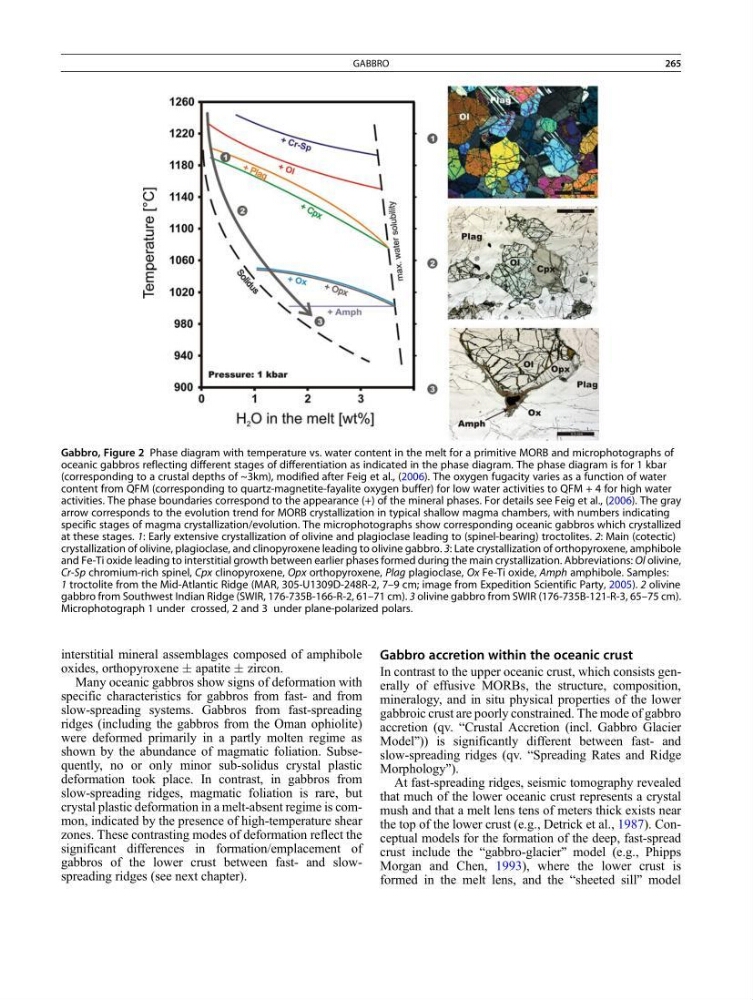
Gabbro, Figure 2 Phase diagram with temperature vs. water content in the melt for a primitive MORB and microphotographs of
oceanic gabbros reflecting different stages of differentiation as indicated in the phase diagram. The phase diagram is for 1 kbar
(corresponding to a crustal depths of ~3km), modified after Feig et al., (2006). The oxygen fugacity varies as a function of water
content from QFM (corresponding to quartz-magnetite-fayalite oxygen buffer) for low water activities to QFM + 4 for high water
activities. The phase boundaries correspond to the appearance (+) of the mineral phases. For details see Feig et al., (2006). The gray
arrow corresponds to the evolution trend for MORB crystallization in typical shallow magma chambers, with numbers indicating
specific stages of magma crystallization/evolution. The microphotographs show corresponding oceanic gabbros which crystallized
at these stages. 1: Early extensive crystallization of olivine and plagioclase leading to (spinel-bearing) troctolites. 2: Main (cotectic)
crystallization of olivine, plagioclase, and clinopyroxene leading to olivine gabbro. 3: Late crystallization of orthopyroxene, amphibole
and Fe-Ti oxide leading to interstitial growth between earlier phases formed during the main crystallization. Abbreviations: Ol olivine,
Cr-Sp chromium-rich spinel, Cpx clinopyroxene, Opx orthopyroxene, Plag plagioclase, Ox Fe-Ti oxide, Amph amphibole. Samples:
1 troctolite from the Mid-Atlantic Ridge (MAR, 305-U1309D-248R-2, 7–9 cm; image from Expedition Scientific Party, 2005). 2 olivine
gabbro from Southwest Indian Ridge (SWIR, 176-735B-166-R-2, 61–71 cm). 3 olivine gabbro from SWIR (176-735B-121-R-3, 65–75 cm).
Microphotograph 1 under crossed, 2 and 3 under plane-polarized polars.
GABBRO
265
oxides, orthopyroxene Æ apatite Æ zircon.
Many oceanic gabbros show signs of deformation with
specific characteristics for gabbros from fast- and from
slow-spreading systems. Gabbros from fast-spreading
ridges (including the gabbros from the Oman ophiolite)
were deformed primarily in a partly molten regime as
shown by the abundance of magmatic foliation. Subsequently, no or only minor sub-solidus crystal plastic
deformation took place. In contrast, in gabbros from
slow-spreading ridges, magmatic foliation is rare, but
crystal plastic deformation in a melt-absent regime is common, indicated by the presence of high-temperature shear
zones. These contrasting modes of deformation reflect the
significant differences in formation/emplacement of
gabbros of the lower crust between fast- and slowspreading ridges (see next chapter).
Gabbro accretion within the oceanic crust
In contrast to the upper oceanic crust, which consists generally of effusive MORBs, the structure, composition,
mineralogy, and in situ physical properties of the lower
gabbroic crust are poorly constrained. The mode of gabbro
accretion (qv. “Crustal Accretion (incl. Gabbro Glacier
Model”)) is significantly different between fast- and
slow-spreading ridges (qv. “Spreading Rates and Ridge
Morphology”).
At fast-spreading ridges, seismic tomography revealed
that much of the lower oceanic crust represents a crystal
mush and that a melt lens tens of meters thick exists near
the top of the lower crust (e.g., Detrick et al., 1987). Conceptual models for the formation of the deep, fast-spread
crust include the “gabbro-glacier” model (e.g., Phipps
Morgan and Chen, 1993), where the lower crust is
formed in the melt lens, and the “sheeted sill” model
Gabbro, Figure 2 Phase diagram with temperature vs. water content in the melt for a primitive MORB and microphotographs of
oceanic gabbros reflecting different stages of differentiation as indicated in the phase diagram. The phase diagram is for 1 kbar
(corresponding to a crustal depths of ~3km), modified after Feig et al., (2006). The oxygen fugacity varies as a function of water
content from QFM (corresponding to quartz-magnetite-fayalite oxygen buffer) for low water activities to QFM + 4 for high water
activities. The phase boundaries correspond to the appearance (+) of the mineral phases. For details see Feig et al., (2006). The gray
arrow corresponds to the evolution trend for MORB crystallization in typical shallow magma chambers, with numbers indicating
specific stages of magma crystallization/evolution. The microphotographs show corresponding oceanic gabbros which crystallized
at these stages. 1: Early extensive crystallization of olivine and plagioclase leading to (spinel-bearing) troctolites. 2: Main (cotectic)
crystallization of olivine, plagioclase, and clinopyroxene leading to olivine gabbro. 3: Late crystallization of orthopyroxene, amphibole
and Fe-Ti oxide leading to interstitial growth between earlier phases formed during the main crystallization. Abbreviations: Ol olivine,
Cr-Sp chromium-rich spinel, Cpx clinopyroxene, Opx orthopyroxene, Plag plagioclase, Ox Fe-Ti oxide, Amph amphibole. Samples:
1 troctolite from the Mid-Atlantic Ridge (MAR, 305-U1309D-248R-2, 7–9 cm; image from Expedition Scientific Party, 2005). 2 olivine
gabbro from Southwest Indian Ridge (SWIR, 176-735B-166-R-2, 61–71 cm). 3 olivine gabbro from SWIR (176-735B-121-R-3, 65–75 cm).
Microphotograph 1 under crossed, 2 and 3 under plane-polarized polars.
GABBRO
265