

(larger clinopyroxene crystals enclose smaller plagioclase
crystals).
Oceanic
plagiogranite:
the
term
“oceanic
plagiogranite” is an often used field term for light-colored,
felsic plutonic rocks within the oceanic crust (e.g.,
Coleman and Donato, 1979; Koepke et al., 2007), but its
exact definition is often questioned. Its use is in accord
with IUGS classification, defining the term “oceanic
plagiogranite” as a “series of plutonic rocks of the oceanic
crust consisting of plagioclase, ranging in composition
from oligoclase to anorthite, quartz, and minor amounts of
hornblende and pyroxene” (Le Maitre, 1989).
General characteristics of oceanic gabbros
Oceanic gabbros are cumulate (qv. “cumulate”) rocks
formed by accumulation of fractionated minerals during
MORB differentiation in shallow magma chambers.
Owing to the relatively slow cooling in the lower crust,
these are mostly medium-grained (grain sizes, 1–5 mm)
to coarse-grained (5–30 mm) rocks. Typical cooling rates
for deeper gabbros from fast-spreading ridges (>500 m
below the sheeted dike complex) are 100–10,000
C per
million years (between 1,000
C and 600
C, derived from
Ca-in-olivine geospeedometry; for details see Coogan,
2014). Crystal settling in magma chambers results in
monotonous equigranular, granular textures, mostly with
subhedral major minerals such as prismatic olivine and
clinopyroxene and tabular plagioclase in concordance
with the formation as cumulate (see microphotographs in
Figure 2).
Ophiolites show that deep gabbros from fast-spreading
ridges exhibit a characteristic layering, which was recently
confirmed by direct drilling into the lower crust of the fastspreading East Pacific Rise (EPR) at Hess Deep (Gillis
et al., 2014). A special gabbro type, so-called vari-textured
gabbro, occurs at fast-spreading ridges at high level
directly below the sheeted dike complex and is quite different in structure and appearance compared to the deeper
cumulate gabbro. Vari-textured gabbros are highly heterogeneous, often showing domains with contrasting grain
size and varying mode, frequently with poikilitic crystal
growth and even pegmatitic growth (e.g., Coogan
et al., 2002; Koepke et al., 2011). In contrast to the lower
gabbros, which are regarded as cumulates, these gabbros
are assumed to correspond more to frozen melts. Gabbros
from slow-spreading ridges are in general isotropic and do
not show any pronounced layering. A characteristic feature of gabbros from slow-spreading ridges is the abundant crystallization of a late, evolved melt producing
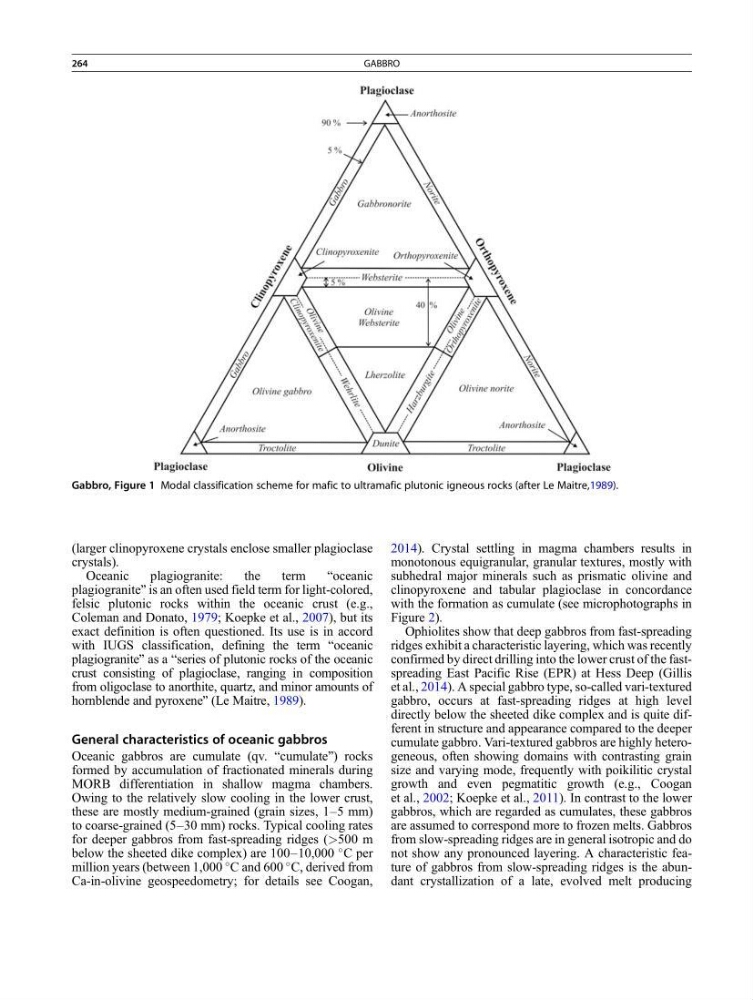
Gabbro, Figure 1 Modal classification scheme for mafic to ultramafic plutonic igneous rocks (after Le Maitre,1989).
264
GABBRO
crystals).
Oceanic
plagiogranite:
the
term
“oceanic
plagiogranite” is an often used field term for light-colored,
felsic plutonic rocks within the oceanic crust (e.g.,
Coleman and Donato, 1979; Koepke et al., 2007), but its
exact definition is often questioned. Its use is in accord
with IUGS classification, defining the term “oceanic
plagiogranite” as a “series of plutonic rocks of the oceanic
crust consisting of plagioclase, ranging in composition
from oligoclase to anorthite, quartz, and minor amounts of
hornblende and pyroxene” (Le Maitre, 1989).
General characteristics of oceanic gabbros
Oceanic gabbros are cumulate (qv. “cumulate”) rocks
formed by accumulation of fractionated minerals during
MORB differentiation in shallow magma chambers.
Owing to the relatively slow cooling in the lower crust,
these are mostly medium-grained (grain sizes, 1–5 mm)
to coarse-grained (5–30 mm) rocks. Typical cooling rates
for deeper gabbros from fast-spreading ridges (>500 m
below the sheeted dike complex) are 100–10,000
C per
million years (between 1,000
C and 600
C, derived from
Ca-in-olivine geospeedometry; for details see Coogan,
2014). Crystal settling in magma chambers results in
monotonous equigranular, granular textures, mostly with
subhedral major minerals such as prismatic olivine and
clinopyroxene and tabular plagioclase in concordance
with the formation as cumulate (see microphotographs in
Figure 2).
Ophiolites show that deep gabbros from fast-spreading
ridges exhibit a characteristic layering, which was recently
confirmed by direct drilling into the lower crust of the fastspreading East Pacific Rise (EPR) at Hess Deep (Gillis
et al., 2014). A special gabbro type, so-called vari-textured
gabbro, occurs at fast-spreading ridges at high level
directly below the sheeted dike complex and is quite different in structure and appearance compared to the deeper
cumulate gabbro. Vari-textured gabbros are highly heterogeneous, often showing domains with contrasting grain
size and varying mode, frequently with poikilitic crystal
growth and even pegmatitic growth (e.g., Coogan
et al., 2002; Koepke et al., 2011). In contrast to the lower
gabbros, which are regarded as cumulates, these gabbros
are assumed to correspond more to frozen melts. Gabbros
from slow-spreading ridges are in general isotropic and do
not show any pronounced layering. A characteristic feature of gabbros from slow-spreading ridges is the abundant crystallization of a late, evolved melt producing
Gabbro, Figure 1 Modal classification scheme for mafic to ultramafic plutonic igneous rocks (after Le Maitre,1989).
264
GABBRO