

(e.g., Bedard, 1991; Kelemen et al., 1997), where the
lower gabbros are generated by the intrusion of sills of
gabbroic mushes. Intermediate models, where part of the
lower crust forms in the shallow melt lens and the rest in
lower crustal sills, are also discussed (e.g., Boudier
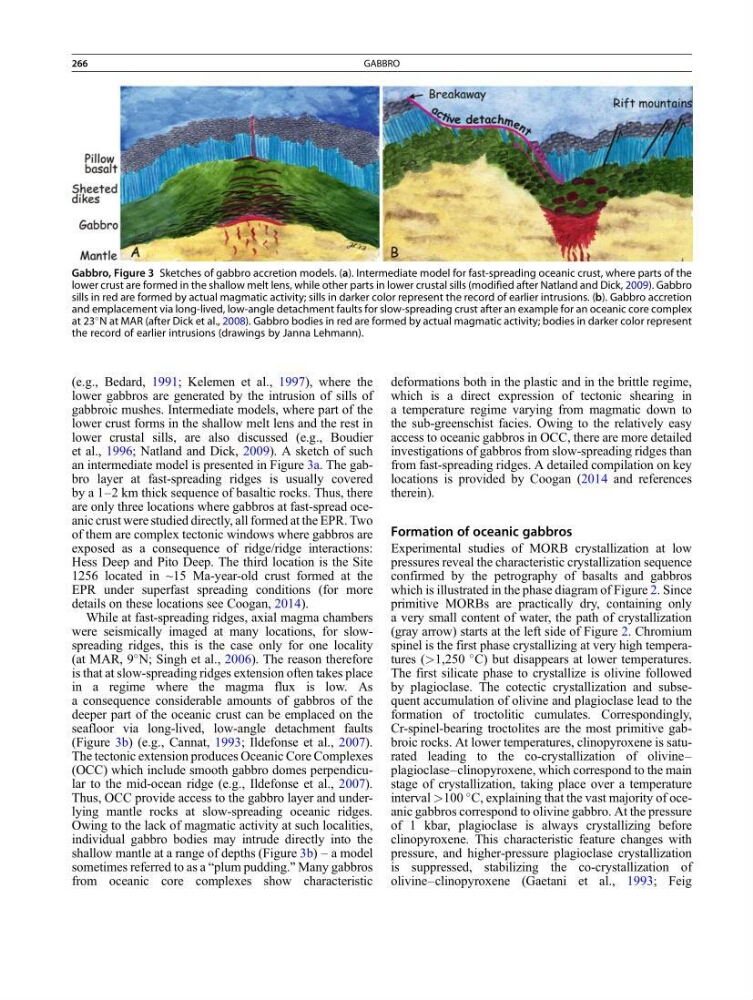
et al., 1996; Natland and Dick, 2009). A sketch of such
an intermediate model is presented in Figure 3a. The gabbro layer at fast-spreading ridges is usually covered
by a 1–2 km thick sequence of basaltic rocks. Thus, there
are only three locations where gabbros at fast-spread oceanic crust were studied directly, all formed at the EPR. Two
of them are complex tectonic windows where gabbros are
exposed as a consequence of ridge/ridge interactions:
Hess Deep and Pito Deep. The third location is the Site
1256 located in ~15 Ma-year-old crust formed at the
EPR under superfast spreading conditions (for more
details on these locations see Coogan, 2014).
While at fast-spreading ridges, axial magma chambers
were seismically imaged at many locations, for slowspreading ridges, this is the case only for one locality
(at MAR, 9
N; Singh et al., 2006). The reason therefore
is that at slow-spreading ridges extension often takes place
in a regime where the magma flux is low. As
a consequence considerable amounts of gabbros of the
deeper part of the oceanic crust can be emplaced on the
seafloor via long-lived, low-angle detachment faults
(Figure 3b) (e.g., Cannat, 1993; Ildefonse et al., 2007).
The tectonic extension produces Oceanic Core Complexes
(OCC) which include smooth gabbro domes perpendicular to the mid-ocean ridge (e.g., Ildefonse et al., 2007).
Thus, OCC provide access to the gabbro layer and underlying mantle rocks at slow-spreading oceanic ridges.
Owing to the lack of magmatic activity at such localities,
individual gabbro bodies may intrude directly into the
shallow mantle at a range of depths (Figure 3b) – a model
sometimes referred to as a “plum pudding.” Many gabbros
from oceanic core complexes show characteristic
deformations both in the plastic and in the brittle regime,
which is a direct expression of tectonic shearing in
a temperature regime varying from magmatic down to
the sub-greenschist facies. Owing to the relatively easy
access to oceanic gabbros in OCC, there are more detailed
investigations of gabbros from slow-spreading ridges than
from fast-spreading ridges. A detailed compilation on key
locations is provided by Coogan (2014 and references
therein).
Formation of oceanic gabbros
Experimental studies of MORB crystallization at low
pressures reveal the characteristic crystallization sequence
confirmed by the petrography of basalts and gabbros
which is illustrated in the phase diagram of Figure 2. Since
primitive MORBs are practically dry, containing only
a very small content of water, the path of crystallization
(gray arrow) starts at the left side of Figure 2. Chromium
spinel is the first phase crystallizing at very high temperatures (>1,250
C) but disappears at lower temperatures.
The first silicate phase to crystallize is olivine followed
by plagioclase. The cotectic crystallization and subsequent accumulation of olivine and plagioclase lead to the
formation of troctolitic cumulates. Correspondingly,
Cr-spinel-bearing troctolites are the most primitive gabbroic rocks. At lower temperatures, clinopyroxene is saturated leading to the co-crystallization of olivine–
plagioclase–clinopyroxene, which correspond to the main
stage of crystallization, taking place over a temperature
interval >100
C, explaining that the vast majority of oceanic gabbros correspond to olivine gabbro. At the pressure
of 1 kbar, plagioclase is always crystallizing before
clinopyroxene. This characteristic feature changes with
pressure, and higher-pressure plagioclase crystallization
is suppressed, stabilizing the co-crystallization of
olivine–clinopyroxene (Gaetani et al., 1993; Feig
Gabbro, Figure 3 Sketches of gabbro accretion models. (a). Intermediate model for fast-spreading oceanic crust, where parts of the
lower crust are formed in the shallow melt lens, while other parts in lower crustal sills (modified after Natland and Dick, 2009). Gabbro
sills in red are formed by actual magmatic activity; sills in darker color represent the record of earlier intrusions. (b). Gabbro accretion
and emplacement via long-lived, low-angle detachment faults for slow-spreading crust after an example for an oceanic core complex
at 23
N at MAR (after Dick et al., 2008). Gabbro bodies in red are formed by actual magmatic activity; bodies in darker color represent
the record of earlier intrusions (drawings by Janna Lehmann).
266
GABBRO
lower gabbros are generated by the intrusion of sills of
gabbroic mushes. Intermediate models, where part of the
lower crust forms in the shallow melt lens and the rest in
lower crustal sills, are also discussed (e.g., Boudier
et al., 1996; Natland and Dick, 2009). A sketch of such
an intermediate model is presented in Figure 3a. The gabbro layer at fast-spreading ridges is usually covered
by a 1–2 km thick sequence of basaltic rocks. Thus, there
are only three locations where gabbros at fast-spread oceanic crust were studied directly, all formed at the EPR. Two
of them are complex tectonic windows where gabbros are
exposed as a consequence of ridge/ridge interactions:
Hess Deep and Pito Deep. The third location is the Site
1256 located in ~15 Ma-year-old crust formed at the
EPR under superfast spreading conditions (for more
details on these locations see Coogan, 2014).
While at fast-spreading ridges, axial magma chambers
were seismically imaged at many locations, for slowspreading ridges, this is the case only for one locality
(at MAR, 9
N; Singh et al., 2006). The reason therefore
is that at slow-spreading ridges extension often takes place
in a regime where the magma flux is low. As
a consequence considerable amounts of gabbros of the
deeper part of the oceanic crust can be emplaced on the
seafloor via long-lived, low-angle detachment faults
(Figure 3b) (e.g., Cannat, 1993; Ildefonse et al., 2007).
The tectonic extension produces Oceanic Core Complexes
(OCC) which include smooth gabbro domes perpendicular to the mid-ocean ridge (e.g., Ildefonse et al., 2007).
Thus, OCC provide access to the gabbro layer and underlying mantle rocks at slow-spreading oceanic ridges.
Owing to the lack of magmatic activity at such localities,
individual gabbro bodies may intrude directly into the
shallow mantle at a range of depths (Figure 3b) – a model
sometimes referred to as a “plum pudding.” Many gabbros
from oceanic core complexes show characteristic
deformations both in the plastic and in the brittle regime,
which is a direct expression of tectonic shearing in
a temperature regime varying from magmatic down to
the sub-greenschist facies. Owing to the relatively easy
access to oceanic gabbros in OCC, there are more detailed
investigations of gabbros from slow-spreading ridges than
from fast-spreading ridges. A detailed compilation on key
locations is provided by Coogan (2014 and references
therein).
Formation of oceanic gabbros
Experimental studies of MORB crystallization at low
pressures reveal the characteristic crystallization sequence
confirmed by the petrography of basalts and gabbros
which is illustrated in the phase diagram of Figure 2. Since
primitive MORBs are practically dry, containing only
a very small content of water, the path of crystallization
(gray arrow) starts at the left side of Figure 2. Chromium
spinel is the first phase crystallizing at very high temperatures (>1,250
C) but disappears at lower temperatures.
The first silicate phase to crystallize is olivine followed
by plagioclase. The cotectic crystallization and subsequent accumulation of olivine and plagioclase lead to the
formation of troctolitic cumulates. Correspondingly,
Cr-spinel-bearing troctolites are the most primitive gabbroic rocks. At lower temperatures, clinopyroxene is saturated leading to the co-crystallization of olivine–
plagioclase–clinopyroxene, which correspond to the main
stage of crystallization, taking place over a temperature
interval >100
C, explaining that the vast majority of oceanic gabbros correspond to olivine gabbro. At the pressure
of 1 kbar, plagioclase is always crystallizing before
clinopyroxene. This characteristic feature changes with
pressure, and higher-pressure plagioclase crystallization
is suppressed, stabilizing the co-crystallization of
olivine–clinopyroxene (Gaetani et al., 1993; Feig
Gabbro, Figure 3 Sketches of gabbro accretion models. (a). Intermediate model for fast-spreading oceanic crust, where parts of the
lower crust are formed in the shallow melt lens, while other parts in lower crustal sills (modified after Natland and Dick, 2009). Gabbro
sills in red are formed by actual magmatic activity; sills in darker color represent the record of earlier intrusions. (b). Gabbro accretion
and emplacement via long-lived, low-angle detachment faults for slow-spreading crust after an example for an oceanic core complex
at 23
N at MAR (after Dick et al., 2008). Gabbro bodies in red are formed by actual magmatic activity; bodies in darker color represent
the record of earlier intrusions (drawings by Janna Lehmann).
266
GABBRO