

but within these values, the influence of salinity is rather
limited (Hemleben et al., 1989; Bijma et al., 1990).
The worldwide biogeography of planktonic foraminifers is characterized by a system of latitudinally oriented
belt-like provinces, punctuated by conspicuous northsouth drifts where ocean currents distort the east-west orientation of isotherms (e.g., the Gulf Stream in the North
Atlantic or the Humboldt Current in the South Pacific;
Figure 3). The limits of these provinces are strikingly similar to near-surface isotherms (Figure 3), which reinforces
the notion of the overwhelming importance of temperature
for determining specific makeups. Each province is characterized by a particular combination of co-occurring species, but individual species ranges seldom coincide with
province boundaries, so that specific ranges overlap extensively and species restricted to any one province are very
few (normally below 10 % of those present anywhere in
the province). Diversity drops conspicuously from the
equator to the poles, but the highest numbers of species
are often found in the subtropics (Figure 3). With a few
exceptions, known morphospecies inhabit all three major
oceans. Most species dwell in the surface waters, either
during their entire life (all species of Globigerinoides,
Globigerina) or as juveniles, while the adults migrate
below 100 m (Globigerinella adamsi, Sphaeroidinella
dehiscens, Neogloboquadrina pachyderma, etc.), but a
number of forms are usually found at 50–100 m
(Globigerina bulloides, Hastigerina pelagica, Orbulina
universa, Globigerinella siphonifera, Globigerina
calida, Pulleniatina obliquiloculata, Neogloboquadrina
dutertrei, Candeina nitida, Globigerina glutinata,
and others). Deep-water species (below 1,000 m)
are
Hastigerinella
digitata
and
Globorotalia
truncatulinoides.
Foraminiferal abundances normally range around
0.001 to >1 individual per L of water, with oligotrophic
central oceanic gyres hosting the lowest densities and
high-productivity upwelling regions the highest. Peak
densities, however, have been recorded in sea-ice
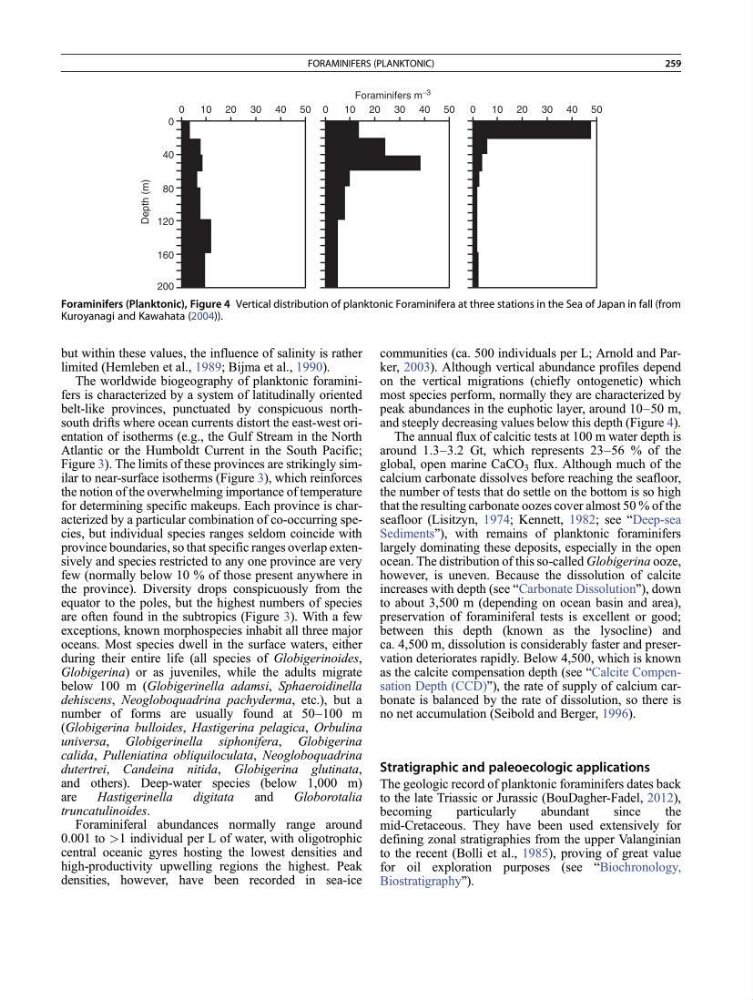
communities (ca. 500 individuals per L; Arnold and Parker, 2003). Although vertical abundance profiles depend
on the vertical migrations (chiefly ontogenetic) which
most species perform, normally they are characterized by
peak abundances in the euphotic layer, around 10–50 m,
and steeply decreasing values below this depth (Figure 4).
The annual flux of calcitic tests at 100 m water depth is
around 1.3–3.2 Gt, which represents 23–56 % of the
global, open marine CaCO 3 flux. Although much of the
calcium carbonate dissolves before reaching the seafloor,
the number of tests that do settle on the bottom is so high
that the resulting carbonate oozes cover almost 50 % of the
seafloor (Lisitzyn, 1974; Kennett, 1982; see “Deep-sea
Sediments”), with remains of planktonic foraminifers
largely dominating these deposits, especially in the open
ocean. The distribution of this so-called Globigerina ooze,
however, is uneven. Because the dissolution of calcite
increases with depth (see “Carbonate Dissolution”), down
to about 3,500 m (depending on ocean basin and area),
preservation of foraminiferal tests is excellent or good;
between this depth (known as the lysocline) and
ca. 4,500 m, dissolution is considerably faster and preservation deteriorates rapidly. Below 4,500, which is known
as the calcite compensation depth (see “Calcite Compensation Depth (CCD)”), the rate of supply of calcium carbonate is balanced by the rate of dissolution, so there is
no net accumulation (Seibold and Berger, 1996).
Stratigraphic and paleoecologic applications
The geologic record of planktonic foraminifers dates back
to the late Triassic or Jurassic (BouDagher-Fadel, 2012),
becoming
particularly
abundant
since
the
mid-Cretaceous. They have been used extensively for
defining zonal stratigraphies from the upper Valanginian
to the recent (Bolli et al., 1985), proving of great value
for oil exploration purposes (see “Biochronology,
Biostratigraphy”).
0
0
40
80
Depth (m)
120
160
200
10 20 30 40 50 0
10 20
Foraminifers m −3
30 40 50
0
10 20 30 40 50
Foraminifers (Planktonic), Figure 4 Vertical distribution of planktonic Foraminifera at three stations in the Sea of Japan in fall (from
Kuroyanagi and Kawahata (2004)).
FORAMINIFERS (PLANKTONIC)
259
limited (Hemleben et al., 1989; Bijma et al., 1990).
The worldwide biogeography of planktonic foraminifers is characterized by a system of latitudinally oriented
belt-like provinces, punctuated by conspicuous northsouth drifts where ocean currents distort the east-west orientation of isotherms (e.g., the Gulf Stream in the North
Atlantic or the Humboldt Current in the South Pacific;
Figure 3). The limits of these provinces are strikingly similar to near-surface isotherms (Figure 3), which reinforces
the notion of the overwhelming importance of temperature
for determining specific makeups. Each province is characterized by a particular combination of co-occurring species, but individual species ranges seldom coincide with
province boundaries, so that specific ranges overlap extensively and species restricted to any one province are very
few (normally below 10 % of those present anywhere in
the province). Diversity drops conspicuously from the
equator to the poles, but the highest numbers of species
are often found in the subtropics (Figure 3). With a few
exceptions, known morphospecies inhabit all three major
oceans. Most species dwell in the surface waters, either
during their entire life (all species of Globigerinoides,
Globigerina) or as juveniles, while the adults migrate
below 100 m (Globigerinella adamsi, Sphaeroidinella
dehiscens, Neogloboquadrina pachyderma, etc.), but a
number of forms are usually found at 50–100 m
(Globigerina bulloides, Hastigerina pelagica, Orbulina
universa, Globigerinella siphonifera, Globigerina
calida, Pulleniatina obliquiloculata, Neogloboquadrina
dutertrei, Candeina nitida, Globigerina glutinata,
and others). Deep-water species (below 1,000 m)
are
Hastigerinella
digitata
and
Globorotalia
truncatulinoides.
Foraminiferal abundances normally range around
0.001 to >1 individual per L of water, with oligotrophic
central oceanic gyres hosting the lowest densities and
high-productivity upwelling regions the highest. Peak
densities, however, have been recorded in sea-ice
communities (ca. 500 individuals per L; Arnold and Parker, 2003). Although vertical abundance profiles depend
on the vertical migrations (chiefly ontogenetic) which
most species perform, normally they are characterized by
peak abundances in the euphotic layer, around 10–50 m,
and steeply decreasing values below this depth (Figure 4).
The annual flux of calcitic tests at 100 m water depth is
around 1.3–3.2 Gt, which represents 23–56 % of the
global, open marine CaCO 3 flux. Although much of the
calcium carbonate dissolves before reaching the seafloor,
the number of tests that do settle on the bottom is so high
that the resulting carbonate oozes cover almost 50 % of the
seafloor (Lisitzyn, 1974; Kennett, 1982; see “Deep-sea
Sediments”), with remains of planktonic foraminifers
largely dominating these deposits, especially in the open
ocean. The distribution of this so-called Globigerina ooze,
however, is uneven. Because the dissolution of calcite
increases with depth (see “Carbonate Dissolution”), down
to about 3,500 m (depending on ocean basin and area),
preservation of foraminiferal tests is excellent or good;
between this depth (known as the lysocline) and
ca. 4,500 m, dissolution is considerably faster and preservation deteriorates rapidly. Below 4,500, which is known
as the calcite compensation depth (see “Calcite Compensation Depth (CCD)”), the rate of supply of calcium carbonate is balanced by the rate of dissolution, so there is
no net accumulation (Seibold and Berger, 1996).
Stratigraphic and paleoecologic applications
The geologic record of planktonic foraminifers dates back
to the late Triassic or Jurassic (BouDagher-Fadel, 2012),
becoming
particularly
abundant
since
the
mid-Cretaceous. They have been used extensively for
defining zonal stratigraphies from the upper Valanginian
to the recent (Bolli et al., 1985), proving of great value
for oil exploration purposes (see “Biochronology,
Biostratigraphy”).
0
0
40
80
Depth (m)
120
160
200
10 20 30 40 50 0
10 20
Foraminifers m −3
30 40 50
0
10 20 30 40 50
Foraminifers (Planktonic), Figure 4 Vertical distribution of planktonic Foraminifera at three stations in the Sea of Japan in fall (from
Kuroyanagi and Kawahata (2004)).
FORAMINIFERS (PLANKTONIC)
259