

species that have been genetically analyzed (DNA
sequence coding for the small subunit and internal transcribed spacer of the nuclear ribosomal RNA genes) until
that year contain between three and six distinct genetic
entities (“sister species”) each. Interestingly, upon closer
examination, most of the new, genetically identified species within traditional morphological species turn out to
show minor but recognizable morphological differences
(De Vargas et al., 2004; Aurahs et al., 2009). It seems plausible that niche partitioning (driven by regional differences in food availability, salinity, temperature), rather
than allopatric speciation through vicariance, is responsible for this diversification (Darling and Wade, 2008;
Aurahs et al., 2009; Seears et al., 2012).
Geographic patterns of abundance and species
composition
Data on the distribution patterns of living planktonic Foraminifera come from three sources: plankton tows, sediment traps, and surface sediment samples. Each has
advantages and drawbacks. Plankton samples retrieve
whole assemblages (unless the mesh size used is too large)
unbiased by postmortem processes (see below), but the
sample size is normally limited and the sample is but a
snapshot representative of a very restricted time offset.
Sediment traps are particularly suitable for investigating
temporal cycles and sedimentation processes, but their
yields are subject to several distorting mechanisms, such
as lateral advection, selective dissolution, and fragmentation due to grazing. Surface sediment samples are by far
the most widely available and used for biogeographic purposes, but as proxies of the distribution of the living
assemblages, they are also the most biased. The sedimentary remains of planktonic foraminifers can differ strongly
from the corresponding planktonic assemblages due to a
number of mechanisms, including selective dissolution
of the less resistant shells (both on the way to the seafloor
and after settling), reworking by bottom fauna, winnowing
by bottom currents, lateral advection by subsurface and
deep currents, submersion and extended survival of colder
water forms under warmer water areas (“equatorward
shadows”), fragmentation due to grazing, vertical integration of shallow- and deep-living species, different reproduction modes, and integration of seasonally dissimilar
abundance patterns (Vincent and Berger, 1981;
Boltovskoy, 1994; Schiebel and Hemleben, 2005). Many
of these modifications tend to enhance the proportions of
cold water species, resulting in assemblages indicative of
colder waters than those overlying the corresponding
sediments.
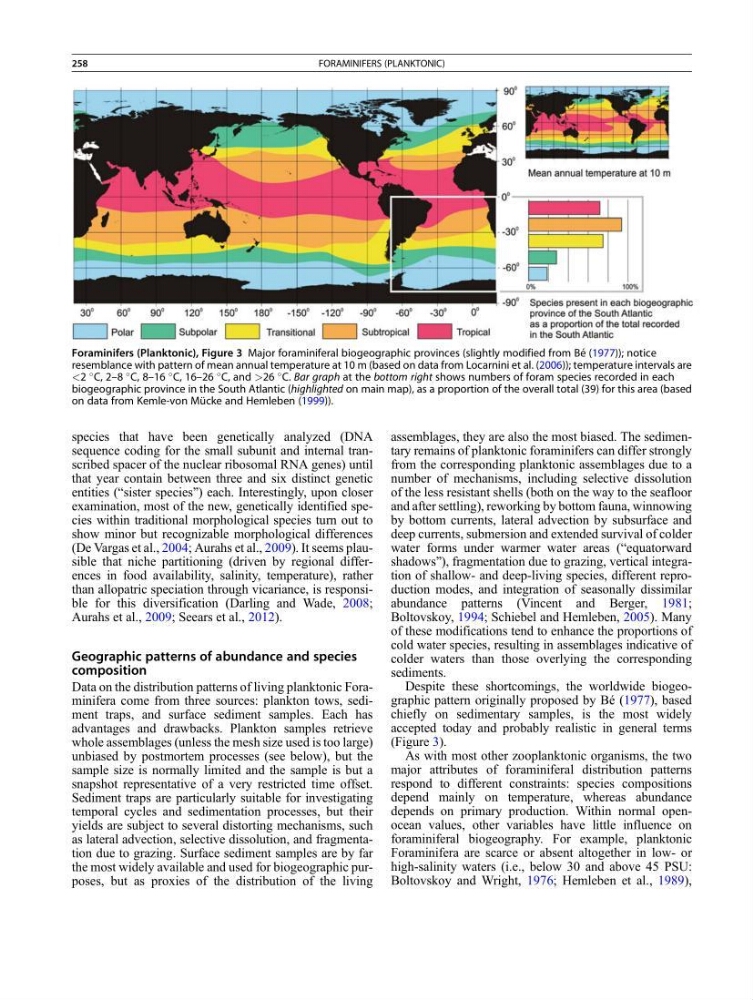
Despite these shortcomings, the worldwide biogeographic pattern originally proposed by Bé (1977), based
chiefly on sedimentary samples, is the most widely
accepted today and probably realistic in general terms
(Figure 3).
As with most other zooplanktonic organisms, the two
major attributes of foraminiferal distribution patterns
respond to different constraints: species compositions
depend mainly on temperature, whereas abundance
depends on primary production. Within normal openocean values, other variables have little influence on
foraminiferal biogeography. For example, planktonic
Foraminifera are scarce or absent altogether in low- or
high-salinity waters (i.e., below 30 and above 45 PSU:
Boltovskoy and Wright, 1976; Hemleben et al., 1989),
Foraminifers (Planktonic), Figure 3 Major foraminiferal biogeographic provinces (slightly modified from Be ´ (1977)); notice
resemblance with pattern of mean annual temperature at 10 m (based on data from Locarnini et al. (2006)); temperature intervals are
<2
C, 2–8
C, 8–16
C, 16–26
C, and >26
C. Bar graph at the bottom right shows numbers of foram species recorded in each
biogeographic province in the South Atlantic (highlighted on main map), as a proportion of the overall total (39) for this area (based
on data from Kemle-von Mu ¨ cke and Hemleben (1999)).
258
FORAMINIFERS (PLANKTONIC)
sequence coding for the small subunit and internal transcribed spacer of the nuclear ribosomal RNA genes) until
that year contain between three and six distinct genetic
entities (“sister species”) each. Interestingly, upon closer
examination, most of the new, genetically identified species within traditional morphological species turn out to
show minor but recognizable morphological differences
(De Vargas et al., 2004; Aurahs et al., 2009). It seems plausible that niche partitioning (driven by regional differences in food availability, salinity, temperature), rather
than allopatric speciation through vicariance, is responsible for this diversification (Darling and Wade, 2008;
Aurahs et al., 2009; Seears et al., 2012).
Geographic patterns of abundance and species
composition
Data on the distribution patterns of living planktonic Foraminifera come from three sources: plankton tows, sediment traps, and surface sediment samples. Each has
advantages and drawbacks. Plankton samples retrieve
whole assemblages (unless the mesh size used is too large)
unbiased by postmortem processes (see below), but the
sample size is normally limited and the sample is but a
snapshot representative of a very restricted time offset.
Sediment traps are particularly suitable for investigating
temporal cycles and sedimentation processes, but their
yields are subject to several distorting mechanisms, such
as lateral advection, selective dissolution, and fragmentation due to grazing. Surface sediment samples are by far
the most widely available and used for biogeographic purposes, but as proxies of the distribution of the living
assemblages, they are also the most biased. The sedimentary remains of planktonic foraminifers can differ strongly
from the corresponding planktonic assemblages due to a
number of mechanisms, including selective dissolution
of the less resistant shells (both on the way to the seafloor
and after settling), reworking by bottom fauna, winnowing
by bottom currents, lateral advection by subsurface and
deep currents, submersion and extended survival of colder
water forms under warmer water areas (“equatorward
shadows”), fragmentation due to grazing, vertical integration of shallow- and deep-living species, different reproduction modes, and integration of seasonally dissimilar
abundance patterns (Vincent and Berger, 1981;
Boltovskoy, 1994; Schiebel and Hemleben, 2005). Many
of these modifications tend to enhance the proportions of
cold water species, resulting in assemblages indicative of
colder waters than those overlying the corresponding
sediments.
Despite these shortcomings, the worldwide biogeographic pattern originally proposed by Bé (1977), based
chiefly on sedimentary samples, is the most widely
accepted today and probably realistic in general terms
(Figure 3).
As with most other zooplanktonic organisms, the two
major attributes of foraminiferal distribution patterns
respond to different constraints: species compositions
depend mainly on temperature, whereas abundance
depends on primary production. Within normal openocean values, other variables have little influence on
foraminiferal biogeography. For example, planktonic
Foraminifera are scarce or absent altogether in low- or
high-salinity waters (i.e., below 30 and above 45 PSU:
Boltovskoy and Wright, 1976; Hemleben et al., 1989),
Foraminifers (Planktonic), Figure 3 Major foraminiferal biogeographic provinces (slightly modified from Be ´ (1977)); notice
resemblance with pattern of mean annual temperature at 10 m (based on data from Locarnini et al. (2006)); temperature intervals are
<2
C, 2–8
C, 8–16
C, 16–26
C, and >26
C. Bar graph at the bottom right shows numbers of foram species recorded in each
biogeographic province in the South Atlantic (highlighted on main map), as a proportion of the overall total (39) for this area (based
on data from Kemle-von Mu ¨ cke and Hemleben (1999)).
258
FORAMINIFERS (PLANKTONIC)