

surface waters and then migrate to layers as deep as
1,000 m or more (Hemleben et al., 1989). Surfacedwelling species reproduce in the pycnocline or chlorophyll maximum layer, and the offspring migrate to more
surficial waters.
Growth of the shell starts with a small spherical chamber
(“proloculum”)
and
the
subsequent
addition of progressively larger chambers around it
(roughly at the rate of one chamber every 48 h; Hemleben
et al., 1989). Successive stages (five, according to
Brummer et al. (1987)) are characterized by marked morphological changes, including inflation of chambers,
development of pores, and development of spine collars,
ridges, secondary apertures, etc. Prior to reproduction,
the shell wall thickens, spines are shed, and internal septa
may disappear.
Trophic relationships
Most species are fairly omnivorous, feeding on a large
spectrum of organisms including diatoms, dinoflagellates,
coccolithophorids, radiolarians, ciliates, pteropods, various invertebrate larvae, copepods, etc. Cannibalism has
been observed in non-spinose species, but not in spinose
forms. Food items can be several times larger than the foraminifer itself. Spinose species tend to prefer animal prey,
whereas non-spinose ones feed chiefly on phytoplankton.
The prey is surrounded by the protist’s rhizopodia
which eventually engulf the organism and transfer ruptured pieces of its body to digestive vacuoles in the extraor intrashell cytoplasm by protoplasmic streaming
(Hemleben et al., 1989).
In addition to heterotrophic feeding, many planktonic
foraminifers possess algal symbionts (dinoflagellates and
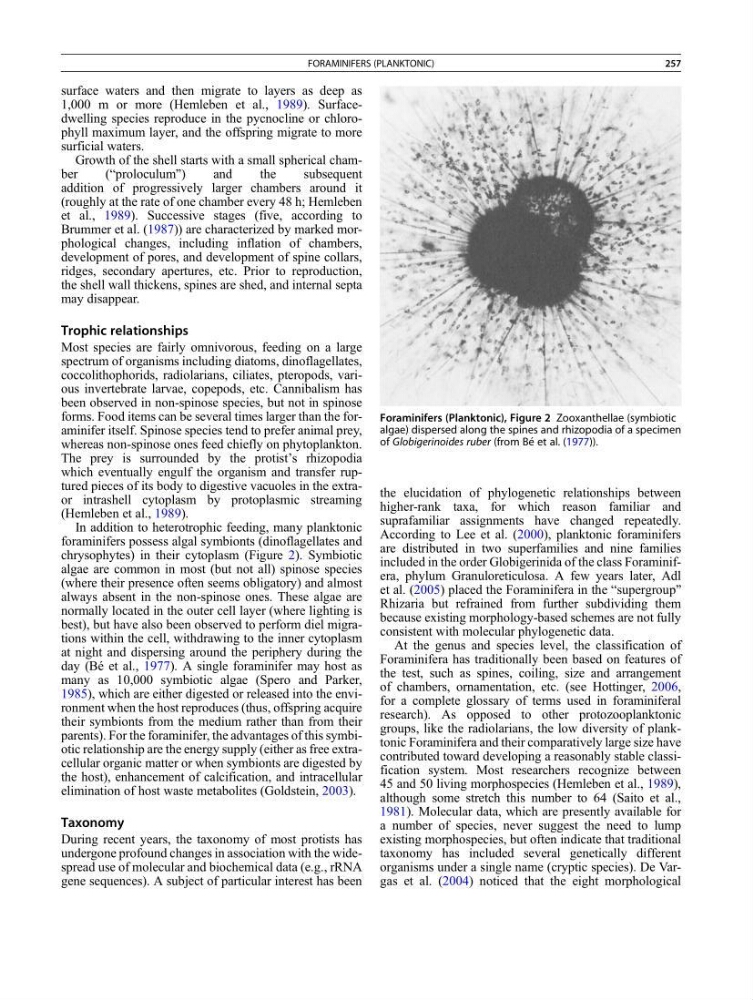
chrysophytes) in their cytoplasm (Figure 2). Symbiotic
algae are common in most (but not all) spinose species
(where their presence often seems obligatory) and almost
always absent in the non-spinose ones. These algae are
normally located in the outer cell layer (where lighting is
best), but have also been observed to perform diel migrations within the cell, withdrawing to the inner cytoplasm
at night and dispersing around the periphery during the
day (Bé et al., 1977). A single foraminifer may host as
many as 10,000 symbiotic algae (Spero and Parker,
1985), which are either digested or released into the environment when the host reproduces (thus, offspring acquire
their symbionts from the medium rather than from their
parents). For the foraminifer, the advantages of this symbiotic relationship are the energy supply (either as free extracellular organic matter or when symbionts are digested by
the host), enhancement of calcification, and intracellular
elimination of host waste metabolites (Goldstein, 2003).
Taxonomy
During recent years, the taxonomy of most protists has
undergone profound changes in association with the widespread use of molecular and biochemical data (e.g., rRNA
gene sequences). A subject of particular interest has been
the elucidation of phylogenetic relationships between
higher-rank taxa, for which reason familiar and
suprafamiliar assignments have changed repeatedly.
According to Lee et al. (2000), planktonic foraminifers
are distributed in two superfamilies and nine families
included in the order Globigerinida of the class Foraminifera, phylum Granuloreticulosa. A few years later, Adl
et al. (2005) placed the Foraminifera in the “supergroup”
Rhizaria but refrained from further subdividing them
because existing morphology-based schemes are not fully
consistent with molecular phylogenetic data.
At the genus and species level, the classification of
Foraminifera has traditionally been based on features of
the test, such as spines, coiling, size and arrangement
of chambers, ornamentation, etc. (see Hottinger, 2006,
for a complete glossary of terms used in foraminiferal
research). As opposed to other protozooplanktonic
groups, like the radiolarians, the low diversity of planktonic Foraminifera and their comparatively large size have
contributed toward developing a reasonably stable classification system. Most researchers recognize between
45 and 50 living morphospecies (Hemleben et al., 1989),
although some stretch this number to 64 (Saito et al.,
1981). Molecular data, which are presently available for
a number of species, never suggest the need to lump
existing morphospecies, but often indicate that traditional
taxonomy has included several genetically different
organisms under a single name (cryptic species). De Vargas et al. (2004) noticed that the eight morphological
Foraminifers (Planktonic), Figure 2 Zooxanthellae (symbiotic
algae) dispersed along the spines and rhizopodia of a specimen
of Globigerinoides ruber (from Be ´ et al. (1977)).
FORAMINIFERS (PLANKTONIC)
257
1,000 m or more (Hemleben et al., 1989). Surfacedwelling species reproduce in the pycnocline or chlorophyll maximum layer, and the offspring migrate to more
surficial waters.
Growth of the shell starts with a small spherical chamber
(“proloculum”)
and
the
subsequent
addition of progressively larger chambers around it
(roughly at the rate of one chamber every 48 h; Hemleben
et al., 1989). Successive stages (five, according to
Brummer et al. (1987)) are characterized by marked morphological changes, including inflation of chambers,
development of pores, and development of spine collars,
ridges, secondary apertures, etc. Prior to reproduction,
the shell wall thickens, spines are shed, and internal septa
may disappear.
Trophic relationships
Most species are fairly omnivorous, feeding on a large
spectrum of organisms including diatoms, dinoflagellates,
coccolithophorids, radiolarians, ciliates, pteropods, various invertebrate larvae, copepods, etc. Cannibalism has
been observed in non-spinose species, but not in spinose
forms. Food items can be several times larger than the foraminifer itself. Spinose species tend to prefer animal prey,
whereas non-spinose ones feed chiefly on phytoplankton.
The prey is surrounded by the protist’s rhizopodia
which eventually engulf the organism and transfer ruptured pieces of its body to digestive vacuoles in the extraor intrashell cytoplasm by protoplasmic streaming
(Hemleben et al., 1989).
In addition to heterotrophic feeding, many planktonic
foraminifers possess algal symbionts (dinoflagellates and
chrysophytes) in their cytoplasm (Figure 2). Symbiotic
algae are common in most (but not all) spinose species
(where their presence often seems obligatory) and almost
always absent in the non-spinose ones. These algae are
normally located in the outer cell layer (where lighting is
best), but have also been observed to perform diel migrations within the cell, withdrawing to the inner cytoplasm
at night and dispersing around the periphery during the
day (Bé et al., 1977). A single foraminifer may host as
many as 10,000 symbiotic algae (Spero and Parker,
1985), which are either digested or released into the environment when the host reproduces (thus, offspring acquire
their symbionts from the medium rather than from their
parents). For the foraminifer, the advantages of this symbiotic relationship are the energy supply (either as free extracellular organic matter or when symbionts are digested by
the host), enhancement of calcification, and intracellular
elimination of host waste metabolites (Goldstein, 2003).
Taxonomy
During recent years, the taxonomy of most protists has
undergone profound changes in association with the widespread use of molecular and biochemical data (e.g., rRNA
gene sequences). A subject of particular interest has been
the elucidation of phylogenetic relationships between
higher-rank taxa, for which reason familiar and
suprafamiliar assignments have changed repeatedly.
According to Lee et al. (2000), planktonic foraminifers
are distributed in two superfamilies and nine families
included in the order Globigerinida of the class Foraminifera, phylum Granuloreticulosa. A few years later, Adl
et al. (2005) placed the Foraminifera in the “supergroup”
Rhizaria but refrained from further subdividing them
because existing morphology-based schemes are not fully
consistent with molecular phylogenetic data.
At the genus and species level, the classification of
Foraminifera has traditionally been based on features of
the test, such as spines, coiling, size and arrangement
of chambers, ornamentation, etc. (see Hottinger, 2006,
for a complete glossary of terms used in foraminiferal
research). As opposed to other protozooplanktonic
groups, like the radiolarians, the low diversity of planktonic Foraminifera and their comparatively large size have
contributed toward developing a reasonably stable classification system. Most researchers recognize between
45 and 50 living morphospecies (Hemleben et al., 1989),
although some stretch this number to 64 (Saito et al.,
1981). Molecular data, which are presently available for
a number of species, never suggest the need to lump
existing morphospecies, but often indicate that traditional
taxonomy has included several genetically different
organisms under a single name (cryptic species). De Vargas et al. (2004) noticed that the eight morphological
Foraminifers (Planktonic), Figure 2 Zooxanthellae (symbiotic
algae) dispersed along the spines and rhizopodia of a specimen
of Globigerinoides ruber (from Be ´ et al. (1977)).
FORAMINIFERS (PLANKTONIC)
257