

is widely used for stratigraphic and paleoenvironmental
studies.
Shell and cell
All planktonic foraminifers build shells (up to 1.5 mm,
mean around 0.3 mm in size) composed of mostly more
or less globular chambers arranged in a streptospiral
(where each chamber is half a whorl), planispiral (coiled
in a single horizontal plane), trochospiral (helical), or, very
rarely, triserial coil. An exception is the genus Orbulina,
which builds a complete sphere around a small
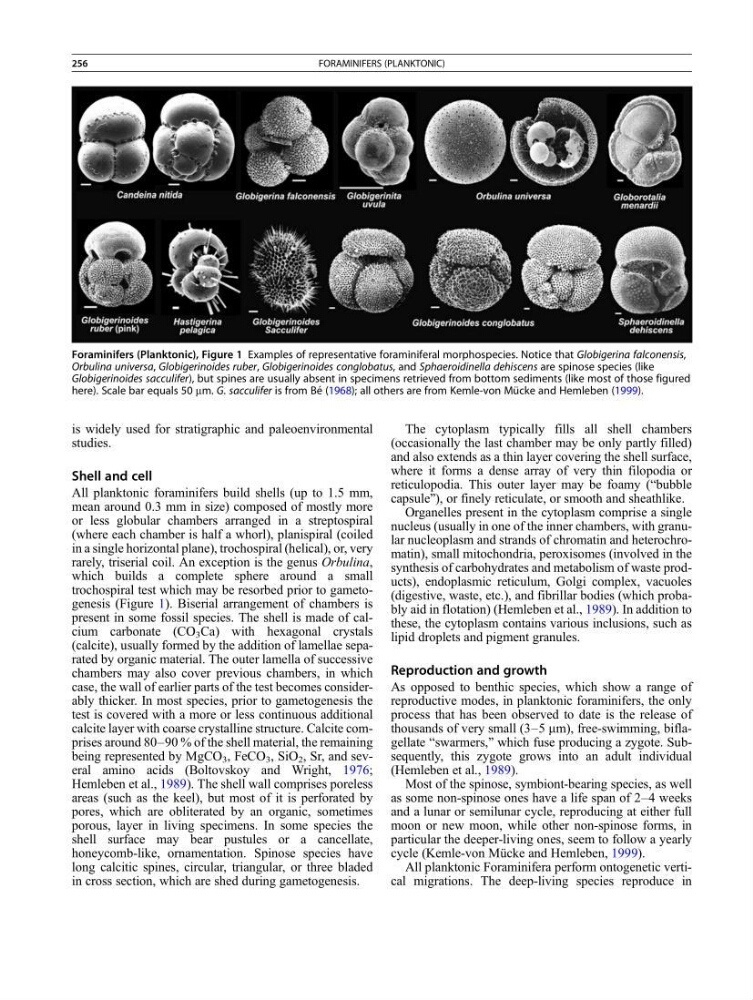
trochospiral test which may be resorbed prior to gametogenesis (Figure 1). Biserial arrangement of chambers is
present in some fossil species. The shell is made of calcium carbonate (CO 3 Ca) with hexagonal crystals
(calcite), usually formed by the addition of lamellae separated by organic material. The outer lamella of successive
chambers may also cover previous chambers, in which
case, the wall of earlier parts of the test becomes considerably thicker. In most species, prior to gametogenesis the
test is covered with a more or less continuous additional
calcite layer with coarse crystalline structure. Calcite comprises around 80–90 % of the shell material, the remaining
being represented by MgCO 3 , FeCO 3 , SiO 2 , Sr, and several amino acids (Boltovskoy and Wright, 1976;
Hemleben et al., 1989). The shell wall comprises poreless
areas (such as the keel), but most of it is perforated by
pores, which are obliterated by an organic, sometimes
porous, layer in living specimens. In some species the
shell surface may bear pustules or a cancellate,
honeycomb-like, ornamentation. Spinose species have
long calcitic spines, circular, triangular, or three bladed
in cross section, which are shed during gametogenesis.
The cytoplasm typically fills all shell chambers
(occasionally the last chamber may be only partly filled)
and also extends as a thin layer covering the shell surface,
where it forms a dense array of very thin filopodia or
reticulopodia. This outer layer may be foamy (“bubble
capsule”), or finely reticulate, or smooth and sheathlike.
Organelles present in the cytoplasm comprise a single
nucleus (usually in one of the inner chambers, with granular nucleoplasm and strands of chromatin and heterochromatin), small mitochondria, peroxisomes (involved in the
synthesis of carbohydrates and metabolism of waste products), endoplasmic reticulum, Golgi complex, vacuoles
(digestive, waste, etc.), and fibrillar bodies (which probably aid in flotation) (Hemleben et al., 1989). In addition to
these, the cytoplasm contains various inclusions, such as
lipid droplets and pigment granules.
Reproduction and growth
As opposed to benthic species, which show a range of
reproductive modes, in planktonic foraminifers, the only
process that has been observed to date is the release of
thousands of very small (3–5 mm), free-swimming, biflagellate “swarmers,” which fuse producing a zygote. Subsequently, this zygote grows into an adult individual
(Hemleben et al., 1989).
Most of the spinose, symbiont-bearing species, as well
as some non-spinose ones have a life span of 2–4 weeks
and a lunar or semilunar cycle, reproducing at either full
moon or new moon, while other non-spinose forms, in
particular the deeper-living ones, seem to follow a yearly
cycle (Kemle-von Mücke and Hemleben, 1999).
All planktonic Foraminifera perform ontogenetic vertical migrations. The deep-living species reproduce in
Foraminifers (Planktonic), Figure 1 Examples of representative foraminiferal morphospecies. Notice that Globigerina falconensis,
Orbulina universa, Globigerinoides ruber, Globigerinoides conglobatus, and Sphaeroidinella dehiscens are spinose species (like
Globigerinoides sacculifer), but spines are usually absent in specimens retrieved from bottom sediments (like most of those figured
here). Scale bar equals 50 mm. G. sacculifer is from Be ´ (1968); all others are from Kemle-von Mu ¨ cke and Hemleben (1999).
256
FORAMINIFERS (PLANKTONIC)
studies.
Shell and cell
All planktonic foraminifers build shells (up to 1.5 mm,
mean around 0.3 mm in size) composed of mostly more
or less globular chambers arranged in a streptospiral
(where each chamber is half a whorl), planispiral (coiled
in a single horizontal plane), trochospiral (helical), or, very
rarely, triserial coil. An exception is the genus Orbulina,
which builds a complete sphere around a small
trochospiral test which may be resorbed prior to gametogenesis (Figure 1). Biserial arrangement of chambers is
present in some fossil species. The shell is made of calcium carbonate (CO 3 Ca) with hexagonal crystals
(calcite), usually formed by the addition of lamellae separated by organic material. The outer lamella of successive
chambers may also cover previous chambers, in which
case, the wall of earlier parts of the test becomes considerably thicker. In most species, prior to gametogenesis the
test is covered with a more or less continuous additional
calcite layer with coarse crystalline structure. Calcite comprises around 80–90 % of the shell material, the remaining
being represented by MgCO 3 , FeCO 3 , SiO 2 , Sr, and several amino acids (Boltovskoy and Wright, 1976;
Hemleben et al., 1989). The shell wall comprises poreless
areas (such as the keel), but most of it is perforated by
pores, which are obliterated by an organic, sometimes
porous, layer in living specimens. In some species the
shell surface may bear pustules or a cancellate,
honeycomb-like, ornamentation. Spinose species have
long calcitic spines, circular, triangular, or three bladed
in cross section, which are shed during gametogenesis.
The cytoplasm typically fills all shell chambers
(occasionally the last chamber may be only partly filled)
and also extends as a thin layer covering the shell surface,
where it forms a dense array of very thin filopodia or
reticulopodia. This outer layer may be foamy (“bubble
capsule”), or finely reticulate, or smooth and sheathlike.
Organelles present in the cytoplasm comprise a single
nucleus (usually in one of the inner chambers, with granular nucleoplasm and strands of chromatin and heterochromatin), small mitochondria, peroxisomes (involved in the
synthesis of carbohydrates and metabolism of waste products), endoplasmic reticulum, Golgi complex, vacuoles
(digestive, waste, etc.), and fibrillar bodies (which probably aid in flotation) (Hemleben et al., 1989). In addition to
these, the cytoplasm contains various inclusions, such as
lipid droplets and pigment granules.
Reproduction and growth
As opposed to benthic species, which show a range of
reproductive modes, in planktonic foraminifers, the only
process that has been observed to date is the release of
thousands of very small (3–5 mm), free-swimming, biflagellate “swarmers,” which fuse producing a zygote. Subsequently, this zygote grows into an adult individual
(Hemleben et al., 1989).
Most of the spinose, symbiont-bearing species, as well
as some non-spinose ones have a life span of 2–4 weeks
and a lunar or semilunar cycle, reproducing at either full
moon or new moon, while other non-spinose forms, in
particular the deeper-living ones, seem to follow a yearly
cycle (Kemle-von Mücke and Hemleben, 1999).
All planktonic Foraminifera perform ontogenetic vertical migrations. The deep-living species reproduce in
Foraminifers (Planktonic), Figure 1 Examples of representative foraminiferal morphospecies. Notice that Globigerina falconensis,
Orbulina universa, Globigerinoides ruber, Globigerinoides conglobatus, and Sphaeroidinella dehiscens are spinose species (like
Globigerinoides sacculifer), but spines are usually absent in specimens retrieved from bottom sediments (like most of those figured
here). Scale bar equals 50 mm. G. sacculifer is from Be ´ (1968); all others are from Kemle-von Mu ¨ cke and Hemleben (1999).
256
FORAMINIFERS (PLANKTONIC)