

Hawaiian fire fountains to violent ultra-Plinian eruptions,
or transient activity classified as Strombolian to Vulcanian. Discrete, short-lived burst events are
characteristic for the latter, whereas steady eruptions
display sustained ejection of fragmented magma-gas
mixtures. Principally, the same categories can be
applied to submarine explosive activity (Head and
Wilson, 2003).
Explosive activity of basaltic low-viscosity systems is
generally driven by expanding magmatic gas bubbles (magmatic eruption). When ground or seawater is mingled with
the magma prior to the eruption, rapid water-steam expansion drives extremely violent phreato- or hydromagmatic
activity (cf. White et al., 2003). However, the vigorousness
of phreatomagmatic events ceases rapidly at water depths
beyond 100 m and should be strongly suppressed in the deep
sea (Zimanowski and Büttner, 2003).
Magma fragmentation is at last responsible for the formation of the clasts observed in primary deposits.
Fragmentation maybe magmatic, that is, due to the expansion of magmatic gas bubbles, caused by water-magma
interaction or both. In either case, the term pyroclastic
applies. (Various, slightly different definitions exists for
the terminology of eruption products and deposits (cf.,
Fisher and Schmincke, 1984; Cas and Wright, 1987;
White and Houghton, 2006).) More specifically, particles
maybe referred to as hydroclastic if derived from the second mechanism. This does not equate to the term
hyaloclastic that typically bears connotation to effusive
activity when flowing lava is quenched in contact with
water.
Occurrence
Pyroclastic deposits and explosive activity is documented
at various MOR in the Pacific and Atlantic Ocean,
near-ridge seamounts and intraplate seamounts on the
Pacific Plate, as well as the Izu-Bonin-Mariana arc
and Lau back-arc basin, Western Pacific Ocean
(Figure 2) (e.g., Gill et al., 1990; Fouquet et al., 1998;
Maicher et al., 2000; White et al., 2003 and chapters
within; Davis and Clague, 2006; Chadwick, 2008;
Sohn et al., 2008; Clague et al., 2009a and references
within; Resing et al., 2011). This distribution of eruption
sites is most certain strongly biased by, if not purely
reflecting the pattern of scientific sampling surveys. In
fact, the presence of pyroclastic fragments appears to be
ubiquitous at most MOR (Clague et al., 2009a). MOR
known for widespread pyroclastic deposits include the
East Pacific Rise, the Juan de Fuca Ridge, the Gorda
Ridge, the central Mid-Atlantic Ridge, and the Gakkel
Ridge.
Explosive activity is thus documented, (1) over nearly
the entire depth range of the worldwide MOR system,
(2) for a wide array of spreading rates, and (3) for the
entire range of MORB geochemical compositions. Individual eruptions at MOR are thought to be small in volume, depositing only a thin cover of pyroclasts onto the
adjacent lava flows (Sohn et al., 2008).
More prominent pyroclastic deposits or clastic sections
containing abundant pyroclastic fragments are known for
many near-ridge seamounts. These often host one or multiple calderas (collapse craters) at their summit and
volcaniclastic sections are frequently found as lithified
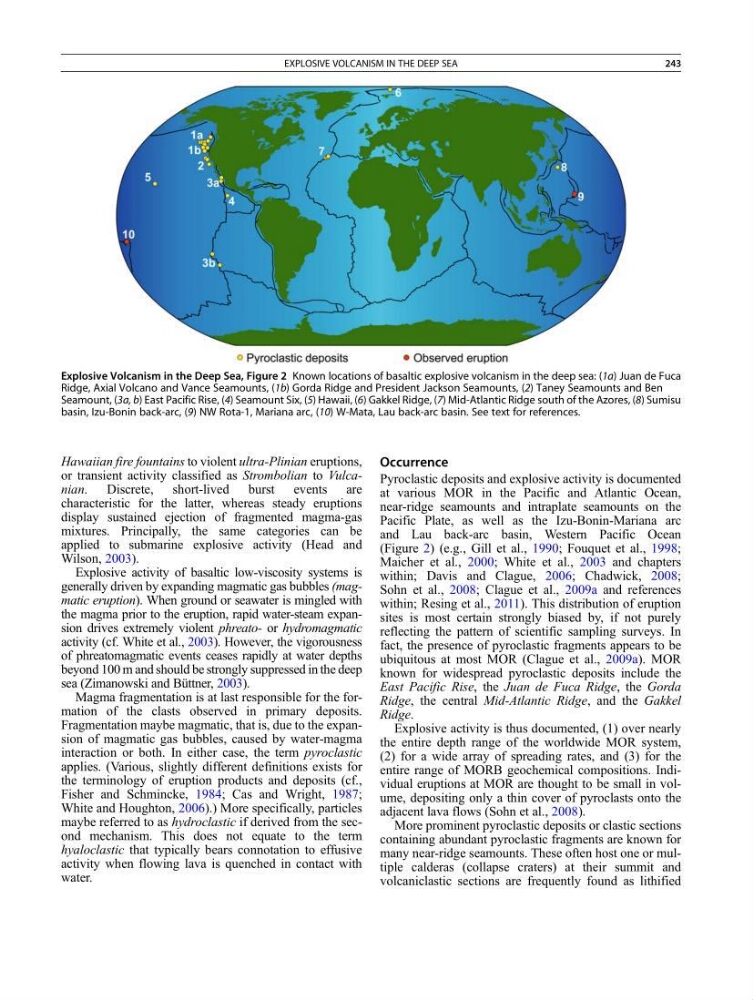
Explosive Volcanism in the Deep Sea, Figure 2 Known locations of basaltic explosive volcanism in the deep sea: (1a) Juan de Fuca
Ridge, Axial Volcano and Vance Seamounts, (1b) Gorda Ridge and President Jackson Seamounts, (2) Taney Seamounts and Ben
Seamount, (3a, b) East Pacific Rise, (4) Seamount Six, (5) Hawaii, (6) Gakkel Ridge, (7) Mid-Atlantic Ridge south of the Azores, (8) Sumisu
basin, Izu-Bonin back-arc, (9) NW Rota-1, Mariana arc, (10) W-Mata, Lau back-arc basin. See text for references.
EXPLOSIVE VOLCANISM IN THE DEEP SEA
243
or transient activity classified as Strombolian to Vulcanian. Discrete, short-lived burst events are
characteristic for the latter, whereas steady eruptions
display sustained ejection of fragmented magma-gas
mixtures. Principally, the same categories can be
applied to submarine explosive activity (Head and
Wilson, 2003).
Explosive activity of basaltic low-viscosity systems is
generally driven by expanding magmatic gas bubbles (magmatic eruption). When ground or seawater is mingled with
the magma prior to the eruption, rapid water-steam expansion drives extremely violent phreato- or hydromagmatic
activity (cf. White et al., 2003). However, the vigorousness
of phreatomagmatic events ceases rapidly at water depths
beyond 100 m and should be strongly suppressed in the deep
sea (Zimanowski and Büttner, 2003).
Magma fragmentation is at last responsible for the formation of the clasts observed in primary deposits.
Fragmentation maybe magmatic, that is, due to the expansion of magmatic gas bubbles, caused by water-magma
interaction or both. In either case, the term pyroclastic
applies. (Various, slightly different definitions exists for
the terminology of eruption products and deposits (cf.,
Fisher and Schmincke, 1984; Cas and Wright, 1987;
White and Houghton, 2006).) More specifically, particles
maybe referred to as hydroclastic if derived from the second mechanism. This does not equate to the term
hyaloclastic that typically bears connotation to effusive
activity when flowing lava is quenched in contact with
water.
Occurrence
Pyroclastic deposits and explosive activity is documented
at various MOR in the Pacific and Atlantic Ocean,
near-ridge seamounts and intraplate seamounts on the
Pacific Plate, as well as the Izu-Bonin-Mariana arc
and Lau back-arc basin, Western Pacific Ocean
(Figure 2) (e.g., Gill et al., 1990; Fouquet et al., 1998;
Maicher et al., 2000; White et al., 2003 and chapters
within; Davis and Clague, 2006; Chadwick, 2008;
Sohn et al., 2008; Clague et al., 2009a and references
within; Resing et al., 2011). This distribution of eruption
sites is most certain strongly biased by, if not purely
reflecting the pattern of scientific sampling surveys. In
fact, the presence of pyroclastic fragments appears to be
ubiquitous at most MOR (Clague et al., 2009a). MOR
known for widespread pyroclastic deposits include the
East Pacific Rise, the Juan de Fuca Ridge, the Gorda
Ridge, the central Mid-Atlantic Ridge, and the Gakkel
Ridge.
Explosive activity is thus documented, (1) over nearly
the entire depth range of the worldwide MOR system,
(2) for a wide array of spreading rates, and (3) for the
entire range of MORB geochemical compositions. Individual eruptions at MOR are thought to be small in volume, depositing only a thin cover of pyroclasts onto the
adjacent lava flows (Sohn et al., 2008).
More prominent pyroclastic deposits or clastic sections
containing abundant pyroclastic fragments are known for
many near-ridge seamounts. These often host one or multiple calderas (collapse craters) at their summit and
volcaniclastic sections are frequently found as lithified
Explosive Volcanism in the Deep Sea, Figure 2 Known locations of basaltic explosive volcanism in the deep sea: (1a) Juan de Fuca
Ridge, Axial Volcano and Vance Seamounts, (1b) Gorda Ridge and President Jackson Seamounts, (2) Taney Seamounts and Ben
Seamount, (3a, b) East Pacific Rise, (4) Seamount Six, (5) Hawaii, (6) Gakkel Ridge, (7) Mid-Atlantic Ridge south of the Azores, (8) Sumisu
basin, Izu-Bonin back-arc, (9) NW Rota-1, Mariana arc, (10) W-Mata, Lau back-arc basin. See text for references.
EXPLOSIVE VOLCANISM IN THE DEEP SEA
243