

Pyroclast
Rock or glass fragment expelled from
volcanic vent during the eruption.
Volcaniclast
Nongenetic term for any fragment of
volcanic origin.
Magma
Multiphase system containing silicate
melt Æ crystals Æ bubbles.
Melt, silicate Liquid phase of a molten rock.
Volatile
Chemical compound of the melt that can
form a free gas phase (mostly water,
carbon dioxide, and sulfur, minor
chlorine and fluorine).
Solubility
Maximum concentration of a volatile
phase dissolvable in the melt; decreases
strongly with declining pressure.
Exsolution
Formation of a free magmatic gas phase
(commonly as bubbles), as the volatile
concentration exceeds solubility.
Introduction
Within the past decades, it has been realized that volcanoes in the deep sea (i.e., water depths in excess of a few
hundreds of meter) compare in their general spectrum of
eruption styles to those on land and explosive activity is
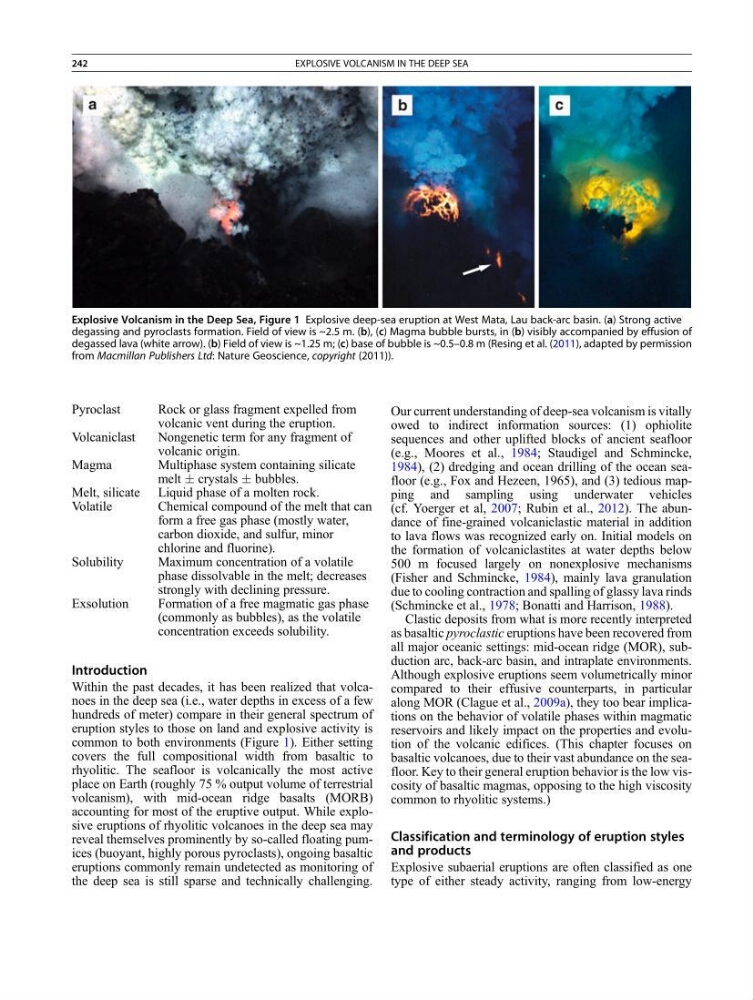
common to both environments (Figure 1). Either setting
covers the full compositional width from basaltic to
rhyolitic. The seafloor is volcanically the most active
place on Earth (roughly 75 % output volume of terrestrial
volcanism), with mid-ocean ridge basalts (MORB)
accounting for most of the eruptive output. While explosive eruptions of rhyolitic volcanoes in the deep sea may
reveal themselves prominently by so-called floating pumices (buoyant, highly porous pyroclasts), ongoing basaltic
eruptions commonly remain undetected as monitoring of
the deep sea is still sparse and technically challenging.
Our current understanding of deep-sea volcanism is vitally
owed to indirect information sources: (1) ophiolite
sequences and other uplifted blocks of ancient seafloor
(e.g., Moores et al., 1984; Staudigel and Schmincke,
1984), (2) dredging and ocean drilling of the ocean seafloor (e.g., Fox and Hezeen, 1965), and (3) tedious mapping and sampling using underwater vehicles
(cf. Yoerger et al, 2007; Rubin et al., 2012). The abundance of fine-grained volcaniclastic material in addition
to lava flows was recognized early on. Initial models on
the formation of volcaniclastites at water depths below
500 m focused largely on nonexplosive mechanisms
(Fisher and Schmincke, 1984), mainly lava granulation
due to cooling contraction and spalling of glassy lava rinds
(Schmincke et al., 1978; Bonatti and Harrison, 1988).
Clastic deposits from what is more recently interpreted
as basaltic pyroclastic eruptions have been recovered from
all major oceanic settings: mid-ocean ridge (MOR), subduction arc, back-arc basin, and intraplate environments.
Although explosive eruptions seem volumetrically minor
compared to their effusive counterparts, in particular
along MOR (Clague et al., 2009a), they too bear implications on the behavior of volatile phases within magmatic
reservoirs and likely impact on the properties and evolution of the volcanic edifices. (This chapter focuses on
basaltic volcanoes, due to their vast abundance on the seafloor. Key to their general eruption behavior is the low viscosity of basaltic magmas, opposing to the high viscosity
common to rhyolitic systems.)
Classification and terminology of eruption styles
and products
Explosive subaerial eruptions are often classified as one
type of either steady activity, ranging from low-energy
Explosive Volcanism in the Deep Sea, Figure 1 Explosive deep-sea eruption at West Mata, Lau back-arc basin. (a) Strong active
degassing and pyroclasts formation. Field of view is ~2.5 m. (b), (c) Magma bubble bursts, in (b) visibly accompanied by effusion of
degassed lava (white arrow). (b) Field of view is ~1.25 m; (c) base of bubble is ~0.5–0.8 m (Resing et al. (2011), adapted by permission
from Macmillan Publishers Ltd: Nature Geoscience, copyright (2011)).
242
EXPLOSIVE VOLCANISM IN THE DEEP SEA
Rock or glass fragment expelled from
volcanic vent during the eruption.
Volcaniclast
Nongenetic term for any fragment of
volcanic origin.
Magma
Multiphase system containing silicate
melt Æ crystals Æ bubbles.
Melt, silicate Liquid phase of a molten rock.
Volatile
Chemical compound of the melt that can
form a free gas phase (mostly water,
carbon dioxide, and sulfur, minor
chlorine and fluorine).
Solubility
Maximum concentration of a volatile
phase dissolvable in the melt; decreases
strongly with declining pressure.
Exsolution
Formation of a free magmatic gas phase
(commonly as bubbles), as the volatile
concentration exceeds solubility.
Introduction
Within the past decades, it has been realized that volcanoes in the deep sea (i.e., water depths in excess of a few
hundreds of meter) compare in their general spectrum of
eruption styles to those on land and explosive activity is
common to both environments (Figure 1). Either setting
covers the full compositional width from basaltic to
rhyolitic. The seafloor is volcanically the most active
place on Earth (roughly 75 % output volume of terrestrial
volcanism), with mid-ocean ridge basalts (MORB)
accounting for most of the eruptive output. While explosive eruptions of rhyolitic volcanoes in the deep sea may
reveal themselves prominently by so-called floating pumices (buoyant, highly porous pyroclasts), ongoing basaltic
eruptions commonly remain undetected as monitoring of
the deep sea is still sparse and technically challenging.
Our current understanding of deep-sea volcanism is vitally
owed to indirect information sources: (1) ophiolite
sequences and other uplifted blocks of ancient seafloor
(e.g., Moores et al., 1984; Staudigel and Schmincke,
1984), (2) dredging and ocean drilling of the ocean seafloor (e.g., Fox and Hezeen, 1965), and (3) tedious mapping and sampling using underwater vehicles
(cf. Yoerger et al, 2007; Rubin et al., 2012). The abundance of fine-grained volcaniclastic material in addition
to lava flows was recognized early on. Initial models on
the formation of volcaniclastites at water depths below
500 m focused largely on nonexplosive mechanisms
(Fisher and Schmincke, 1984), mainly lava granulation
due to cooling contraction and spalling of glassy lava rinds
(Schmincke et al., 1978; Bonatti and Harrison, 1988).
Clastic deposits from what is more recently interpreted
as basaltic pyroclastic eruptions have been recovered from
all major oceanic settings: mid-ocean ridge (MOR), subduction arc, back-arc basin, and intraplate environments.
Although explosive eruptions seem volumetrically minor
compared to their effusive counterparts, in particular
along MOR (Clague et al., 2009a), they too bear implications on the behavior of volatile phases within magmatic
reservoirs and likely impact on the properties and evolution of the volcanic edifices. (This chapter focuses on
basaltic volcanoes, due to their vast abundance on the seafloor. Key to their general eruption behavior is the low viscosity of basaltic magmas, opposing to the high viscosity
common to rhyolitic systems.)
Classification and terminology of eruption styles
and products
Explosive subaerial eruptions are often classified as one
type of either steady activity, ranging from low-energy
Explosive Volcanism in the Deep Sea, Figure 1 Explosive deep-sea eruption at West Mata, Lau back-arc basin. (a) Strong active
degassing and pyroclasts formation. Field of view is ~2.5 m. (b), (c) Magma bubble bursts, in (b) visibly accompanied by effusion of
degassed lava (white arrow). (b) Field of view is ~1.25 m; (c) base of bubble is ~0.5–0.8 m (Resing et al. (2011), adapted by permission
from Macmillan Publishers Ltd: Nature Geoscience, copyright (2011)).
242
EXPLOSIVE VOLCANISM IN THE DEEP SEA