

units exposed within the caldera wall. Well-studied examples include the Vance Seamount chain, west of the
Juan de Fuca ridge; the President Jackson
Seamounts, west of the Gorda ridge; or Seamount Six,
east to the Northern East Pacific Rise. The intraplate
seamount Loihi, Hawaii, exhibits unconsolidated
volcaniclastic sequences of several meters thickness,
derived from Strombolian and Hawaiian activity
(Clague et al., 2003a; Schipper et al., 2010). For wide
parts of the deposits, the accumulation was found to be
fairly rapid at an average rate of 0.37 cm/year (Clague,
2009).
Along the subduction zone of the Western Pacific Plate,
submarine explosive activity is known for the Izu-BoninMariana arc and the Lau back-arc basin. Explosive submarine activity in this setting has been recognized as early as
1990 (Gill et al., 1990) and directly observed at NW Rota1, Mariana arc (Chadwick, 2008), and West Mata, Lau
Basin (Resing et al., 2011) – the first deep-sea eruptions
ever to be witnessed by eye. Detailed mapping of the morphology and structure of the volcanic terrain and deposits
in the Lau back-arc basin suggests pyroclastic eruptions to
be a prevalent phenomenon in this environment rather
than the exception.
Eruption products
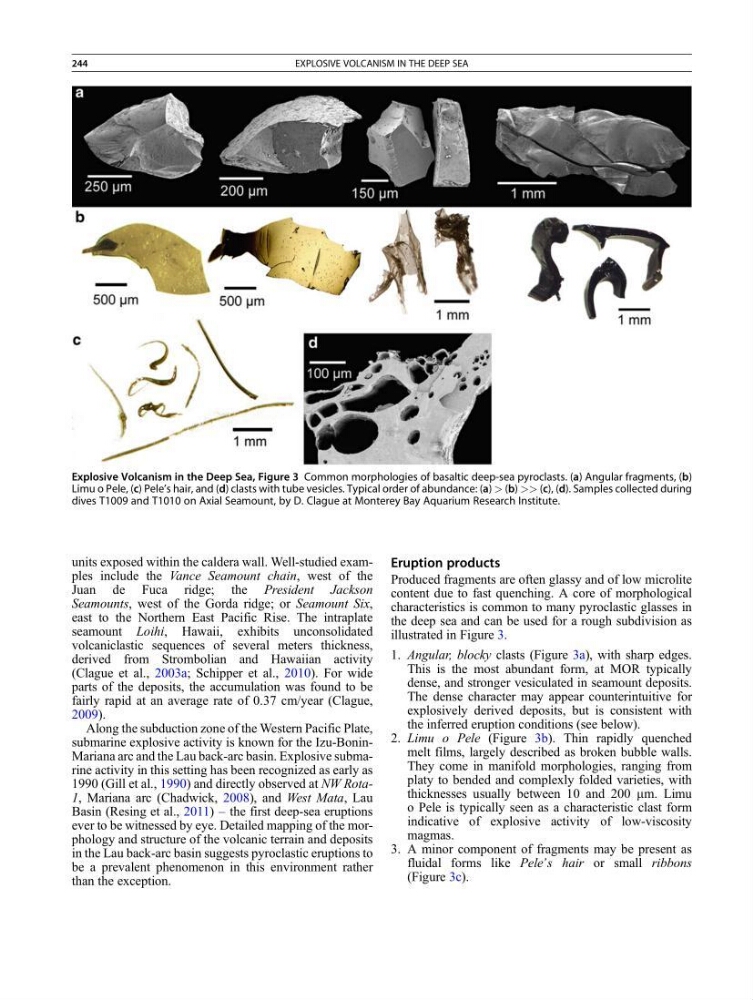
Produced fragments are often glassy and of low microlite
content due to fast quenching. A core of morphological
characteristics is common to many pyroclastic glasses in
the deep sea and can be used for a rough subdivision as
illustrated in Figure 3.
1. Angular, blocky clasts (Figure 3a), with sharp edges.
This is the most abundant form, at MOR typically
dense, and stronger vesiculated in seamount deposits.
The dense character may appear counterintuitive for
explosively derived deposits, but is consistent with
the inferred eruption conditions (see below).
2. Limu o Pele (Figure 3b). Thin rapidly quenched
melt films, largely described as broken bubble walls.
They come in manifold morphologies, ranging from
platy to bended and complexly folded varieties, with
thicknesses usually between 10 and 200 mm. Limu
o Pele is typically seen as a characteristic clast form
indicative of explosive activity of low-viscosity
magmas.
3. A minor component of fragments may be present as
fluidal forms like Pele’s hair or small ribbons
(Figure 3c).
Explosive Volcanism in the Deep Sea, Figure 3 Common morphologies of basaltic deep-sea pyroclasts. (a) Angular fragments, (b)
Limu o Pele, (c) Pele’s hair, and (d) clasts with tube vesicles. Typical order of abundance: (a) > (b) >> (c), (d). Samples collected during
dives T1009 and T1010 on Axial Seamount, by D. Clague at Monterey Bay Aquarium Research Institute.
244
EXPLOSIVE VOLCANISM IN THE DEEP SEA
Juan de Fuca ridge; the President Jackson
Seamounts, west of the Gorda ridge; or Seamount Six,
east to the Northern East Pacific Rise. The intraplate
seamount Loihi, Hawaii, exhibits unconsolidated
volcaniclastic sequences of several meters thickness,
derived from Strombolian and Hawaiian activity
(Clague et al., 2003a; Schipper et al., 2010). For wide
parts of the deposits, the accumulation was found to be
fairly rapid at an average rate of 0.37 cm/year (Clague,
2009).
Along the subduction zone of the Western Pacific Plate,
submarine explosive activity is known for the Izu-BoninMariana arc and the Lau back-arc basin. Explosive submarine activity in this setting has been recognized as early as
1990 (Gill et al., 1990) and directly observed at NW Rota1, Mariana arc (Chadwick, 2008), and West Mata, Lau
Basin (Resing et al., 2011) – the first deep-sea eruptions
ever to be witnessed by eye. Detailed mapping of the morphology and structure of the volcanic terrain and deposits
in the Lau back-arc basin suggests pyroclastic eruptions to
be a prevalent phenomenon in this environment rather
than the exception.
Eruption products
Produced fragments are often glassy and of low microlite
content due to fast quenching. A core of morphological
characteristics is common to many pyroclastic glasses in
the deep sea and can be used for a rough subdivision as
illustrated in Figure 3.
1. Angular, blocky clasts (Figure 3a), with sharp edges.
This is the most abundant form, at MOR typically
dense, and stronger vesiculated in seamount deposits.
The dense character may appear counterintuitive for
explosively derived deposits, but is consistent with
the inferred eruption conditions (see below).
2. Limu o Pele (Figure 3b). Thin rapidly quenched
melt films, largely described as broken bubble walls.
They come in manifold morphologies, ranging from
platy to bended and complexly folded varieties, with
thicknesses usually between 10 and 200 mm. Limu
o Pele is typically seen as a characteristic clast form
indicative of explosive activity of low-viscosity
magmas.
3. A minor component of fragments may be present as
fluidal forms like Pele’s hair or small ribbons
(Figure 3c).
Explosive Volcanism in the Deep Sea, Figure 3 Common morphologies of basaltic deep-sea pyroclasts. (a) Angular fragments, (b)
Limu o Pele, (c) Pele’s hair, and (d) clasts with tube vesicles. Typical order of abundance: (a) > (b) >> (c), (d). Samples collected during
dives T1009 and T1010 on Axial Seamount, by D. Clague at Monterey Bay Aquarium Research Institute.
244
EXPLOSIVE VOLCANISM IN THE DEEP SEA