

Continental shelf margin deltas
Continental shelf margin deltas are typically most well
developed during sea-level lowstands or formed by rivers
with large sediment loads during prolonged sea-level
stillstands. The majority of shelf margin deltas in the
recent geologic record have developed during falling
sea-level or sea-level lowstand conditions as river valleys
lengthen, incise across subaerially exposed continental
shelf sediments, and discharge their sedimentary load at
the shelf margin (Suter, 1994). With sufficient sediment
load or during lowstand conditions, these deltas continue
to build seaward, creating an apron of deltaic sediment
along the shelf edge that extends the preexisting continental margin into deeper basinal waters. Numerous lowstand
shelf margin deltas, as listed above, formed during the
Late Pleistocene sea-level fall and lowstand culminating
at approximately 18,000 year BP. Some specific examples
include those found seaward of the Rio Grande and the
Mississippi River deltas (Morton and Price, 1987; Suter
et al., 1987; Suter, 1994). Sufficiently large rivers carrying
substantial sediment loads may also construct shelf margin delta deposits during sea-level highstand conditions.
The main stem of the modern Mississippi River delta
represented by the “bird-foot” delta is an example of a
shelf margin highstand delta (Boyd et al., 1989).
Delta components
The delta plain contains a subaerial and subaqueous zone
where sediments are discharged from the alluvial valley
and accumulate in the receiving basin (Figure 5).
Typically, a delta plain is subdivided into an upper delta
plain and a lower delta plain, each of which is characterized by different vegetation, morphology, and depositional processes (Reineck and Singh, 1973; Coleman,
1981; Elliot, 1986).
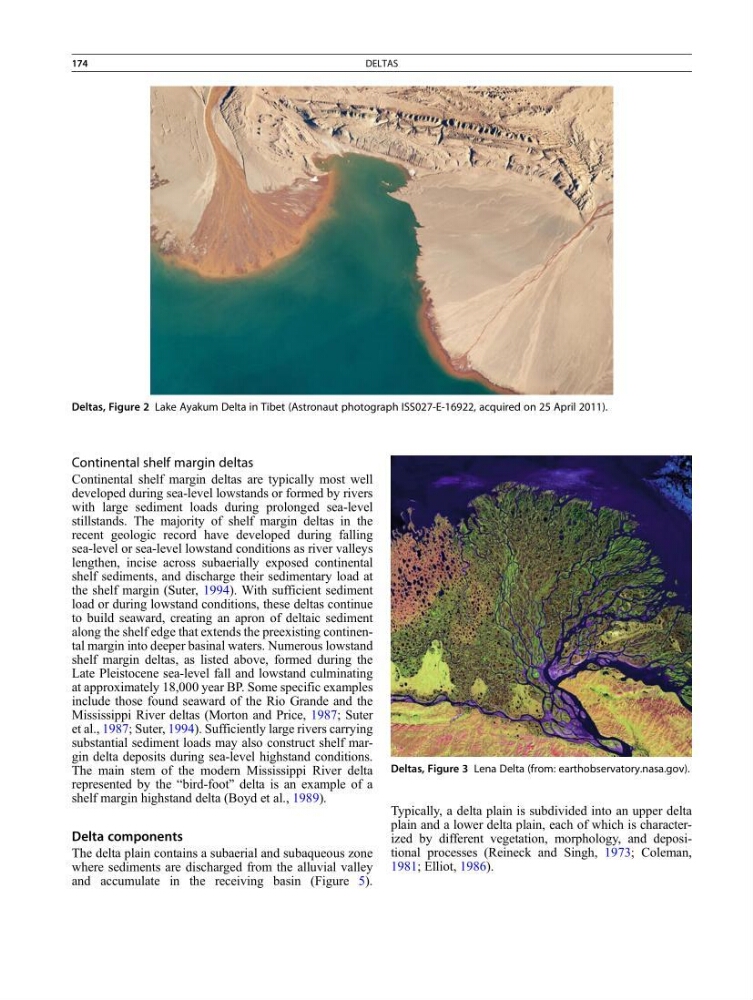
Deltas, Figure 2 Lake Ayakum Delta in Tibet (Astronaut photograph ISS027-E-16922, acquired on 25 April 2011).
Deltas, Figure 3 Lena Delta (from: earthobservatory.nasa.gov).
174
DELTAS
Continental shelf margin deltas are typically most well
developed during sea-level lowstands or formed by rivers
with large sediment loads during prolonged sea-level
stillstands. The majority of shelf margin deltas in the
recent geologic record have developed during falling
sea-level or sea-level lowstand conditions as river valleys
lengthen, incise across subaerially exposed continental
shelf sediments, and discharge their sedimentary load at
the shelf margin (Suter, 1994). With sufficient sediment
load or during lowstand conditions, these deltas continue
to build seaward, creating an apron of deltaic sediment
along the shelf edge that extends the preexisting continental margin into deeper basinal waters. Numerous lowstand
shelf margin deltas, as listed above, formed during the
Late Pleistocene sea-level fall and lowstand culminating
at approximately 18,000 year BP. Some specific examples
include those found seaward of the Rio Grande and the
Mississippi River deltas (Morton and Price, 1987; Suter
et al., 1987; Suter, 1994). Sufficiently large rivers carrying
substantial sediment loads may also construct shelf margin delta deposits during sea-level highstand conditions.
The main stem of the modern Mississippi River delta
represented by the “bird-foot” delta is an example of a
shelf margin highstand delta (Boyd et al., 1989).
Delta components
The delta plain contains a subaerial and subaqueous zone
where sediments are discharged from the alluvial valley
and accumulate in the receiving basin (Figure 5).
Typically, a delta plain is subdivided into an upper delta
plain and a lower delta plain, each of which is characterized by different vegetation, morphology, and depositional processes (Reineck and Singh, 1973; Coleman,
1981; Elliot, 1986).
Deltas, Figure 2 Lake Ayakum Delta in Tibet (Astronaut photograph ISS027-E-16922, acquired on 25 April 2011).
Deltas, Figure 3 Lena Delta (from: earthobservatory.nasa.gov).
174
DELTAS