

environmental conditions. Equations can be made to relate
the amount of each assemblage from a past time to the
environmental conditions at that time. The assemblage
techniques can be used to assess past ocean temperatures,
e.g., CLIMAP project members (1976).
Pelagic sediments rich in biogenic components can be
mapped by their opal and carbonate content (Figure 7;
Archer, 1996, Leinen et al., 1986). CaCO 3 is prominent in
the Atlantic Ocean, because the ocean chemistry in the
basin leads to better preservation (section “Seafloor Processes Affecting Deep-Sea Sediment Composition: Dissolution, Early Diagenesis, and Sediment Movement”).
In the Pacific Ocean, biogenic sediments are primarily
found in the south Pacific because the crust is shallower
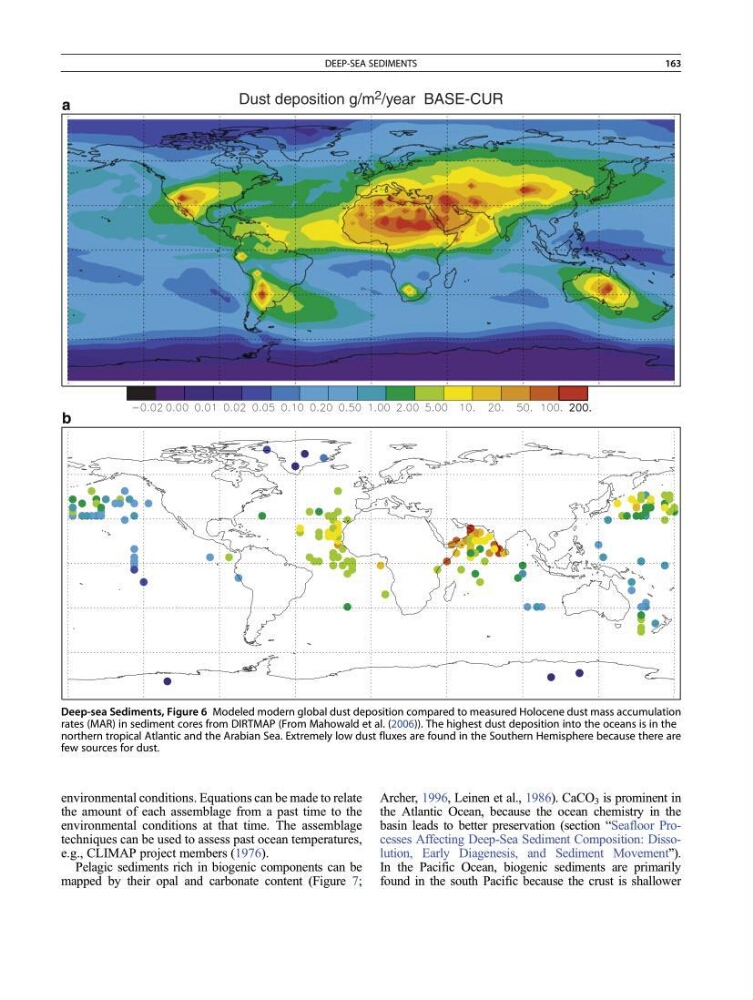
Dust deposition g/m 2 /year BASE-CUR
a
b
Deep-sea Sediments, Figure 6 Modeled modern global dust deposition compared to measured Holocene dust mass accumulation
rates (MAR) in sediment cores from DIRTMAP (From Mahowald et al. (2006)). The highest dust deposition into the oceans is in the
northern tropical Atlantic and the Arabian Sea. Extremely low dust fluxes are found in the Southern Hemisphere because there are
few sources for dust.
DEEP-SEA SEDIMENTS
163
the amount of each assemblage from a past time to the
environmental conditions at that time. The assemblage
techniques can be used to assess past ocean temperatures,
e.g., CLIMAP project members (1976).
Pelagic sediments rich in biogenic components can be
mapped by their opal and carbonate content (Figure 7;
Archer, 1996, Leinen et al., 1986). CaCO 3 is prominent in
the Atlantic Ocean, because the ocean chemistry in the
basin leads to better preservation (section “Seafloor Processes Affecting Deep-Sea Sediment Composition: Dissolution, Early Diagenesis, and Sediment Movement”).
In the Pacific Ocean, biogenic sediments are primarily
found in the south Pacific because the crust is shallower
Dust deposition g/m 2 /year BASE-CUR
a
b
Deep-sea Sediments, Figure 6 Modeled modern global dust deposition compared to measured Holocene dust mass accumulation
rates (MAR) in sediment cores from DIRTMAP (From Mahowald et al. (2006)). The highest dust deposition into the oceans is in the
northern tropical Atlantic and the Arabian Sea. Extremely low dust fluxes are found in the Southern Hemisphere because there are
few sources for dust.
DEEP-SEA SEDIMENTS
163