

found (Rea et al., 2006). Typically, dust fluxes into the
Southern Hemisphere oceans are 1–2 orders of magnitude
lower than those in the North Pacific (Rea, 1994). In the
Southern Hemisphere, there are only two major dust
sources, one in South America and one in Australia
(Figure 6). In contrast, there are extensive northern arid
regions, including northern Africa, Asia, and North
America.
Volcanic ash is also a significant air-transported sediment component that can be found a surprisingly long distance from explosive volcanoes (Scheidegger et al., 1980;
Olivarez et al., 1991). It also can be a significant source of
Fe to the oceans (Duggen et al., 2010). Volcanic ash is
most often recognized as discrete coarse layers of volcanic
glass (e.g., Drexler et al., 1980), but dispersed ash can also
be found using its distinctive chemical composition
(Finney et al., 1988; Olivarez et al., 1991).
Biogenic sediment components
Biogenic sediments are primarily composed of mineralized hard parts produced by a variety of marine organisms.
They also include organic remains (the C org fraction) and
elements like Ba that precipitate within C org -rich particle
rain as it falls from the euphotic zone to the seafloor
(Griffith and Paytan, 2012). In shallow water, corals and
calcareous algae are major producers of biogenic sediments, but in the pelagic realm, the production of mineral
tests by protist plankton is the major source of this deepsea sediment component (Kennett, 1982). Production by
plankton is often large enough to produce sediment accumulations that are essentially pure biogenic tests (Berger,
1973; Burckle and Cirilli, 1987; Lyle et al., 2010).
Biogenic sediments are divided into siliceous and calcareous oozes based on the composition of the plankton
test. Tests are made of either biogenic SiO 2 (biogenic opal
or biogenic silica) or biogenic CaCO 3 (biogenic carbonate). Both phytoplankton and zooplankton contribute to
biogenic sediment production (Lipps, 1993). Singlecelled photosynthetic algae are a major source of both biogenic silica (diatoms, with a minor contribution by
silicoflagellates)
and
biogenic
carbonate
(coccolithophorids). The larger zooplankton tests are also
significant fractions of biogenic sediment: foraminifera
produce sand-sized tests of biogenic carbonate, whereas
radiolaria produce silt- to fine-sand-sized tests of biogenic
silica.
Biogenic carbonates are commonly used for paleoceanographic reconstructions because the tests of foraminifera are large enough to be easily separated from
sediments for analysis. The chemistry of the test gives
quantitative data about the environmental conditions at
the time they were formed (e.g., Dekens et al., 2007).
The preserved microfossil assemblages (census of different species preserved in a layer) can also be used to infer
environmental conditions (e.g., Le and Shackleton,
1994) because plankton species live within characteristic
Common Mid-Point location
51940
54770
57600
60430
1420z
1811z
2203z
0202z
3
4
5
6
Seconds
Hemipelagic
Sediments
Cascadia Abyssal
Plain
Turbidites
Gorda
Ridge
Axis
Portland
San
Francisco
Gorda
Ridge
23-km scale
Time along trackline
1994-Oct 1
1994-Sep 30
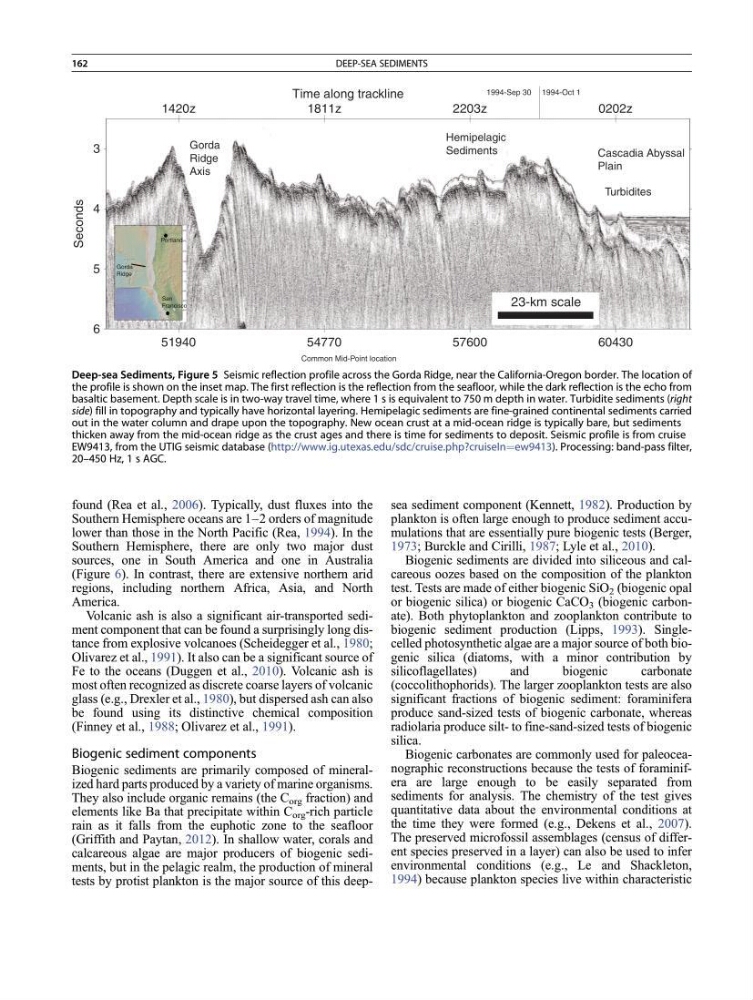
Deep-sea Sediments, Figure 5 Seismic reflection profile across the Gorda Ridge, near the California-Oregon border. The location of
the profile is shown on the inset map. The first reflection is the reflection from the seafloor, while the dark reflection is the echo from
basaltic basement. Depth scale is in two-way travel time, where 1 s is equivalent to 750 m depth in water. Turbidite sediments (right
side) fill in topography and typically have horizontal layering. Hemipelagic sediments are fine-grained continental sediments carried
out in the water column and drape upon the topography. New ocean crust at a mid-ocean ridge is typically bare, but sediments
thicken away from the mid-ocean ridge as the crust ages and there is time for sediments to deposit. Seismic profile is from cruise
EW9413, from the UTIG seismic database (http://www.ig.utexas.edu/sdc/cruise.php?cruiseIn¼ew9413). Processing: band-pass filter,
20–450 Hz, 1 s AGC.
162
DEEP-SEA SEDIMENTS
Southern Hemisphere oceans are 1–2 orders of magnitude
lower than those in the North Pacific (Rea, 1994). In the
Southern Hemisphere, there are only two major dust
sources, one in South America and one in Australia
(Figure 6). In contrast, there are extensive northern arid
regions, including northern Africa, Asia, and North
America.
Volcanic ash is also a significant air-transported sediment component that can be found a surprisingly long distance from explosive volcanoes (Scheidegger et al., 1980;
Olivarez et al., 1991). It also can be a significant source of
Fe to the oceans (Duggen et al., 2010). Volcanic ash is
most often recognized as discrete coarse layers of volcanic
glass (e.g., Drexler et al., 1980), but dispersed ash can also
be found using its distinctive chemical composition
(Finney et al., 1988; Olivarez et al., 1991).
Biogenic sediment components
Biogenic sediments are primarily composed of mineralized hard parts produced by a variety of marine organisms.
They also include organic remains (the C org fraction) and
elements like Ba that precipitate within C org -rich particle
rain as it falls from the euphotic zone to the seafloor
(Griffith and Paytan, 2012). In shallow water, corals and
calcareous algae are major producers of biogenic sediments, but in the pelagic realm, the production of mineral
tests by protist plankton is the major source of this deepsea sediment component (Kennett, 1982). Production by
plankton is often large enough to produce sediment accumulations that are essentially pure biogenic tests (Berger,
1973; Burckle and Cirilli, 1987; Lyle et al., 2010).
Biogenic sediments are divided into siliceous and calcareous oozes based on the composition of the plankton
test. Tests are made of either biogenic SiO 2 (biogenic opal
or biogenic silica) or biogenic CaCO 3 (biogenic carbonate). Both phytoplankton and zooplankton contribute to
biogenic sediment production (Lipps, 1993). Singlecelled photosynthetic algae are a major source of both biogenic silica (diatoms, with a minor contribution by
silicoflagellates)
and
biogenic
carbonate
(coccolithophorids). The larger zooplankton tests are also
significant fractions of biogenic sediment: foraminifera
produce sand-sized tests of biogenic carbonate, whereas
radiolaria produce silt- to fine-sand-sized tests of biogenic
silica.
Biogenic carbonates are commonly used for paleoceanographic reconstructions because the tests of foraminifera are large enough to be easily separated from
sediments for analysis. The chemistry of the test gives
quantitative data about the environmental conditions at
the time they were formed (e.g., Dekens et al., 2007).
The preserved microfossil assemblages (census of different species preserved in a layer) can also be used to infer
environmental conditions (e.g., Le and Shackleton,
1994) because plankton species live within characteristic
Common Mid-Point location
51940
54770
57600
60430
1420z
1811z
2203z
0202z
3
4
5
6
Seconds
Hemipelagic
Sediments
Cascadia Abyssal
Plain
Turbidites
Gorda
Ridge
Axis
Portland
San
Francisco
Gorda
Ridge
23-km scale
Time along trackline
1994-Oct 1
1994-Sep 30
Deep-sea Sediments, Figure 5 Seismic reflection profile across the Gorda Ridge, near the California-Oregon border. The location of
the profile is shown on the inset map. The first reflection is the reflection from the seafloor, while the dark reflection is the echo from
basaltic basement. Depth scale is in two-way travel time, where 1 s is equivalent to 750 m depth in water. Turbidite sediments (right
side) fill in topography and typically have horizontal layering. Hemipelagic sediments are fine-grained continental sediments carried
out in the water column and drape upon the topography. New ocean crust at a mid-ocean ridge is typically bare, but sediments
thicken away from the mid-ocean ridge as the crust ages and there is time for sediments to deposit. Seismic profile is from cruise
EW9413, from the UTIG seismic database (http://www.ig.utexas.edu/sdc/cruise.php?cruiseIn¼ew9413). Processing: band-pass filter,
20–450 Hz, 1 s AGC.
162
DEEP-SEA SEDIMENTS