

Sediment composition can be used to track average current flow along the continental margins and how sediments move from the rivers to the deep sea. Krissek
(1984), for example, estimated that 50–90 % of the river
sediment flux to the Oregon/northern California margin
escaped to deposit in the deep sea.
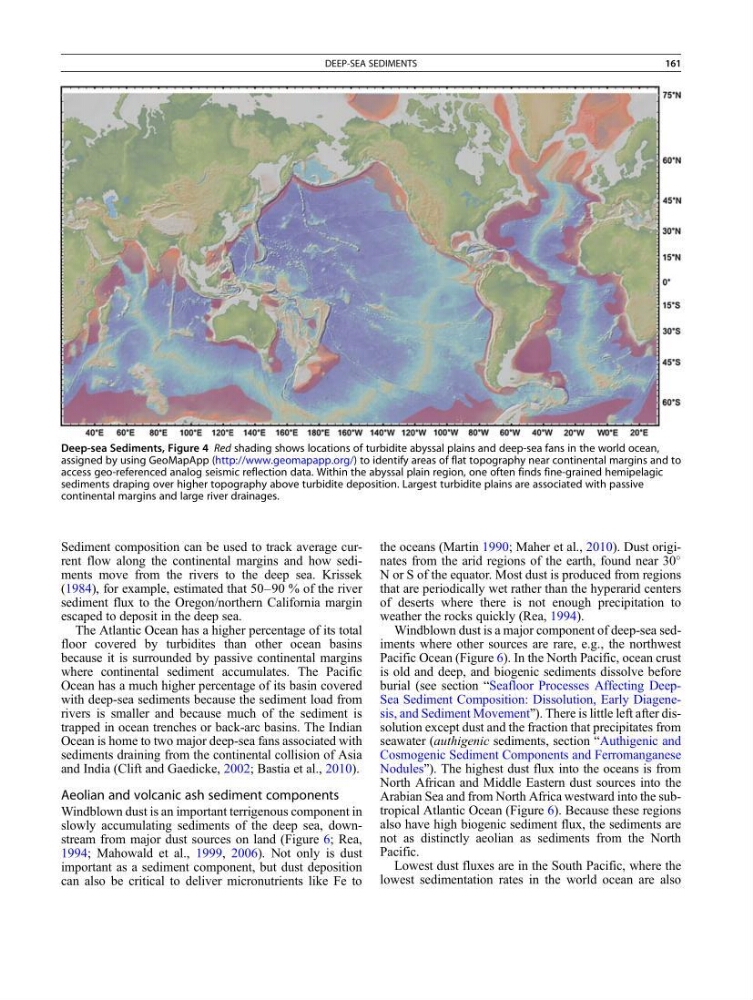
The Atlantic Ocean has a higher percentage of its total
floor covered by turbidites than other ocean basins
because it is surrounded by passive continental margins
where continental sediment accumulates. The Pacific
Ocean has a much higher percentage of its basin covered
with deep-sea sediments because the sediment load from
rivers is smaller and because much of the sediment is
trapped in ocean trenches or back-arc basins. The Indian
Ocean is home to two major deep-sea fans associated with
sediments draining from the continental collision of Asia
and India (Clift and Gaedicke, 2002; Bastia et al., 2010).
Aeolian and volcanic ash sediment components
Windblown dust is an important terrigenous component in
slowly accumulating sediments of the deep sea, downstream from major dust sources on land (Figure 6; Rea,
1994; Mahowald et al., 1999, 2006). Not only is dust
important as a sediment component, but dust deposition
can also be critical to deliver micronutrients like Fe to
the oceans (Martin 1990; Maher et al., 2010). Dust originates from the arid regions of the earth, found near 30
N or S of the equator. Most dust is produced from regions
that are periodically wet rather than the hyperarid centers
of deserts where there is not enough precipitation to
weather the rocks quickly (Rea, 1994).
Windblown dust is a major component of deep-sea sediments where other sources are rare, e.g., the northwest
Pacific Ocean (Figure 6). In the North Pacific, ocean crust
is old and deep, and biogenic sediments dissolve before
burial (see section “Seafloor Processes Affecting DeepSea Sediment Composition: Dissolution, Early Diagenesis, and Sediment Movement”). There is little left after dissolution except dust and the fraction that precipitates from
seawater (authigenic sediments, section “Authigenic and
Cosmogenic Sediment Components and Ferromanganese
Nodules”). The highest dust flux into the oceans is from
North African and Middle Eastern dust sources into the
Arabian Sea and from North Africa westward into the subtropical Atlantic Ocean (Figure 6). Because these regions
also have high biogenic sediment flux, the sediments are
not as distinctly aeolian as sediments from the North
Pacific.
Lowest dust fluxes are in the South Pacific, where the
lowest sedimentation rates in the world ocean are also
Deep-sea Sediments, Figure 4 Red shading shows locations of turbidite abyssal plains and deep-sea fans in the world ocean,
assigned by using GeoMapApp (http://www.geomapapp.org/) to identify areas of flat topography near continental margins and to
access geo-referenced analog seismic reflection data. Within the abyssal plain region, one often finds fine-grained hemipelagic
sediments draping over higher topography above turbidite deposition. Largest turbidite plains are associated with passive
continental margins and large river drainages.
DEEP-SEA SEDIMENTS
161
(1984), for example, estimated that 50–90 % of the river
sediment flux to the Oregon/northern California margin
escaped to deposit in the deep sea.
The Atlantic Ocean has a higher percentage of its total
floor covered by turbidites than other ocean basins
because it is surrounded by passive continental margins
where continental sediment accumulates. The Pacific
Ocean has a much higher percentage of its basin covered
with deep-sea sediments because the sediment load from
rivers is smaller and because much of the sediment is
trapped in ocean trenches or back-arc basins. The Indian
Ocean is home to two major deep-sea fans associated with
sediments draining from the continental collision of Asia
and India (Clift and Gaedicke, 2002; Bastia et al., 2010).
Aeolian and volcanic ash sediment components
Windblown dust is an important terrigenous component in
slowly accumulating sediments of the deep sea, downstream from major dust sources on land (Figure 6; Rea,
1994; Mahowald et al., 1999, 2006). Not only is dust
important as a sediment component, but dust deposition
can also be critical to deliver micronutrients like Fe to
the oceans (Martin 1990; Maher et al., 2010). Dust originates from the arid regions of the earth, found near 30
N or S of the equator. Most dust is produced from regions
that are periodically wet rather than the hyperarid centers
of deserts where there is not enough precipitation to
weather the rocks quickly (Rea, 1994).
Windblown dust is a major component of deep-sea sediments where other sources are rare, e.g., the northwest
Pacific Ocean (Figure 6). In the North Pacific, ocean crust
is old and deep, and biogenic sediments dissolve before
burial (see section “Seafloor Processes Affecting DeepSea Sediment Composition: Dissolution, Early Diagenesis, and Sediment Movement”). There is little left after dissolution except dust and the fraction that precipitates from
seawater (authigenic sediments, section “Authigenic and
Cosmogenic Sediment Components and Ferromanganese
Nodules”). The highest dust flux into the oceans is from
North African and Middle Eastern dust sources into the
Arabian Sea and from North Africa westward into the subtropical Atlantic Ocean (Figure 6). Because these regions
also have high biogenic sediment flux, the sediments are
not as distinctly aeolian as sediments from the North
Pacific.
Lowest dust fluxes are in the South Pacific, where the
lowest sedimentation rates in the world ocean are also
Deep-sea Sediments, Figure 4 Red shading shows locations of turbidite abyssal plains and deep-sea fans in the world ocean,
assigned by using GeoMapApp (http://www.geomapapp.org/) to identify areas of flat topography near continental margins and to
access geo-referenced analog seismic reflection data. Within the abyssal plain region, one often finds fine-grained hemipelagic
sediments draping over higher topography above turbidite deposition. Largest turbidite plains are associated with passive
continental margins and large river drainages.
DEEP-SEA SEDIMENTS
161