

waters and the intensity of early diagenesis (chemical and
physical changes as sediment is converted to rock; section
“Seafloor Processes Affecting Deep-Sea Sediment Composition: Dissolution, Early Diagenesis, and Sediment
Movement”) depends upon C org degradation.
Turbidites and hemipelagic sediment components
The most abundant deep-sea sediments are terrigenous
sediments derived from rivers or glaciers and which may
temporarily reside on continental shelves before being
deposited on abyssal plains. Turbidites are terrigenous in
origin but not considered pelagic sediments. They are rapidly deposited from turbidity currents, relatively thick
sediment-water slurries that flow down from continental
shelves into the adjacent deep ocean. They are a type of
continental margin sediment that happens to lie on the
deep-ocean floor.
Turbidite-filled abyssal plains are common along continental margins (Figure 4) and are most commonly associated with passive continental margins, e.g., most of the
Atlantic Basin, especially where there is high flux of sediments carried to continental margins by rivers or glaciers.
Turbidites mostly fill basins at the toe of continental margins, and because they are deposited from dense sediment
suspensions, they tend to ignore topography and form a
relatively flat deposit surrounding existing ridges or other
upraised topography. An example of turbidite deposition
can be found on the right-hand side of Figure 5, nearest
to the North American continent. Figure 5 shows a seismic
reflection profile across the Gorda Ridge, a slowspreading mid-ocean ridge near the California-Oregon
border.
Hemipelagic sediments, in contrast to turbidites, are
fine-grained clay sediments that fall out of the water column and drape over the seafloor topography (Damuth,
1977; Gorsline et al., 1984). The sediment drape across
topography can be found on the higher topography on
Figure 5. Ocean crust is being formed at the Gorda Ridge
axis and is transported east and west from the ridge axis.
As the crust moves, it gradually gets covered with a thick
layer of fine-grained sediment. Sediment at 2203z on
Figure 5, for example, is about 150 m thick and is on
crust about two million years old, indicating an average
sedimentation rate of 70–80 m/10
6 years.
The fine-grained sediments that make up hemipelagic
sediments originate from turbid plumes from rivers or
from resuspension of fine-grained shelf sediments by
internal waves or storms. The fine-grained sediments are
then carried by currents and eventually deposited
(Karlin, 1980; Krissek, 1984; Biscaye et al., 1988).
0.01
0.1
1
10
100
0.01
0.1
1
10
Sedimentation rate (cm/kyr)
C-org %
Biogenic
sediments
Hemipelagic
sediments
Distal
hydrothermal
sediments
&
Aeolian
sediments
Proximal
hydrothermal
sediments
Authigenic
sediments
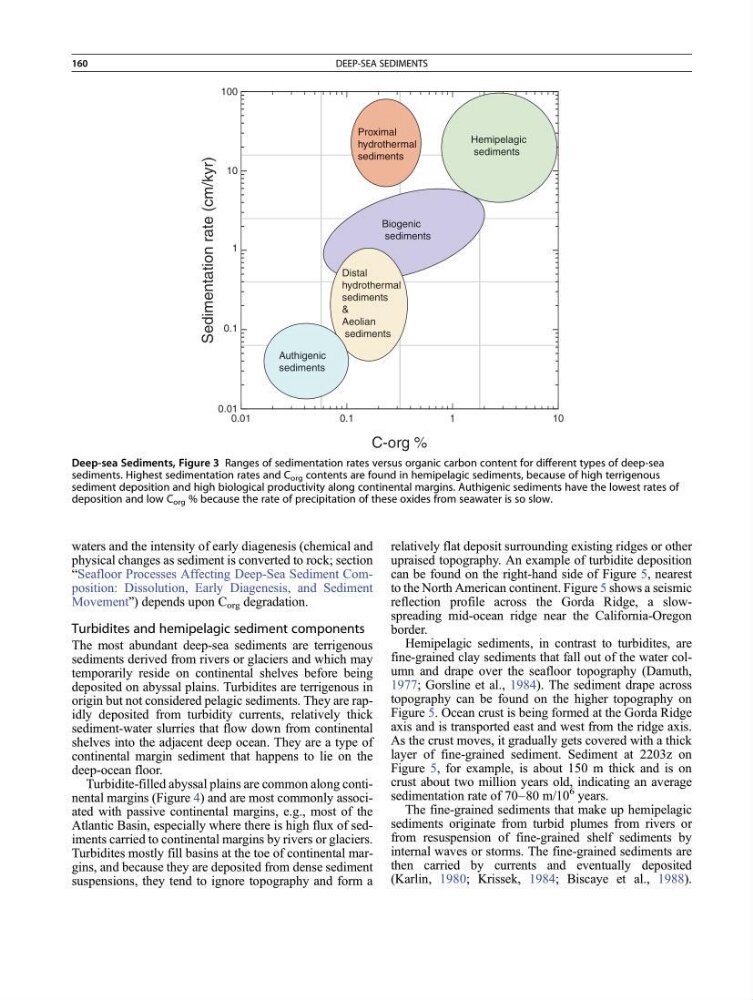
Deep-sea Sediments, Figure 3 Ranges of sedimentation rates versus organic carbon content for different types of deep-sea
sediments. Highest sedimentation rates and C org contents are found in hemipelagic sediments, because of high terrigenous
sediment deposition and high biological productivity along continental margins. Authigenic sediments have the lowest rates of
deposition and low C org % because the rate of precipitation of these oxides from seawater is so slow.
160
DEEP-SEA SEDIMENTS
physical changes as sediment is converted to rock; section
“Seafloor Processes Affecting Deep-Sea Sediment Composition: Dissolution, Early Diagenesis, and Sediment
Movement”) depends upon C org degradation.
Turbidites and hemipelagic sediment components
The most abundant deep-sea sediments are terrigenous
sediments derived from rivers or glaciers and which may
temporarily reside on continental shelves before being
deposited on abyssal plains. Turbidites are terrigenous in
origin but not considered pelagic sediments. They are rapidly deposited from turbidity currents, relatively thick
sediment-water slurries that flow down from continental
shelves into the adjacent deep ocean. They are a type of
continental margin sediment that happens to lie on the
deep-ocean floor.
Turbidite-filled abyssal plains are common along continental margins (Figure 4) and are most commonly associated with passive continental margins, e.g., most of the
Atlantic Basin, especially where there is high flux of sediments carried to continental margins by rivers or glaciers.
Turbidites mostly fill basins at the toe of continental margins, and because they are deposited from dense sediment
suspensions, they tend to ignore topography and form a
relatively flat deposit surrounding existing ridges or other
upraised topography. An example of turbidite deposition
can be found on the right-hand side of Figure 5, nearest
to the North American continent. Figure 5 shows a seismic
reflection profile across the Gorda Ridge, a slowspreading mid-ocean ridge near the California-Oregon
border.
Hemipelagic sediments, in contrast to turbidites, are
fine-grained clay sediments that fall out of the water column and drape over the seafloor topography (Damuth,
1977; Gorsline et al., 1984). The sediment drape across
topography can be found on the higher topography on
Figure 5. Ocean crust is being formed at the Gorda Ridge
axis and is transported east and west from the ridge axis.
As the crust moves, it gradually gets covered with a thick
layer of fine-grained sediment. Sediment at 2203z on
Figure 5, for example, is about 150 m thick and is on
crust about two million years old, indicating an average
sedimentation rate of 70–80 m/10
6 years.
The fine-grained sediments that make up hemipelagic
sediments originate from turbid plumes from rivers or
from resuspension of fine-grained shelf sediments by
internal waves or storms. The fine-grained sediments are
then carried by currents and eventually deposited
(Karlin, 1980; Krissek, 1984; Biscaye et al., 1988).
0.01
0.1
1
10
100
0.01
0.1
1
10
Sedimentation rate (cm/kyr)
C-org %
Biogenic
sediments
Hemipelagic
sediments
Distal
hydrothermal
sediments
&
Aeolian
sediments
Proximal
hydrothermal
sediments
Authigenic
sediments
Deep-sea Sediments, Figure 3 Ranges of sedimentation rates versus organic carbon content for different types of deep-sea
sediments. Highest sedimentation rates and C org contents are found in hemipelagic sediments, because of high terrigenous
sediment deposition and high biological productivity along continental margins. Authigenic sediments have the lowest rates of
deposition and low C org % because the rate of precipitation of these oxides from seawater is so slow.
160
DEEP-SEA SEDIMENTS