

and above the calcite compensation depth (CCD). Because
CaCO 3 solubility is pressure dependent, the CCD represents where all CaCO 3 dissolves and none has been preserved. CaCO 3 will not accumulate in the oldest and
deepest parts of the ocean basin like the North Pacific, even
though plankton produce CaCO 3 and it rains to the seafloor
(e.g., Zaric et al., 2005). High production of CaCO 3 occurs
in pelagic, moderately strong upwelling regimes, especially
60°
30°
0°
-30°
-60°
Biogenic opal %
CaCO 3 -free
<10%
>10%
>20%
>40%
>80%
a
b
<20% CaCO 3
20-40% CaCO 3
40-60% CaCO 3
>60% CaCO 3
Global
CaCO 3 %,
surface sediments
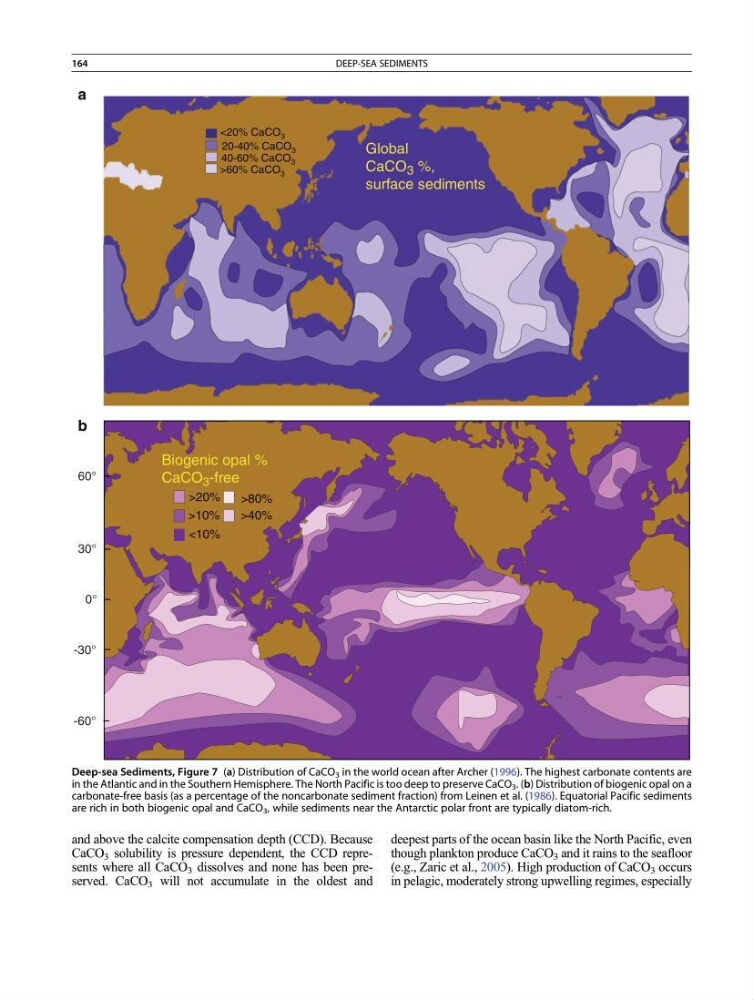
Deep-sea Sediments, Figure 7 (a) Distribution of CaCO 3 in the world ocean after Archer (1996). The highest carbonate contents are
in the Atlantic and in the Southern Hemisphere. The North Pacific is too deep to preserve CaCO 3 . (b) Distribution of biogenic opal on a
carbonate-free basis (as a percentage of the noncarbonate sediment fraction) from Leinen et al. (1986). Equatorial Pacific sediments
are rich in both biogenic opal and CaCO 3 , while sediments near the Antarctic polar front are typically diatom-rich.
164
DEEP-SEA SEDIMENTS
CaCO 3 solubility is pressure dependent, the CCD represents where all CaCO 3 dissolves and none has been preserved. CaCO 3 will not accumulate in the oldest and
deepest parts of the ocean basin like the North Pacific, even
though plankton produce CaCO 3 and it rains to the seafloor
(e.g., Zaric et al., 2005). High production of CaCO 3 occurs
in pelagic, moderately strong upwelling regimes, especially
60°
30°
0°
-30°
-60°
Biogenic opal %
CaCO 3 -free
<10%
>10%
>20%
>40%
>80%
a
b
<20% CaCO 3
20-40% CaCO 3
40-60% CaCO 3
>60% CaCO 3
Global
CaCO 3 %,
surface sediments
Deep-sea Sediments, Figure 7 (a) Distribution of CaCO 3 in the world ocean after Archer (1996). The highest carbonate contents are
in the Atlantic and in the Southern Hemisphere. The North Pacific is too deep to preserve CaCO 3 . (b) Distribution of biogenic opal on a
carbonate-free basis (as a percentage of the noncarbonate sediment fraction) from Leinen et al. (1986). Equatorial Pacific sediments
are rich in both biogenic opal and CaCO 3 , while sediments near the Antarctic polar front are typically diatom-rich.
164
DEEP-SEA SEDIMENTS