

(Te
4+ ) and platinum (Pt
2+ ) oxidize to Te
6+ and Pt
4+
(e.g., Hein and Koschinsky, 2014). Fe–Mn crusts with
slower growth rates also have higher concentrations of
metals sorbed onto the main mineral phases. Crusts that
form in the oxygen-minimum zone (OMZ) have the
slowest growth rates and contain the highest concentrations of metals of economic interest. The OMZ is created
by upwelling of nutrient-rich waters along the flanks of
seamounts, which promotes productivity in surface waters
over the seamounts. As the plankton die and sink through
the water column, the organic matter oxidizes and depletes
the seawater of oxygen, creating the OMZ. In the central
Pacific Ocean, the OMZ commonly occurs from about
500 m to 2,000 m water depths.
Composition
Fe–Mn crusts have a simple mineralogy and are composed predominantly of vernadite (Mn oxide) and
noncrystalline Fe oxyhydroxide. They contain minor
amounts of detrital minerals such as quartz and feldspar
derived from weathering of seabed outcrops and blown
by winds from the continents. Older layers of thick crusts
contain a phosphate mineral called carbonate fluorapatite,
which is a secondary mineral that formed long after the
Mn and Fe minerals precipitated from seawater.
Fe and Mn occur in subequal amounts (Fe/Mn
~0.7–1.4) in Fe–Mn crusts, and Co, the trace metal of
most economic interest, can be up to 2 % but usually averages 0.33–0.67 % by weight (0.1 % ¼ 1,000 parts per million, ppm) for large areas of the global ocean (Table 1); for
smaller mine-site size areas (500 km
2
), Co can average
0.8 %. Fe–Mn crusts have the highest concentrations of
Te compared to other rock types (global mean about
50 ppm); Te is a rare metal that is needed by the solar-cell
industry for thin-film photovoltaics and is the best material for converting sunlight into electricity. Fe–Mn crusts
are also significantly enriched in bismuth (Bi), molybdenum (Mo), niobium (Nb), nickel (Ni), platinum (Pt),
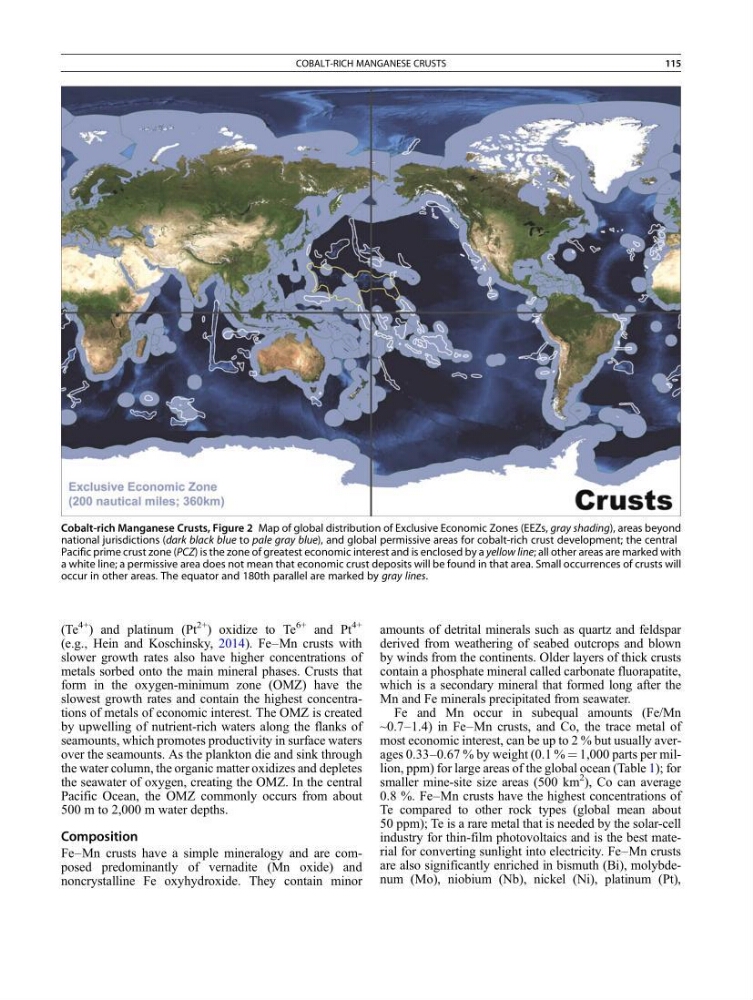
Cobalt-rich Manganese Crusts, Figure 2 Map of global distribution of Exclusive Economic Zones (EEZs, gray shading), areas beyond
national jurisdictions (dark black blue to pale gray blue), and global permissive areas for cobalt-rich crust development; the central
Pacific prime crust zone (PCZ) is the zone of greatest economic interest and is enclosed by a yellow line; all other areas are marked with
a white line; a permissive area does not mean that economic crust deposits will be found in that area. Small occurrences of crusts will
occur in other areas. The equator and 180th parallel are marked by gray lines.
COBALT-RICH MANGANESE CRUSTS
115
4+ ) and platinum (Pt
2+ ) oxidize to Te
6+ and Pt
4+
(e.g., Hein and Koschinsky, 2014). Fe–Mn crusts with
slower growth rates also have higher concentrations of
metals sorbed onto the main mineral phases. Crusts that
form in the oxygen-minimum zone (OMZ) have the
slowest growth rates and contain the highest concentrations of metals of economic interest. The OMZ is created
by upwelling of nutrient-rich waters along the flanks of
seamounts, which promotes productivity in surface waters
over the seamounts. As the plankton die and sink through
the water column, the organic matter oxidizes and depletes
the seawater of oxygen, creating the OMZ. In the central
Pacific Ocean, the OMZ commonly occurs from about
500 m to 2,000 m water depths.
Composition
Fe–Mn crusts have a simple mineralogy and are composed predominantly of vernadite (Mn oxide) and
noncrystalline Fe oxyhydroxide. They contain minor
amounts of detrital minerals such as quartz and feldspar
derived from weathering of seabed outcrops and blown
by winds from the continents. Older layers of thick crusts
contain a phosphate mineral called carbonate fluorapatite,
which is a secondary mineral that formed long after the
Mn and Fe minerals precipitated from seawater.
Fe and Mn occur in subequal amounts (Fe/Mn
~0.7–1.4) in Fe–Mn crusts, and Co, the trace metal of
most economic interest, can be up to 2 % but usually averages 0.33–0.67 % by weight (0.1 % ¼ 1,000 parts per million, ppm) for large areas of the global ocean (Table 1); for
smaller mine-site size areas (500 km
2
), Co can average
0.8 %. Fe–Mn crusts have the highest concentrations of
Te compared to other rock types (global mean about
50 ppm); Te is a rare metal that is needed by the solar-cell
industry for thin-film photovoltaics and is the best material for converting sunlight into electricity. Fe–Mn crusts
are also significantly enriched in bismuth (Bi), molybdenum (Mo), niobium (Nb), nickel (Ni), platinum (Pt),
Cobalt-rich Manganese Crusts, Figure 2 Map of global distribution of Exclusive Economic Zones (EEZs, gray shading), areas beyond
national jurisdictions (dark black blue to pale gray blue), and global permissive areas for cobalt-rich crust development; the central
Pacific prime crust zone (PCZ) is the zone of greatest economic interest and is enclosed by a yellow line; all other areas are marked with
a white line; a permissive area does not mean that economic crust deposits will be found in that area. Small occurrences of crusts will
occur in other areas. The equator and 180th parallel are marked by gray lines.
COBALT-RICH MANGANESE CRUSTS
115