

a contribution of Fe or Mn, mostly to the lowermost
layers, from hydrothermal sources associated with the
spreading centers; this hydrothermal contribution can
dilute the metals in crusts of economic interest. Fe–Mn
crusts of economic interest occur distant from hydrothermal sources and from continental margins and thus are
not associated with direct volcanic, hydrothermal, or river
input. Based on these criteria, coupled with the oldest seamounts occurring in the equatorial NW Pacific, the area of
greatest economic interest occurs in the equatorial centralNW Pacific (Figure 2), which is called the prime crust
zone (PCZ; Hein et al., 2009).
Formation
Mn oxide (MnO 2 •xH 2 O) and Fe oxyhydroxide (FeO
(OH)) are the dominant minerals that compose Fe–Mn
crusts, which precipitate from cold seawater onto rock surfaces, called hydrogenetic precipitation. Seawater is the
source of Mn, Fe, and all the metals associated with those
main components (Table 1). Elements dissolved in seawater are derived predominantly from the continents via rivers and windblown (eolian) dust. The mineral particles
delivered to the ocean by those sources dissolve to various
degrees in seawater, and the released elements form ionic
and element complexes in seawater. Another source of elements to seawater is hydrothermal venting that occurs
along the 89,000 kilometers (km) of oceanic spreading
centers and volcanic arcs. However, the continents are
the dominant source for all the elements dissolved in seawater except Mn and Fe, which come from hydrothermal
input at oceanic spreading centers. Once the elements are
dissolved in seawater, a first-order electrochemical model
indicates that positively charged ions will sorb onto the
surface of the Mn oxide, which has a strong negative surface charge at seawater pH. In contrast, the negative and
neutral element complexes in seawater will sorb onto the
slightly positively charged surface of Fe oxyhydroxide
(Koschinsky and Hein, 2003). Elements may be weakly
sorbed, called outer-sphere sorption, or strongly sorbed,
called inner-sphere sorption, where covalent bonds usually form that tightly hold the metals to the main Fe and
Mn minerals. Many of the metals that are highly enriched
in Fe–Mn crusts are oxidized from a mobile state to an
immobile state on the surface of the Fe and Mn minerals
after inner-sphere absorption (Hein and Koschinsky,
2014). For example, cobalt (Co
2+ ), cerium (Ce
3+ ), and
thallium (Tl
+ ) oxidize to Co
3+ , Ce
4+ , and Tl
3+ , respectively, on the surface of the Mn oxide, and tellurium
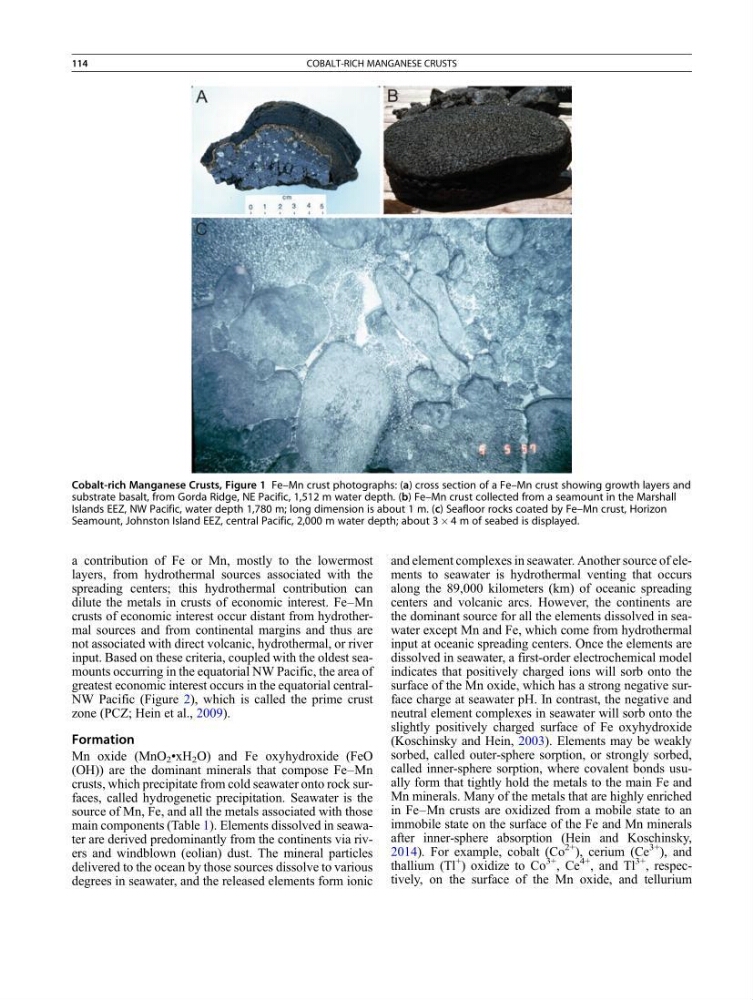
Cobalt-rich Manganese Crusts, Figure 1 Fe–Mn crust photographs: (a) cross section of a Fe–Mn crust showing growth layers and
substrate basalt, from Gorda Ridge, NE Pacific, 1,512 m water depth. (b) Fe–Mn crust collected from a seamount in the Marshall
Islands EEZ, NW Pacific, water depth 1,780 m; long dimension is about 1 m. (c) Seafloor rocks coated by Fe–Mn crust, Horizon
Seamount, Johnston Island EEZ, central Pacific, 2,000 m water depth; about 3 Â 4 m of seabed is displayed.
114
COBALT-RICH MANGANESE CRUSTS
layers, from hydrothermal sources associated with the
spreading centers; this hydrothermal contribution can
dilute the metals in crusts of economic interest. Fe–Mn
crusts of economic interest occur distant from hydrothermal sources and from continental margins and thus are
not associated with direct volcanic, hydrothermal, or river
input. Based on these criteria, coupled with the oldest seamounts occurring in the equatorial NW Pacific, the area of
greatest economic interest occurs in the equatorial centralNW Pacific (Figure 2), which is called the prime crust
zone (PCZ; Hein et al., 2009).
Formation
Mn oxide (MnO 2 •xH 2 O) and Fe oxyhydroxide (FeO
(OH)) are the dominant minerals that compose Fe–Mn
crusts, which precipitate from cold seawater onto rock surfaces, called hydrogenetic precipitation. Seawater is the
source of Mn, Fe, and all the metals associated with those
main components (Table 1). Elements dissolved in seawater are derived predominantly from the continents via rivers and windblown (eolian) dust. The mineral particles
delivered to the ocean by those sources dissolve to various
degrees in seawater, and the released elements form ionic
and element complexes in seawater. Another source of elements to seawater is hydrothermal venting that occurs
along the 89,000 kilometers (km) of oceanic spreading
centers and volcanic arcs. However, the continents are
the dominant source for all the elements dissolved in seawater except Mn and Fe, which come from hydrothermal
input at oceanic spreading centers. Once the elements are
dissolved in seawater, a first-order electrochemical model
indicates that positively charged ions will sorb onto the
surface of the Mn oxide, which has a strong negative surface charge at seawater pH. In contrast, the negative and
neutral element complexes in seawater will sorb onto the
slightly positively charged surface of Fe oxyhydroxide
(Koschinsky and Hein, 2003). Elements may be weakly
sorbed, called outer-sphere sorption, or strongly sorbed,
called inner-sphere sorption, where covalent bonds usually form that tightly hold the metals to the main Fe and
Mn minerals. Many of the metals that are highly enriched
in Fe–Mn crusts are oxidized from a mobile state to an
immobile state on the surface of the Fe and Mn minerals
after inner-sphere absorption (Hein and Koschinsky,
2014). For example, cobalt (Co
2+ ), cerium (Ce
3+ ), and
thallium (Tl
+ ) oxidize to Co
3+ , Ce
4+ , and Tl
3+ , respectively, on the surface of the Mn oxide, and tellurium
Cobalt-rich Manganese Crusts, Figure 1 Fe–Mn crust photographs: (a) cross section of a Fe–Mn crust showing growth layers and
substrate basalt, from Gorda Ridge, NE Pacific, 1,512 m water depth. (b) Fe–Mn crust collected from a seamount in the Marshall
Islands EEZ, NW Pacific, water depth 1,780 m; long dimension is about 1 m. (c) Seafloor rocks coated by Fe–Mn crust, Horizon
Seamount, Johnston Island EEZ, central Pacific, 2,000 m water depth; about 3 Â 4 m of seabed is displayed.
114
COBALT-RICH MANGANESE CRUSTS