

south, coral reef coasts occur around Taiwan, most of
Southeast Asia, the islands of the Philippines, and along
coasts of the northern half of the Australian continent.
Coasts of Indonesia and eastern Africa also contain reefs.
Coral reefs, the largest biological constructions on
Earth, occur in many different forms (e.g., barrier [or shelf
reefs], fringing, atolls) making up distinctive coasts. Barrier reefs occur along continental, mainland, and island
coasts and are separated (not attached) from the land by
a lagoon of 10 m or more water depth. One of the largest
examples is the Great Barrier Reef, which stretches more
than 2,000 km along the northeastern coast of Australia
(offshore Queensland) (Woodroffe, 2002). Additional
examples of large barrier-type reef coasts include the
Belizean Barrier Reef and the Florida Reef Tract. Barrier
reefs may also occur on mid-ocean islands, viz., Moorea
in French Polynesia, Tahiti, Fiji Islands, and Bahamian
Archipelago. Fringing reefs (Kennedy and Woodroffe,
2002) are associated with mainland coasts where there is
shallow water between the reef flat and the land or where
they are partly attached to the land as seen at Ningaloo
Reef along the coast of Western Australia and in the Caribbean, Red Sea, and elsewhere. Atolls contain an annular or
irregular reef around a central lagoon that lies above
a submerged volcanic peak.
Ice (Polar) coasts
An ice (bordered) coast (so-called cold coast or highlatitude coast) forms where a glacier extends to the sea.
Perhaps the most spectacular examples occur in Antarctica
where continental glaciers form a wall of ice that is in
direct contact with the water. About one-third of
Antarctica’s coastline (i.e., 11,000 km) is occupied by
ice cliffs at the ocean interface (Walker, 2005). Waterterminating glaciers also occur in the form of mountain
glaciers that flow down to the sea in fjords, as seen, for
example, in Greenland and in nonpolar tidewater areas
such as southern Alaska and Chile as well as Ellesmere,
Baffin Island, Bylot Island, and Devon Island. A major
characteristic of ice coasts is presence of ice shelves, icebergs, and sea ice.
Coastal zone (management)
The term coastal refers to regional mosaics of habitats
including intertidal habitats (mangroves, marshes, mud
flats, rocky shores, sandy beaches), semi-enclosed bodies
of water (estuaries, sounds, bays, fjords, fjards, gulfs,
seas), benthic habitats (coral reefs, sea grass beds, kelp
forests, hard and soft bottoms), and the open waters of
the coastal ocean to the seaward limits of the exclusive
economic zone (EEZ), i.e., from the head of the tidal
waters to the outer limits of the EEZ (Christian and
Mazzilli, 2007). This definition was adopted for the study
of large-scale regional change for the Global Observing
Systems of the United Nations. Because coastal areas
(q.v.) are particularly sensitive to global change, sentinel
ecosystems are used to evaluate terrestrial, wetland, and
freshwater ecosystems along the coast.
The coastal zone or coast areas are terms that attempt to
better define coast. The point of view here is in relation to
the legalities of management. Such definitions are required
to provide order to human use of the coast, which can be
quite deleterious unless properly managed and constrained
in this ecologically sensitive environment. The main considerations of coast in this sense relate to landward and seaward boundaries or jurisdictions, usually based on tidal
lines. As pointed out by Quadros and Collier (2008), the
rigorous and consistent realization of the line of intersection between a nominated tidal datum and the land mass
is notoriously difficult. This difficulty in turn creates spatial
uncertainty and the potential for conflict.
The location of seaward boundaries shows great variation between countries due to different sets of criteria:
(1) political, legal, or administrative criteria, such as the
outward limit of the national territorial sea (e.g., New
Zealand, France (implicitly), Spain, Singapore), or the
boundary between provincial or state jurisdiction and
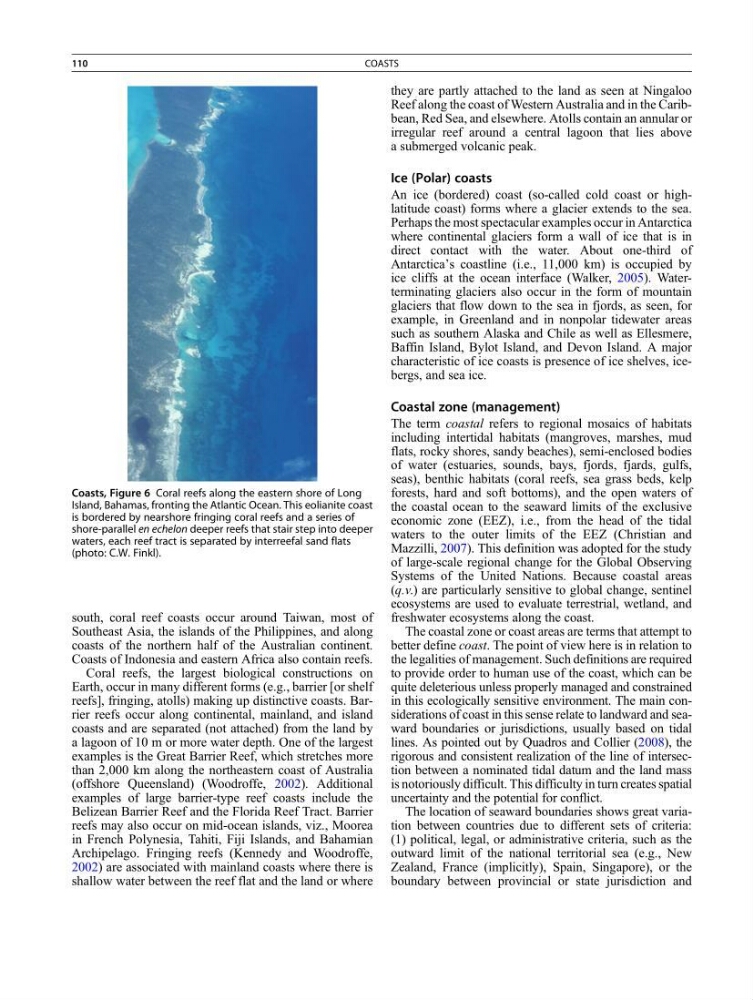
Coasts, Figure 6 Coral reefs along the eastern shore of Long
Island, Bahamas, fronting the Atlantic Ocean. This eolianite coast
is bordered by nearshore fringing coral reefs and a series of
shore-parallel en echelon deeper reefs that stair step into deeper
waters, each reef tract is separated by interreefal sand flats
(photo: C.W. Finkl).
110
COASTS
Southeast Asia, the islands of the Philippines, and along
coasts of the northern half of the Australian continent.
Coasts of Indonesia and eastern Africa also contain reefs.
Coral reefs, the largest biological constructions on
Earth, occur in many different forms (e.g., barrier [or shelf
reefs], fringing, atolls) making up distinctive coasts. Barrier reefs occur along continental, mainland, and island
coasts and are separated (not attached) from the land by
a lagoon of 10 m or more water depth. One of the largest
examples is the Great Barrier Reef, which stretches more
than 2,000 km along the northeastern coast of Australia
(offshore Queensland) (Woodroffe, 2002). Additional
examples of large barrier-type reef coasts include the
Belizean Barrier Reef and the Florida Reef Tract. Barrier
reefs may also occur on mid-ocean islands, viz., Moorea
in French Polynesia, Tahiti, Fiji Islands, and Bahamian
Archipelago. Fringing reefs (Kennedy and Woodroffe,
2002) are associated with mainland coasts where there is
shallow water between the reef flat and the land or where
they are partly attached to the land as seen at Ningaloo
Reef along the coast of Western Australia and in the Caribbean, Red Sea, and elsewhere. Atolls contain an annular or
irregular reef around a central lagoon that lies above
a submerged volcanic peak.
Ice (Polar) coasts
An ice (bordered) coast (so-called cold coast or highlatitude coast) forms where a glacier extends to the sea.
Perhaps the most spectacular examples occur in Antarctica
where continental glaciers form a wall of ice that is in
direct contact with the water. About one-third of
Antarctica’s coastline (i.e., 11,000 km) is occupied by
ice cliffs at the ocean interface (Walker, 2005). Waterterminating glaciers also occur in the form of mountain
glaciers that flow down to the sea in fjords, as seen, for
example, in Greenland and in nonpolar tidewater areas
such as southern Alaska and Chile as well as Ellesmere,
Baffin Island, Bylot Island, and Devon Island. A major
characteristic of ice coasts is presence of ice shelves, icebergs, and sea ice.
Coastal zone (management)
The term coastal refers to regional mosaics of habitats
including intertidal habitats (mangroves, marshes, mud
flats, rocky shores, sandy beaches), semi-enclosed bodies
of water (estuaries, sounds, bays, fjords, fjards, gulfs,
seas), benthic habitats (coral reefs, sea grass beds, kelp
forests, hard and soft bottoms), and the open waters of
the coastal ocean to the seaward limits of the exclusive
economic zone (EEZ), i.e., from the head of the tidal
waters to the outer limits of the EEZ (Christian and
Mazzilli, 2007). This definition was adopted for the study
of large-scale regional change for the Global Observing
Systems of the United Nations. Because coastal areas
(q.v.) are particularly sensitive to global change, sentinel
ecosystems are used to evaluate terrestrial, wetland, and
freshwater ecosystems along the coast.
The coastal zone or coast areas are terms that attempt to
better define coast. The point of view here is in relation to
the legalities of management. Such definitions are required
to provide order to human use of the coast, which can be
quite deleterious unless properly managed and constrained
in this ecologically sensitive environment. The main considerations of coast in this sense relate to landward and seaward boundaries or jurisdictions, usually based on tidal
lines. As pointed out by Quadros and Collier (2008), the
rigorous and consistent realization of the line of intersection between a nominated tidal datum and the land mass
is notoriously difficult. This difficulty in turn creates spatial
uncertainty and the potential for conflict.
The location of seaward boundaries shows great variation between countries due to different sets of criteria:
(1) political, legal, or administrative criteria, such as the
outward limit of the national territorial sea (e.g., New
Zealand, France (implicitly), Spain, Singapore), or the
boundary between provincial or state jurisdiction and
Coasts, Figure 6 Coral reefs along the eastern shore of Long
Island, Bahamas, fronting the Atlantic Ocean. This eolianite coast
is bordered by nearshore fringing coral reefs and a series of
shore-parallel en echelon deeper reefs that stair step into deeper
waters, each reef tract is separated by interreefal sand flats
(photo: C.W. Finkl).
110
COASTS