

Discussions of the geographic distributions of muddy
coasts may be found in Bird and Schwartz (1985),
Davies (1980), and Flemming (2002) where regional
details are provided. A well-known example of a muddy
coast is provided by Anthony et al. (2010) for the
1,500 km-long coast of South America between
the Amazon and the Orinoco river mouths where this
coast is the world’s muddiest. This is due to the
huge suspended-sediment discharge of the Amazon
River (10
6
 754 t year
-1
Æ 9 %), part of which is
transported alongshore as mudbanks.
Reef coasts
Coral reef coasts (see “Reef Coasts”), which contain some
of the largest diversity of life in the world, are sometimes
referred to as the rainforest of the sea. The three widely
recognized coral reef regions include the Indo-Pacific
Region, wider Caribbean (including the Bahamas to the
north and northeastern coasts of South America), and
the Red Sea. Because of restrictive requirements for the
growth of coral reef ecosystems (Figure 6), coral reef
coasts occur along much of the Central and South Pacific
Ocean as far north as Hawaii and southern Japan. Farther
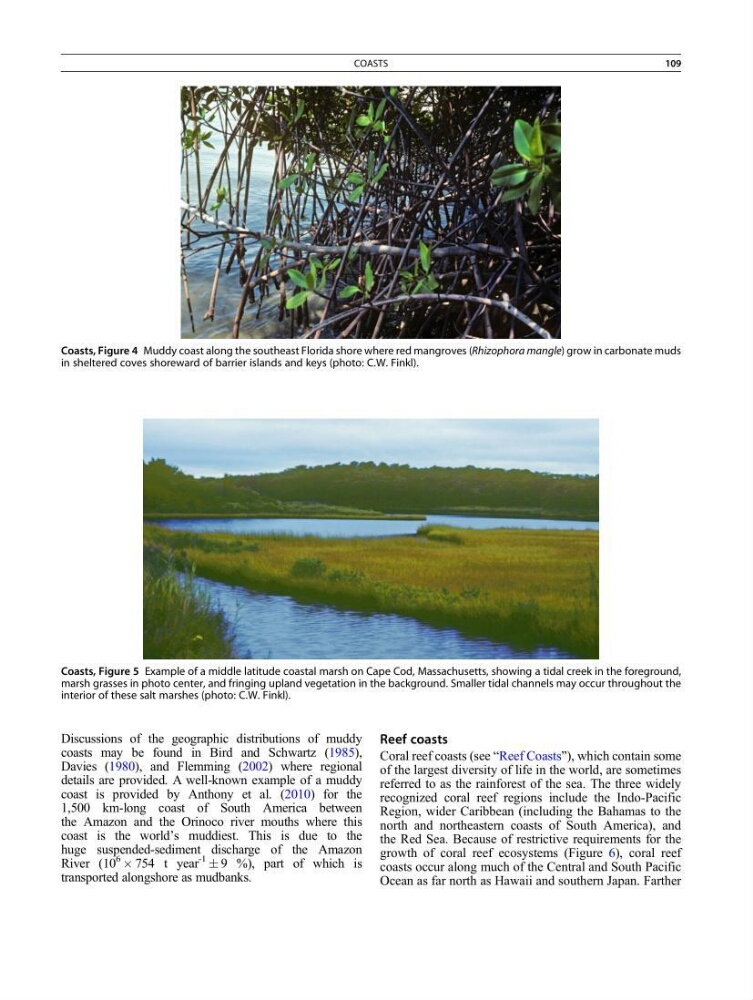
Coasts, Figure 4 Muddy coast along the southeast Florida shore where red mangroves (Rhizophora mangle) grow in carbonate muds
in sheltered coves shoreward of barrier islands and keys (photo: C.W. Finkl).
Coasts, Figure 5 Example of a middle latitude coastal marsh on Cape Cod, Massachusetts, showing a tidal creek in the foreground,
marsh grasses in photo center, and fringing upland vegetation in the background. Smaller tidal channels may occur throughout the
interior of these salt marshes (photo: C.W. Finkl).
COASTS
109
coasts may be found in Bird and Schwartz (1985),
Davies (1980), and Flemming (2002) where regional
details are provided. A well-known example of a muddy
coast is provided by Anthony et al. (2010) for the
1,500 km-long coast of South America between
the Amazon and the Orinoco river mouths where this
coast is the world’s muddiest. This is due to the
huge suspended-sediment discharge of the Amazon
River (10
6
 754 t year
-1
Æ 9 %), part of which is
transported alongshore as mudbanks.
Reef coasts
Coral reef coasts (see “Reef Coasts”), which contain some
of the largest diversity of life in the world, are sometimes
referred to as the rainforest of the sea. The three widely
recognized coral reef regions include the Indo-Pacific
Region, wider Caribbean (including the Bahamas to the
north and northeastern coasts of South America), and
the Red Sea. Because of restrictive requirements for the
growth of coral reef ecosystems (Figure 6), coral reef
coasts occur along much of the Central and South Pacific
Ocean as far north as Hawaii and southern Japan. Farther
Coasts, Figure 4 Muddy coast along the southeast Florida shore where red mangroves (Rhizophora mangle) grow in carbonate muds
in sheltered coves shoreward of barrier islands and keys (photo: C.W. Finkl).
Coasts, Figure 5 Example of a middle latitude coastal marsh on Cape Cod, Massachusetts, showing a tidal creek in the foreground,
marsh grasses in photo center, and fringing upland vegetation in the background. Smaller tidal channels may occur throughout the
interior of these salt marshes (photo: C.W. Finkl).
COASTS
109