

(mineralogical) composition to provide diversity in the
appearance of the world’s beaches (Pilkey et al., 2011).
There are many examples of the world’s best beaches, longest beaches, widest beaches, and so on. In the United
States, there are about 650 major public recreational
beaches, and they have been ranked annually according
to fifty criteria since 1991 to determine the top ten beaches
(Leatherman, 1997). A range of selected examples of
coasts with the longest beaches in the world include
Brazil’s Praia do Cassino Beach (over 250 km long),
India’s Cox’s Bazar (about 240 km long), Texas’ Padre
Island (about 210 km long), Australia’s Coorong Beach
(194 km), New Zealand’s Ninety Mile Beach (each about
145 km long), Mexico’s Playa Novillero (about 80 km
long), and America’s Virginia Beach (about 55 km long).
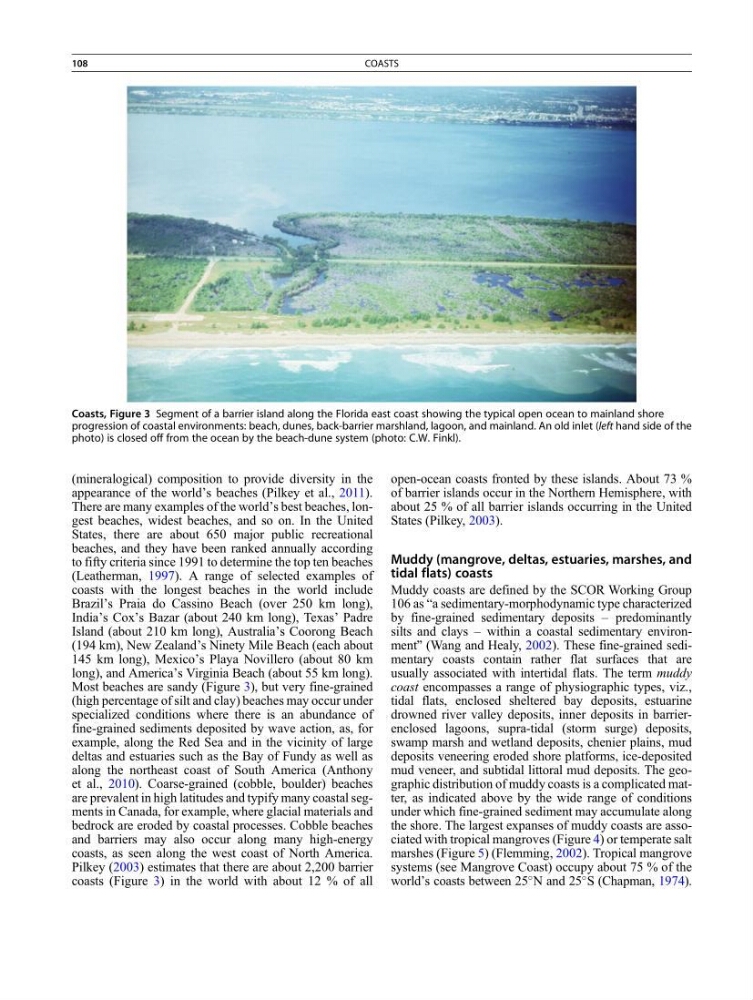
Most beaches are sandy (Figure 3), but very fine-grained
(high percentage of silt and clay) beaches may occur under
specialized conditions where there is an abundance of
fine-grained sediments deposited by wave action, as, for
example, along the Red Sea and in the vicinity of large
deltas and estuaries such as the Bay of Fundy as well as
along the northeast coast of South America (Anthony
et al., 2010). Coarse-grained (cobble, boulder) beaches
are prevalent in high latitudes and typify many coastal segments in Canada, for example, where glacial materials and
bedrock are eroded by coastal processes. Cobble beaches
and barriers may also occur along many high-energy
coasts, as seen along the west coast of North America.
Pilkey (2003) estimates that there are about 2,200 barrier
coasts (Figure 3) in the world with about 12 % of all
open-ocean coasts fronted by these islands. About 73 %
of barrier islands occur in the Northern Hemisphere, with
about 25 % of all barrier islands occurring in the United
States (Pilkey, 2003).
Muddy (mangrove, deltas, estuaries, marshes, and
tidal flats) coasts
Muddy coasts are defined by the SCOR Working Group
106 as “a sedimentary-morphodynamic type characterized
by fine-grained sedimentary deposits – predominantly
silts and clays – within a coastal sedimentary environment” (Wang and Healy, 2002). These fine-grained sedimentary coasts contain rather flat surfaces that are
usually associated with intertidal flats. The term muddy
coast encompasses a range of physiographic types, viz.,
tidal flats, enclosed sheltered bay deposits, estuarine
drowned river valley deposits, inner deposits in barrierenclosed lagoons, supra-tidal (storm surge) deposits,
swamp marsh and wetland deposits, chenier plains, mud
deposits veneering eroded shore platforms, ice-deposited
mud veneer, and subtidal littoral mud deposits. The geographic distribution of muddy coasts is a complicated matter, as indicated above by the wide range of conditions
under which fine-grained sediment may accumulate along
the shore. The largest expanses of muddy coasts are associated with tropical mangroves (Figure 4) or temperate salt
marshes (Figure 5) (Flemming, 2002). Tropical mangrove
systems (see Mangrove Coast) occupy about 75 % of the
world’s coasts between 25
N and 25
S (Chapman, 1974).
Coasts, Figure 3 Segment of a barrier island along the Florida east coast showing the typical open ocean to mainland shore
progression of coastal environments: beach, dunes, back-barrier marshland, lagoon, and mainland. An old inlet (left hand side of the
photo) is closed off from the ocean by the beach-dune system (photo: C.W. Finkl).
108
COASTS
appearance of the world’s beaches (Pilkey et al., 2011).
There are many examples of the world’s best beaches, longest beaches, widest beaches, and so on. In the United
States, there are about 650 major public recreational
beaches, and they have been ranked annually according
to fifty criteria since 1991 to determine the top ten beaches
(Leatherman, 1997). A range of selected examples of
coasts with the longest beaches in the world include
Brazil’s Praia do Cassino Beach (over 250 km long),
India’s Cox’s Bazar (about 240 km long), Texas’ Padre
Island (about 210 km long), Australia’s Coorong Beach
(194 km), New Zealand’s Ninety Mile Beach (each about
145 km long), Mexico’s Playa Novillero (about 80 km
long), and America’s Virginia Beach (about 55 km long).
Most beaches are sandy (Figure 3), but very fine-grained
(high percentage of silt and clay) beaches may occur under
specialized conditions where there is an abundance of
fine-grained sediments deposited by wave action, as, for
example, along the Red Sea and in the vicinity of large
deltas and estuaries such as the Bay of Fundy as well as
along the northeast coast of South America (Anthony
et al., 2010). Coarse-grained (cobble, boulder) beaches
are prevalent in high latitudes and typify many coastal segments in Canada, for example, where glacial materials and
bedrock are eroded by coastal processes. Cobble beaches
and barriers may also occur along many high-energy
coasts, as seen along the west coast of North America.
Pilkey (2003) estimates that there are about 2,200 barrier
coasts (Figure 3) in the world with about 12 % of all
open-ocean coasts fronted by these islands. About 73 %
of barrier islands occur in the Northern Hemisphere, with
about 25 % of all barrier islands occurring in the United
States (Pilkey, 2003).
Muddy (mangrove, deltas, estuaries, marshes, and
tidal flats) coasts
Muddy coasts are defined by the SCOR Working Group
106 as “a sedimentary-morphodynamic type characterized
by fine-grained sedimentary deposits – predominantly
silts and clays – within a coastal sedimentary environment” (Wang and Healy, 2002). These fine-grained sedimentary coasts contain rather flat surfaces that are
usually associated with intertidal flats. The term muddy
coast encompasses a range of physiographic types, viz.,
tidal flats, enclosed sheltered bay deposits, estuarine
drowned river valley deposits, inner deposits in barrierenclosed lagoons, supra-tidal (storm surge) deposits,
swamp marsh and wetland deposits, chenier plains, mud
deposits veneering eroded shore platforms, ice-deposited
mud veneer, and subtidal littoral mud deposits. The geographic distribution of muddy coasts is a complicated matter, as indicated above by the wide range of conditions
under which fine-grained sediment may accumulate along
the shore. The largest expanses of muddy coasts are associated with tropical mangroves (Figure 4) or temperate salt
marshes (Figure 5) (Flemming, 2002). Tropical mangrove
systems (see Mangrove Coast) occupy about 75 % of the
world’s coasts between 25
N and 25
S (Chapman, 1974).
Coasts, Figure 3 Segment of a barrier island along the Florida east coast showing the typical open ocean to mainland shore
progression of coastal environments: beach, dunes, back-barrier marshland, lagoon, and mainland. An old inlet (left hand side of the
photo) is closed off from the ocean by the beach-dune system (photo: C.W. Finkl).
108
COASTS