

there is debate as to the location of the highest sea cliffs
depending on the slope of the cliff face and actual free fall
distance. The location of the world’s highest sea cliffs thus
depends on the definition of cliff. Kalaupapa, Hawaii
(1,010 m high), and the north face of Mitre Peak, Milford
Sound, New Zealand, which drops 1,694 meters (Seddon
and Dadelszen, 1898), are extreme examples. The average
slope of these cliffs is roughly 60 degrees, but a more vertical drop of 1,560 m into the sea occurs at Maujit
Qaqarssuasia in the Torssuktak (Tunoq) Fjord (Sound),
southeast Greenland (Beckwith, 1989). Considering
a truly vertical drop, Mount Thor on Baffin Island in Arctic Canada is among the highest at about 1,370 m for the
longest purely vertical drop on Earth (Simon, 2012).
These spectacular sea cliffs are tourist attractions around
the world for a very specialized kind of coast. Many cliffy
coasts have gently sloping seaward ramps (Type
A platforms) or subhorizontal surface terminating in
a seaward or low-tide scarp (Type B platforms) (Trenhaile,
1987). These shore platforms (wave-cut platforms) often
contain shallow pools and are subject to subaerial
weathering at low tide. Lithology and structure are important to the types of rocky coasts with volcanic rocks and
limestones forming some of the most spectacular and scenic coasts. Many terraces and benches are uplifted above
present sea-level, while others are below the water. Sea
caves, arches (bridges), and stacks (Figure 2) are additional types of erosional landforms that are characteristic
of rocky coasts (Woodroffe, 2002). More subtle forms of
rocky coasts are associated with drowned glacial landscapes with drumlins or other glaciated terrains with
exposed bedrock to form skerries or partially submerged
whalebacks.
Beach and barrier coasts
Beaches (q.v.), which are normally backed by Dunes
(q.v.), make up about 70 % of the world’s coasts (Bird,
1976) and are well-known types of sedimentary coast. In
Australia, where Short and Farmer (2012) report no fewer
than 11,761 beaches, dunes back 80 % of the beaches and
about 40 % of the coast. Beach sediment is extremely variable in terms of size, shape, color, and chemical
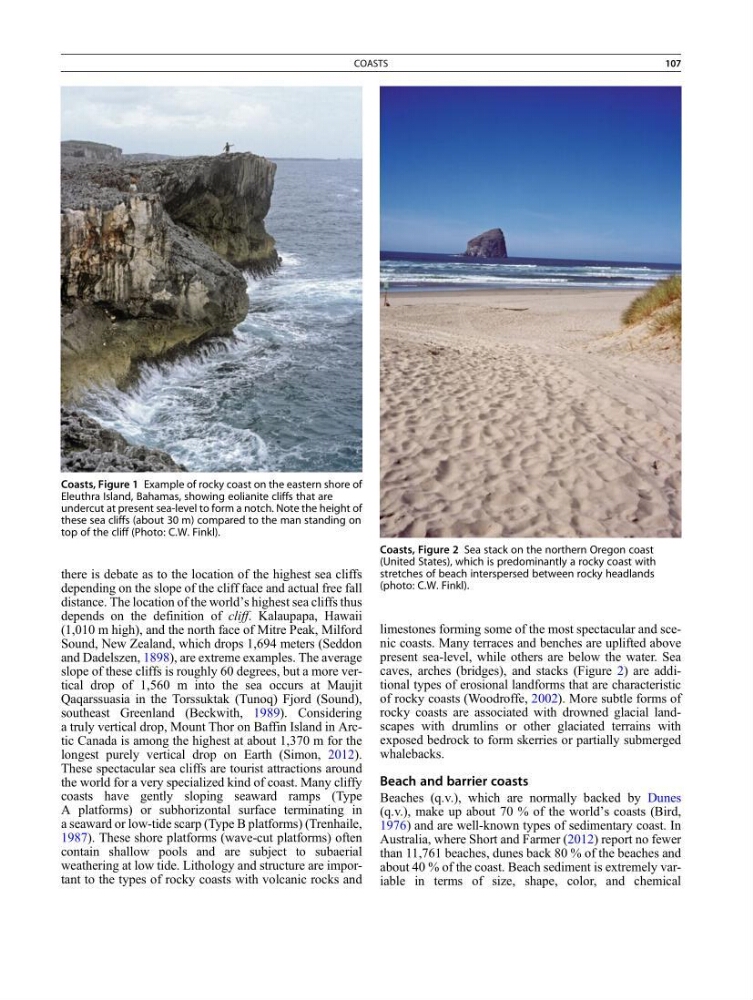
Coasts, Figure 1 Example of rocky coast on the eastern shore of
Eleuthra Island, Bahamas, showing eolianite cliffs that are
undercut at present sea-level to form a notch. Note the height of
these sea cliffs (about 30 m) compared to the man standing on
top of the cliff (Photo: C.W. Finkl).
Coasts, Figure 2 Sea stack on the northern Oregon coast
(United States), which is predominantly a rocky coast with
stretches of beach interspersed between rocky headlands
(photo: C.W. Finkl).
COASTS
107
depending on the slope of the cliff face and actual free fall
distance. The location of the world’s highest sea cliffs thus
depends on the definition of cliff. Kalaupapa, Hawaii
(1,010 m high), and the north face of Mitre Peak, Milford
Sound, New Zealand, which drops 1,694 meters (Seddon
and Dadelszen, 1898), are extreme examples. The average
slope of these cliffs is roughly 60 degrees, but a more vertical drop of 1,560 m into the sea occurs at Maujit
Qaqarssuasia in the Torssuktak (Tunoq) Fjord (Sound),
southeast Greenland (Beckwith, 1989). Considering
a truly vertical drop, Mount Thor on Baffin Island in Arctic Canada is among the highest at about 1,370 m for the
longest purely vertical drop on Earth (Simon, 2012).
These spectacular sea cliffs are tourist attractions around
the world for a very specialized kind of coast. Many cliffy
coasts have gently sloping seaward ramps (Type
A platforms) or subhorizontal surface terminating in
a seaward or low-tide scarp (Type B platforms) (Trenhaile,
1987). These shore platforms (wave-cut platforms) often
contain shallow pools and are subject to subaerial
weathering at low tide. Lithology and structure are important to the types of rocky coasts with volcanic rocks and
limestones forming some of the most spectacular and scenic coasts. Many terraces and benches are uplifted above
present sea-level, while others are below the water. Sea
caves, arches (bridges), and stacks (Figure 2) are additional types of erosional landforms that are characteristic
of rocky coasts (Woodroffe, 2002). More subtle forms of
rocky coasts are associated with drowned glacial landscapes with drumlins or other glaciated terrains with
exposed bedrock to form skerries or partially submerged
whalebacks.
Beach and barrier coasts
Beaches (q.v.), which are normally backed by Dunes
(q.v.), make up about 70 % of the world’s coasts (Bird,
1976) and are well-known types of sedimentary coast. In
Australia, where Short and Farmer (2012) report no fewer
than 11,761 beaches, dunes back 80 % of the beaches and
about 40 % of the coast. Beach sediment is extremely variable in terms of size, shape, color, and chemical
Coasts, Figure 1 Example of rocky coast on the eastern shore of
Eleuthra Island, Bahamas, showing eolianite cliffs that are
undercut at present sea-level to form a notch. Note the height of
these sea cliffs (about 30 m) compared to the man standing on
top of the cliff (Photo: C.W. Finkl).
Coasts, Figure 2 Sea stack on the northern Oregon coast
(United States), which is predominantly a rocky coast with
stretches of beach interspersed between rocky headlands
(photo: C.W. Finkl).
COASTS
107