

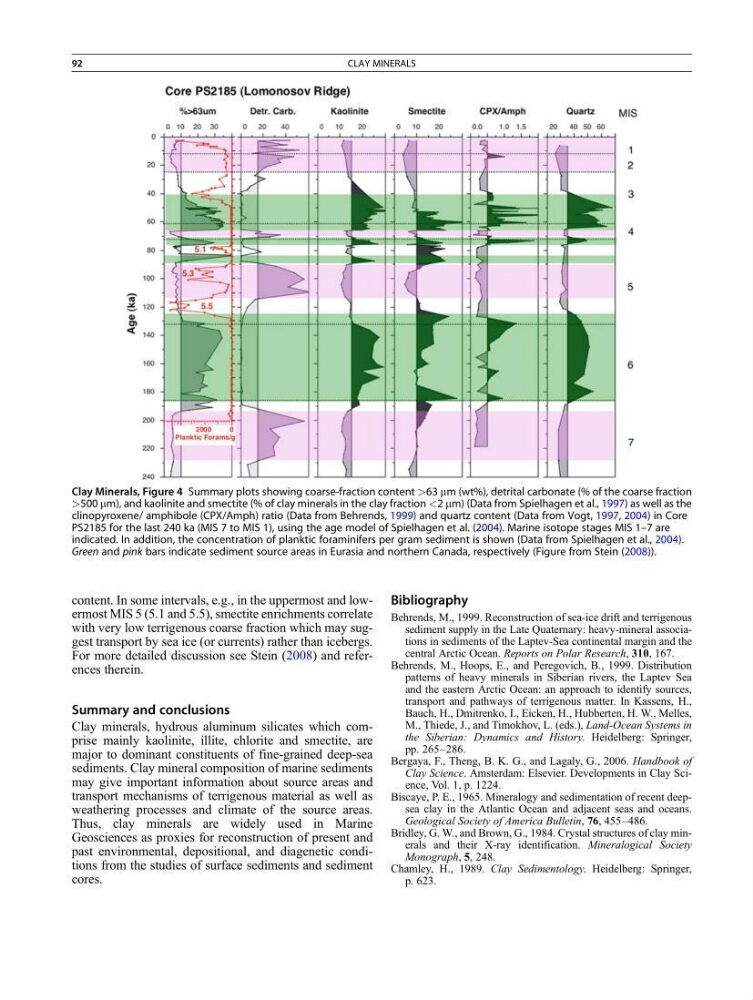
content. In some intervals, e.g., in the uppermost and lowermost MIS 5 (5.1 and 5.5), smectite enrichments correlate
with very low terrigenous coarse fraction which may suggest transport by sea ice (or currents) rather than icebergs.
For more detailed discussion see Stein (2008) and references therein.
Summary and conclusions
Clay minerals, hydrous aluminum silicates which comprise mainly kaolinite, illite, chlorite and smectite, are
major to dominant constituents of fine-grained deep-sea
sediments. Clay mineral composition of marine sediments
may give important information about source areas and
transport mechanisms of terrigenous material as well as
weathering processes and climate of the source areas.
Thus, clay minerals are widely used in Marine
Geosciences as proxies for reconstruction of present and
past environmental, depositional, and diagenetic conditions from the studies of surface sediments and sediment
cores.
Bibliography
Behrends, M., 1999. Reconstruction of sea-ice drift and terrigenous
sediment supply in the Late Quaternary: heavy-mineral associations in sediments of the Laptev-Sea continental margin and the
central Arctic Ocean. Reports on Polar Research, 310, 167.
Behrends, M., Hoops, E., and Peregovich, B., 1999. Distribution
patterns of heavy minerals in Siberian rivers, the Laptev Sea
and the eastern Arctic Ocean: an approach to identify sources,
transport and pathways of terrigenous matter. In Kassens, H.,
Bauch, H., Dmitrenko, I., Eicken, H., Hubberten, H. W., Melles,
M., Thiede, J., and Timokhov, L. (eds.), Land-Ocean Systems in
the Siberian: Dynamics and History. Heidelberg: Springer,
pp. 265–286.
Bergaya, F., Theng, B. K. G., and Lagaly, G., 2006. Handbook of
Clay Science. Amsterdam: Elsevier. Developments in Clay Science, Vol. 1, p. 1224.
Biscaye, P. E., 1965. Mineralogy and sedimentation of recent deepsea clay in the Atlantic Ocean and adjacent seas and oceans.
Geological Society of America Bulletin, 76, 455–486.
Bridley, G. W., and Brown, G., 1984. Crystal structures of clay minerals and their X-ray identification. Mineralogical Society
Monograph, 5, 248.
Chamley, H., 1989. Clay Sedimentology. Heidelberg: Springer,
p. 623.
Clay Minerals, Figure 4 Summary plots showing coarse-fraction content >63 mm (wt%), detrital carbonate (% of the coarse fraction
>500 mm), and kaolinite and smectite (% of clay minerals in the clay fraction <2 mm) (Data from Spielhagen et al., 1997) as well as the
clinopyroxene/ amphibole (CPX/Amph) ratio (Data from Behrends, 1999) and quartz content (Data from Vogt, 1997, 2004) in Core
PS2185 for the last 240 ka (MIS 7 to MIS 1), using the age model of Spielhagen et al. (2004). Marine isotope stages MIS 1–7 are
indicated. In addition, the concentration of planktic foraminifers per gram sediment is shown (Data from Spielhagen et al., 2004).
Green and pink bars indicate sediment source areas in Eurasia and northern Canada, respectively (Figure from Stein (2008)).
92
CLAY MINERALS
with very low terrigenous coarse fraction which may suggest transport by sea ice (or currents) rather than icebergs.
For more detailed discussion see Stein (2008) and references therein.
Summary and conclusions
Clay minerals, hydrous aluminum silicates which comprise mainly kaolinite, illite, chlorite and smectite, are
major to dominant constituents of fine-grained deep-sea
sediments. Clay mineral composition of marine sediments
may give important information about source areas and
transport mechanisms of terrigenous material as well as
weathering processes and climate of the source areas.
Thus, clay minerals are widely used in Marine
Geosciences as proxies for reconstruction of present and
past environmental, depositional, and diagenetic conditions from the studies of surface sediments and sediment
cores.
Bibliography
Behrends, M., 1999. Reconstruction of sea-ice drift and terrigenous
sediment supply in the Late Quaternary: heavy-mineral associations in sediments of the Laptev-Sea continental margin and the
central Arctic Ocean. Reports on Polar Research, 310, 167.
Behrends, M., Hoops, E., and Peregovich, B., 1999. Distribution
patterns of heavy minerals in Siberian rivers, the Laptev Sea
and the eastern Arctic Ocean: an approach to identify sources,
transport and pathways of terrigenous matter. In Kassens, H.,
Bauch, H., Dmitrenko, I., Eicken, H., Hubberten, H. W., Melles,
M., Thiede, J., and Timokhov, L. (eds.), Land-Ocean Systems in
the Siberian: Dynamics and History. Heidelberg: Springer,
pp. 265–286.
Bergaya, F., Theng, B. K. G., and Lagaly, G., 2006. Handbook of
Clay Science. Amsterdam: Elsevier. Developments in Clay Science, Vol. 1, p. 1224.
Biscaye, P. E., 1965. Mineralogy and sedimentation of recent deepsea clay in the Atlantic Ocean and adjacent seas and oceans.
Geological Society of America Bulletin, 76, 455–486.
Bridley, G. W., and Brown, G., 1984. Crystal structures of clay minerals and their X-ray identification. Mineralogical Society
Monograph, 5, 248.
Chamley, H., 1989. Clay Sedimentology. Heidelberg: Springer,
p. 623.
Clay Minerals, Figure 4 Summary plots showing coarse-fraction content >63 mm (wt%), detrital carbonate (% of the coarse fraction
>500 mm), and kaolinite and smectite (% of clay minerals in the clay fraction <2 mm) (Data from Spielhagen et al., 1997) as well as the
clinopyroxene/ amphibole (CPX/Amph) ratio (Data from Behrends, 1999) and quartz content (Data from Vogt, 1997, 2004) in Core
PS2185 for the last 240 ka (MIS 7 to MIS 1), using the age model of Spielhagen et al. (2004). Marine isotope stages MIS 1–7 are
indicated. In addition, the concentration of planktic foraminifers per gram sediment is shown (Data from Spielhagen et al., 2004).
Green and pink bars indicate sediment source areas in Eurasia and northern Canada, respectively (Figure from Stein (2008)).
92
CLAY MINERALS