

electron acceptor: sulfur-oxidizing microbes transform
hydrogen
sulfide
to
sulfate
using
oxygen
(H 2 S + 2O 2 ¼ SO 4
2À + 2H
+ ), while consortia of microbes
can use sulfate to oxidize methane, thereby producing sulfide (CH 4 + SO 4
2À
¼ HCO 3
À + HS
À + H 2 O). Many compounds act as electron donor/acceptor pairs in a wide
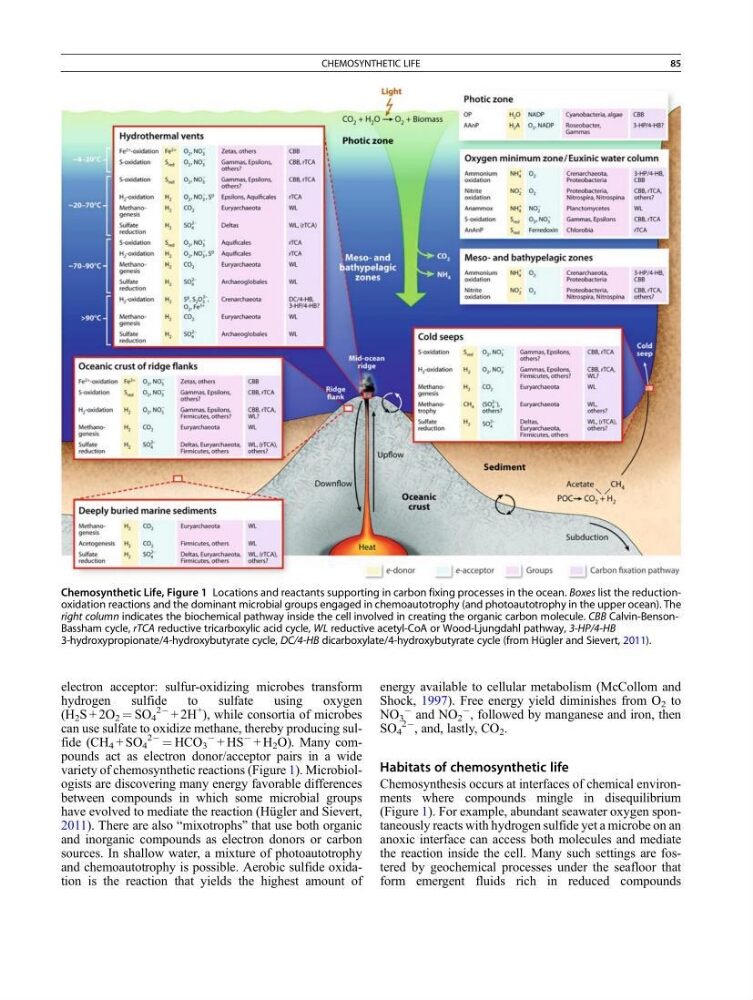
variety of chemosynthetic reactions (Figure 1). Microbiologists are discovering many energy favorable differences
between compounds in which some microbial groups
have evolved to mediate the reaction (Hügler and Sievert,
2011). There are also “mixotrophs” that use both organic
and inorganic compounds as electron donors or carbon
sources. In shallow water, a mixture of photoautotrophy
and chemoautotrophy is possible. Aerobic sulfide oxidation is the reaction that yields the highest amount of
energy available to cellular metabolism (McCollom and
Shock, 1997). Free energy yield diminishes from O 2 to
NO 3
À and NO 2
À , followed by manganese and iron, then
SO 4
2À , and, lastly, CO 2 .
Habitats of chemosynthetic life
Chemosynthesis occurs at interfaces of chemical environments where compounds mingle in disequilibrium
(Figure 1). For example, abundant seawater oxygen spontaneously reacts with hydrogen sulfide yet a microbe on an
anoxic interface can access both molecules and mediate
the reaction inside the cell. Many such settings are fostered by geochemical processes under the seafloor that
form emergent fluids rich in reduced compounds
Chemosynthetic Life, Figure 1 Locations and reactants supporting in carbon fixing processes in the ocean. Boxes list the reductionoxidation reactions and the dominant microbial groups engaged in chemoautotrophy (and photoautotrophy in the upper ocean). The
right column indicates the biochemical pathway inside the cell involved in creating the organic carbon molecule. CBB Calvin-BensonBassham cycle, rTCA reductive tricarboxylic acid cycle, WL reductive acetyl-CoA or Wood-Ljungdahl pathway, 3-HP/4-HB
3-hydroxypropionate/4-hydroxybutyrate cycle, DC/4-HB dicarboxylate/4-hydroxybutyrate cycle (from Hu ¨ gler and Sievert, 2011).
CHEMOSYNTHETIC LIFE
85
hydrogen
sulfide
to
sulfate
using
oxygen
(H 2 S + 2O 2 ¼ SO 4
2À + 2H
+ ), while consortia of microbes
can use sulfate to oxidize methane, thereby producing sulfide (CH 4 + SO 4
2À
¼ HCO 3
À + HS
À + H 2 O). Many compounds act as electron donor/acceptor pairs in a wide
variety of chemosynthetic reactions (Figure 1). Microbiologists are discovering many energy favorable differences
between compounds in which some microbial groups
have evolved to mediate the reaction (Hügler and Sievert,
2011). There are also “mixotrophs” that use both organic
and inorganic compounds as electron donors or carbon
sources. In shallow water, a mixture of photoautotrophy
and chemoautotrophy is possible. Aerobic sulfide oxidation is the reaction that yields the highest amount of
energy available to cellular metabolism (McCollom and
Shock, 1997). Free energy yield diminishes from O 2 to
NO 3
À and NO 2
À , followed by manganese and iron, then
SO 4
2À , and, lastly, CO 2 .
Habitats of chemosynthetic life
Chemosynthesis occurs at interfaces of chemical environments where compounds mingle in disequilibrium
(Figure 1). For example, abundant seawater oxygen spontaneously reacts with hydrogen sulfide yet a microbe on an
anoxic interface can access both molecules and mediate
the reaction inside the cell. Many such settings are fostered by geochemical processes under the seafloor that
form emergent fluids rich in reduced compounds
Chemosynthetic Life, Figure 1 Locations and reactants supporting in carbon fixing processes in the ocean. Boxes list the reductionoxidation reactions and the dominant microbial groups engaged in chemoautotrophy (and photoautotrophy in the upper ocean). The
right column indicates the biochemical pathway inside the cell involved in creating the organic carbon molecule. CBB Calvin-BensonBassham cycle, rTCA reductive tricarboxylic acid cycle, WL reductive acetyl-CoA or Wood-Ljungdahl pathway, 3-HP/4-HB
3-hydroxypropionate/4-hydroxybutyrate cycle, DC/4-HB dicarboxylate/4-hydroxybutyrate cycle (from Hu ¨ gler and Sievert, 2011).
CHEMOSYNTHETIC LIFE
85