

Wagner, T., Wallmann, K., Herrle, J. O., Hofmann, P., and Stüsser,
I., 2007. Consequences of moderate 25,000 year lasting emission of light CO2 into the mid-Cretaceous ocean. Earth and
Planetary Science Letters, 259, 200–211.
Wefer, G., and Berger, W. H., 1991. Isotope paleontology: growth
and composition of extant calcareous species. Marine Geology,
100, 207–248.
Wefer, G., Berger, W. H., Bijma, J., and Fischer, G., 1999. Clues to
ocean history: a brief overview of proxies. In Fischer, G., and
Wefer, G. (eds.), Use of Proxies in Paleoceanography. Berlin:
Springer, pp. 1–68.
Weissert, H., McKenzie, J. A., and Hochuli, P., 1979. Cyclic anoxic
event in the early Cretaceous Tethys ocean. Geology, 7,
147–151.
Weissert, H., Lini, A., Föllmi, K. B., and Kuhn, O., 1998. Correlation of early Cretaceous carbon isotope stratigraphy and platform
drowning events: a possible link? Palaeogeography Palaeoclimatology Palaeoecology, 137, 189–203.
Weissert, H., Joachimski, M., and Sarnthein, M., 2008. Chemostratigraphy. Newsletters on Stratigraphy, 42, 145–179.
Wendler, I., 2013. A critical evaluation of carbon isotope stratigraphy and biostratigraphic implications for late Cretaceous global
correlation. Earth Science Reviews, 126, 116–146.
Zachos, J., Pagani, M., Sloan, L., Thomas, E., and Billups, K., 2001.
Trends rhythms, and aberrations in global climate 65 Ma to present. Science, 292, 689–693.
Zahn, R., Winn, K., and Sarnthein, M., 1986. Benthic foraminiferal
13 C and accumulation rates of organic carbon: Uvigerina peregrine group and Cibicidoides wuellerstorfi. Paleoceanography,
1, 27–42.
Cross-references
Anoxic Oceans
Biochronology, Biostratigraphy
Cold Seeps
Currents
Deep-sea Sediments
Marine Gas Hydrates
General Ocean Circulation - its Signals in the Sediments
Marine Microfossils
Modelling Past Oceans
Organic Matter
Oxygen Isotopes
Paleoceanographic Proxies
Paleoproductivity
Sapropels
Source Rocks, Reservoirs
CARBONATE DISSOLUTION
Leif G. Anderson
Department of Marine Sciences, University of
Gothenburg, Gothenburg, Sweden
Definition
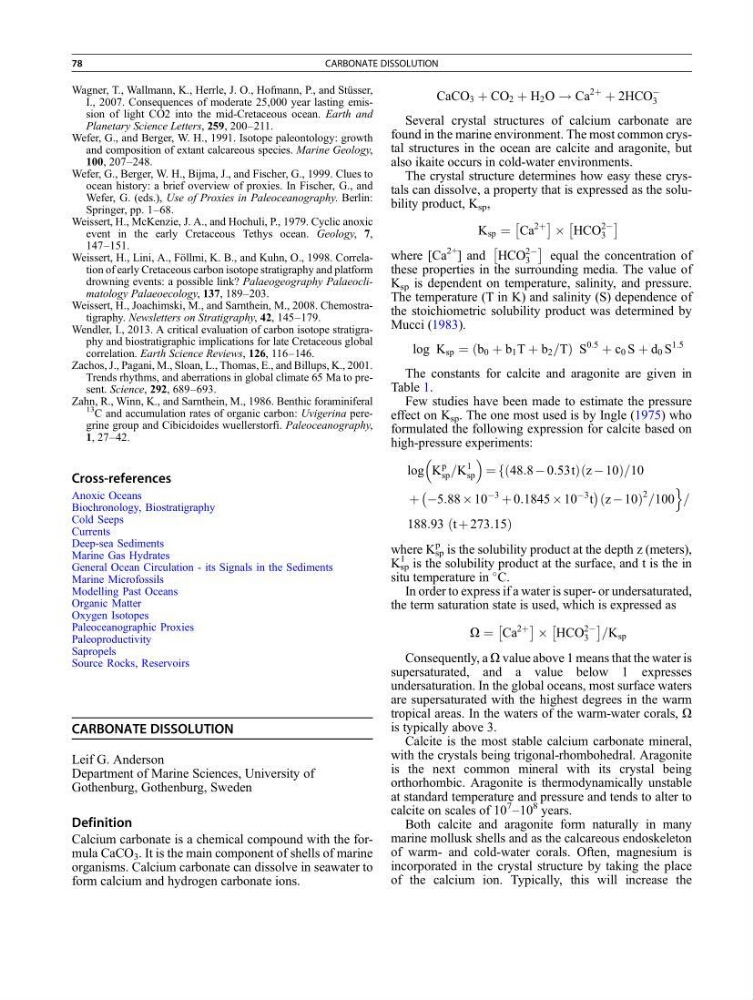
Calcium carbonate is a chemical compound with the formula CaCO 3 . It is the main component of shells of marine
organisms. Calcium carbonate can dissolve in seawater to
form calcium and hydrogen carbonate ions.
CaCO 3 þ CO 2 þ H 2 O ! Ca
2þ
þ 2HCO
À
3
Several crystal structures of calcium carbonate are
found in the marine environment. The most common crystal structures in the ocean are calcite and aragonite, but
also ikaite occurs in cold-water environments.
The crystal structure determines how easy these crystals can dissolve, a property that is expressed as the solubility product, K sp ,
K sp ¼ Ca
2þ
Â
à  HCO
2À
3
Â
Ã
where [Ca
2+ ] and HCO
2À
3
Â
Ã
equal the concentration of
these properties in the surrounding media. The value of
K sp is dependent on temperature, salinity, and pressure.
The temperature (T in K) and salinity (S) dependence of
the stoichiometric solubility product was determined by
Mucci (1983).
log K sp ¼ b 0 þ b 1 T þ b 2 =T
ð
ÞS
0:5
þ c 0 S þ d 0 S
1:5
The constants for calcite and aragonite are given in
Table 1.
Few studies have been made to estimate the pressure
effect on K sp . The one most used is by Ingle (1975) who
formulated the following expression for calcite based on
high-pressure experiments:
log K
p
sp =K
1
sp
¼ 48:8 À 0:53t
ð
Þz À 10
ð
Þ=10
f
þ À5:88 Â 10
À3
þ 0:1845 Â 10
À3 t
À
Á
z À 10
ð
Þ
2 =100
o
=
188:93 t þ 273:15
ð
Þ
where K sp
p is the solubility product at the depth z (meters),
K sp
1 is the solubility product at the surface, and t is the in
situ temperature in
C.
In order to express if a water is super- or undersaturated,
the term saturation state is used, which is expressed as
O ¼ Ca
2þ
Â
à  HCO
2À
3
Â
à =K sp
Consequently, a O value above 1 means that the water is
supersaturated, and a value below 1 expresses
undersaturation. In the global oceans, most surface waters
are supersaturated with the highest degrees in the warm
tropical areas. In the waters of the warm-water corals, O
is typically above 3.
Calcite is the most stable calcium carbonate mineral,
with the crystals being trigonal-rhombohedral. Aragonite
is the next common mineral with its crystal being
orthorhombic. Aragonite is thermodynamically unstable
at standard temperature and pressure and tends to alter to
calcite on scales of 10
7
–10
8 years.
Both calcite and aragonite form naturally in many
marine mollusk shells and as the calcareous endoskeleton
of warm- and cold-water corals. Often, magnesium is
incorporated in the crystal structure by taking the place
of the calcium ion. Typically, this will increase the
78
CARBONATE DISSOLUTION
I., 2007. Consequences of moderate 25,000 year lasting emission of light CO2 into the mid-Cretaceous ocean. Earth and
Planetary Science Letters, 259, 200–211.
Wefer, G., and Berger, W. H., 1991. Isotope paleontology: growth
and composition of extant calcareous species. Marine Geology,
100, 207–248.
Wefer, G., Berger, W. H., Bijma, J., and Fischer, G., 1999. Clues to
ocean history: a brief overview of proxies. In Fischer, G., and
Wefer, G. (eds.), Use of Proxies in Paleoceanography. Berlin:
Springer, pp. 1–68.
Weissert, H., McKenzie, J. A., and Hochuli, P., 1979. Cyclic anoxic
event in the early Cretaceous Tethys ocean. Geology, 7,
147–151.
Weissert, H., Lini, A., Föllmi, K. B., and Kuhn, O., 1998. Correlation of early Cretaceous carbon isotope stratigraphy and platform
drowning events: a possible link? Palaeogeography Palaeoclimatology Palaeoecology, 137, 189–203.
Weissert, H., Joachimski, M., and Sarnthein, M., 2008. Chemostratigraphy. Newsletters on Stratigraphy, 42, 145–179.
Wendler, I., 2013. A critical evaluation of carbon isotope stratigraphy and biostratigraphic implications for late Cretaceous global
correlation. Earth Science Reviews, 126, 116–146.
Zachos, J., Pagani, M., Sloan, L., Thomas, E., and Billups, K., 2001.
Trends rhythms, and aberrations in global climate 65 Ma to present. Science, 292, 689–693.
Zahn, R., Winn, K., and Sarnthein, M., 1986. Benthic foraminiferal
13 C and accumulation rates of organic carbon: Uvigerina peregrine group and Cibicidoides wuellerstorfi. Paleoceanography,
1, 27–42.
Cross-references
Anoxic Oceans
Biochronology, Biostratigraphy
Cold Seeps
Currents
Deep-sea Sediments
Marine Gas Hydrates
General Ocean Circulation - its Signals in the Sediments
Marine Microfossils
Modelling Past Oceans
Organic Matter
Oxygen Isotopes
Paleoceanographic Proxies
Paleoproductivity
Sapropels
Source Rocks, Reservoirs
CARBONATE DISSOLUTION
Leif G. Anderson
Department of Marine Sciences, University of
Gothenburg, Gothenburg, Sweden
Definition
Calcium carbonate is a chemical compound with the formula CaCO 3 . It is the main component of shells of marine
organisms. Calcium carbonate can dissolve in seawater to
form calcium and hydrogen carbonate ions.
CaCO 3 þ CO 2 þ H 2 O ! Ca
2þ
þ 2HCO
À
3
Several crystal structures of calcium carbonate are
found in the marine environment. The most common crystal structures in the ocean are calcite and aragonite, but
also ikaite occurs in cold-water environments.
The crystal structure determines how easy these crystals can dissolve, a property that is expressed as the solubility product, K sp ,
K sp ¼ Ca
2þ
Â
à  HCO
2À
3
Â
Ã
where [Ca
2+ ] and HCO
2À
3
Â
Ã
equal the concentration of
these properties in the surrounding media. The value of
K sp is dependent on temperature, salinity, and pressure.
The temperature (T in K) and salinity (S) dependence of
the stoichiometric solubility product was determined by
Mucci (1983).
log K sp ¼ b 0 þ b 1 T þ b 2 =T
ð
ÞS
0:5
þ c 0 S þ d 0 S
1:5
The constants for calcite and aragonite are given in
Table 1.
Few studies have been made to estimate the pressure
effect on K sp . The one most used is by Ingle (1975) who
formulated the following expression for calcite based on
high-pressure experiments:
log K
p
sp =K
1
sp
¼ 48:8 À 0:53t
ð
Þz À 10
ð
Þ=10
f
þ À5:88 Â 10
À3
þ 0:1845 Â 10
À3 t
À
Á
z À 10
ð
Þ
2 =100
o
=
188:93 t þ 273:15
ð
Þ
where K sp
p is the solubility product at the depth z (meters),
K sp
1 is the solubility product at the surface, and t is the in
situ temperature in
C.
In order to express if a water is super- or undersaturated,
the term saturation state is used, which is expressed as
O ¼ Ca
2þ
Â
à  HCO
2À
3
Â
à =K sp
Consequently, a O value above 1 means that the water is
supersaturated, and a value below 1 expresses
undersaturation. In the global oceans, most surface waters
are supersaturated with the highest degrees in the warm
tropical areas. In the waters of the warm-water corals, O
is typically above 3.
Calcite is the most stable calcium carbonate mineral,
with the crystals being trigonal-rhombohedral. Aragonite
is the next common mineral with its crystal being
orthorhombic. Aragonite is thermodynamically unstable
at standard temperature and pressure and tends to alter to
calcite on scales of 10
7
–10
8 years.
Both calcite and aragonite form naturally in many
marine mollusk shells and as the calcareous endoskeleton
of warm- and cold-water corals. Often, magnesium is
incorporated in the crystal structure by taking the place
of the calcium ion. Typically, this will increase the
78
CARBONATE DISSOLUTION