

solubility, i.e., the more percent magnesium a crystal contains, the more soluble it gets.
Ikaite is the mineral name for the hexahydrate of calcium carbonate, CaCO 3 ·6H 2 O. It is only found in a metastable state and decomposes rapidly once removed from
near-freezing water (below 6
C). It was first discovered
in nature in the bottom of the Ikka Fjord in SW Greenland.
Here, it is believed to be created when carbonate ion-rich
groundwater seeps out and meets the seawater that is rich
in calcium ions. During the last 10 years, its occurrence
has been found in sea ice, first reported from the Weddell
Sea (Dieckmann et al., 2008), and has been observed as
grain sizes of hundreds of micrometers.
The solubility of calcite and aragonite is mainly determined by the carbonate ion concentration in the deep
ocean as both the salinity and the calcium ion concentration are quite constant. The carbonate ion concentration
is impacted by the formation of carbon dioxide through
mineralization of sinking organic matter. This also means
that the longer the water has been exposed to sinking
organic matter, the higher the carbon dioxide content gets,
and the concentration of carbonate ions decreases.
CO 2 þ H 2 O þ CO
2À
3 ⇄ 2HCO
À
3
One consequence of this is that the depth at which one
finds the water at saturation, i.e., O ¼ 1, is deepest in the
regions of deepwater formation and shallowest in the
regions where the waters have not been in contact with
the surface for a long time. This means that the deepest saturation depths are found in the Atlantic Ocean and the
shallowest in the Pacific Ocean.
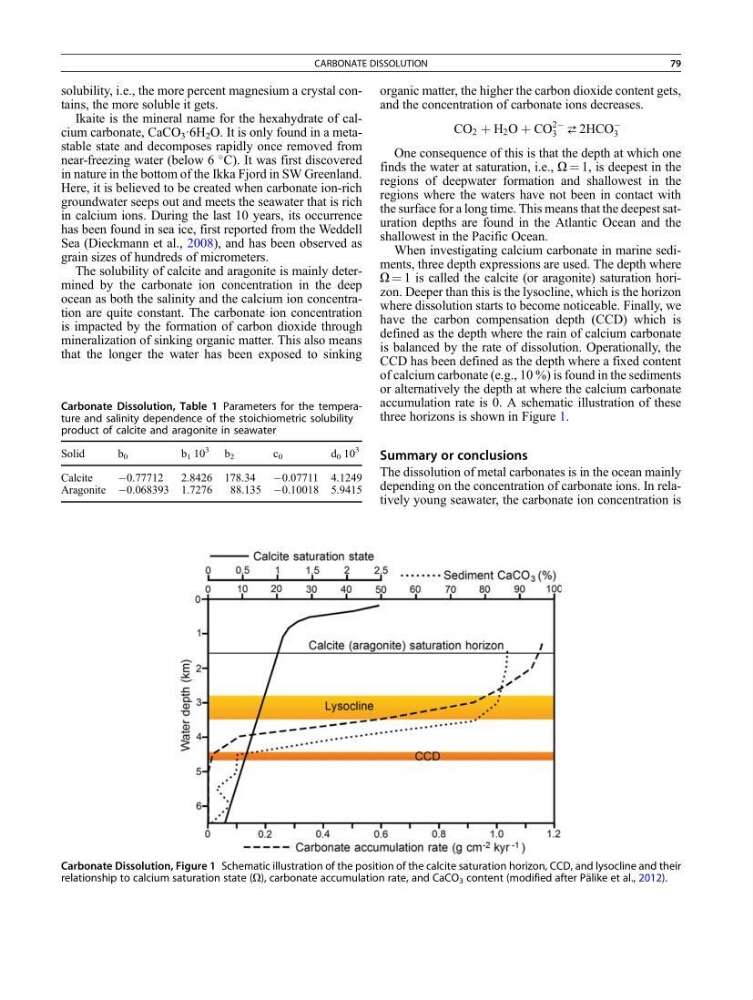
When investigating calcium carbonate in marine sediments, three depth expressions are used. The depth where
O ¼ 1 is called the calcite (or aragonite) saturation horizon. Deeper than this is the lysocline, which is the horizon
where dissolution starts to become noticeable. Finally, we
have the carbon compensation depth (CCD) which is
defined as the depth where the rain of calcium carbonate
is balanced by the rate of dissolution. Operationally, the
CCD has been defined as the depth where a fixed content
of calcium carbonate (e.g., 10 %) is found in the sediments
or alternatively the depth at where the calcium carbonate
accumulation rate is 0. A schematic illustration of these
three horizons is shown in Figure 1.
Summary or conclusions
The dissolution of metal carbonates is in the ocean mainly
depending on the concentration of carbonate ions. In relatively young seawater, the carbonate ion concentration is
Carbonate Dissolution, Table 1 Parameters for the temperature and salinity dependence of the stoichiometric solubility
product of calcite and aragonite in seawater
Solid
b 0
b 1 10
3
b 2
c 0
d 0 10
3
Calcite
À0.77712
2.8426 178.34
À0.07711 4.1249
Aragonite À0.068393 1.7276
88.135 À0.10018 5.9415
Carbonate Dissolution, Figure 1 Schematic illustration of the position of the calcite saturation horizon, CCD, and lysocline and their
relationship to calcium saturation state (O), carbonate accumulation rate, and CaCO 3 content (modified after Pa ¨like et al., 2012).
CARBONATE DISSOLUTION
79
Ikaite is the mineral name for the hexahydrate of calcium carbonate, CaCO 3 ·6H 2 O. It is only found in a metastable state and decomposes rapidly once removed from
near-freezing water (below 6
C). It was first discovered
in nature in the bottom of the Ikka Fjord in SW Greenland.
Here, it is believed to be created when carbonate ion-rich
groundwater seeps out and meets the seawater that is rich
in calcium ions. During the last 10 years, its occurrence
has been found in sea ice, first reported from the Weddell
Sea (Dieckmann et al., 2008), and has been observed as
grain sizes of hundreds of micrometers.
The solubility of calcite and aragonite is mainly determined by the carbonate ion concentration in the deep
ocean as both the salinity and the calcium ion concentration are quite constant. The carbonate ion concentration
is impacted by the formation of carbon dioxide through
mineralization of sinking organic matter. This also means
that the longer the water has been exposed to sinking
organic matter, the higher the carbon dioxide content gets,
and the concentration of carbonate ions decreases.
CO 2 þ H 2 O þ CO
2À
3 ⇄ 2HCO
À
3
One consequence of this is that the depth at which one
finds the water at saturation, i.e., O ¼ 1, is deepest in the
regions of deepwater formation and shallowest in the
regions where the waters have not been in contact with
the surface for a long time. This means that the deepest saturation depths are found in the Atlantic Ocean and the
shallowest in the Pacific Ocean.
When investigating calcium carbonate in marine sediments, three depth expressions are used. The depth where
O ¼ 1 is called the calcite (or aragonite) saturation horizon. Deeper than this is the lysocline, which is the horizon
where dissolution starts to become noticeable. Finally, we
have the carbon compensation depth (CCD) which is
defined as the depth where the rain of calcium carbonate
is balanced by the rate of dissolution. Operationally, the
CCD has been defined as the depth where a fixed content
of calcium carbonate (e.g., 10 %) is found in the sediments
or alternatively the depth at where the calcium carbonate
accumulation rate is 0. A schematic illustration of these
three horizons is shown in Figure 1.
Summary or conclusions
The dissolution of metal carbonates is in the ocean mainly
depending on the concentration of carbonate ions. In relatively young seawater, the carbonate ion concentration is
Carbonate Dissolution, Table 1 Parameters for the temperature and salinity dependence of the stoichiometric solubility
product of calcite and aragonite in seawater
Solid
b 0
b 1 10
3
b 2
c 0
d 0 10
3
Calcite
À0.77712
2.8426 178.34
À0.07711 4.1249
Aragonite À0.068393 1.7276
88.135 À0.10018 5.9415
Carbonate Dissolution, Figure 1 Schematic illustration of the position of the calcite saturation horizon, CCD, and lysocline and their
relationship to calcium saturation state (O), carbonate accumulation rate, and CaCO 3 content (modified after Pa ¨like et al., 2012).
CARBONATE DISSOLUTION
79