

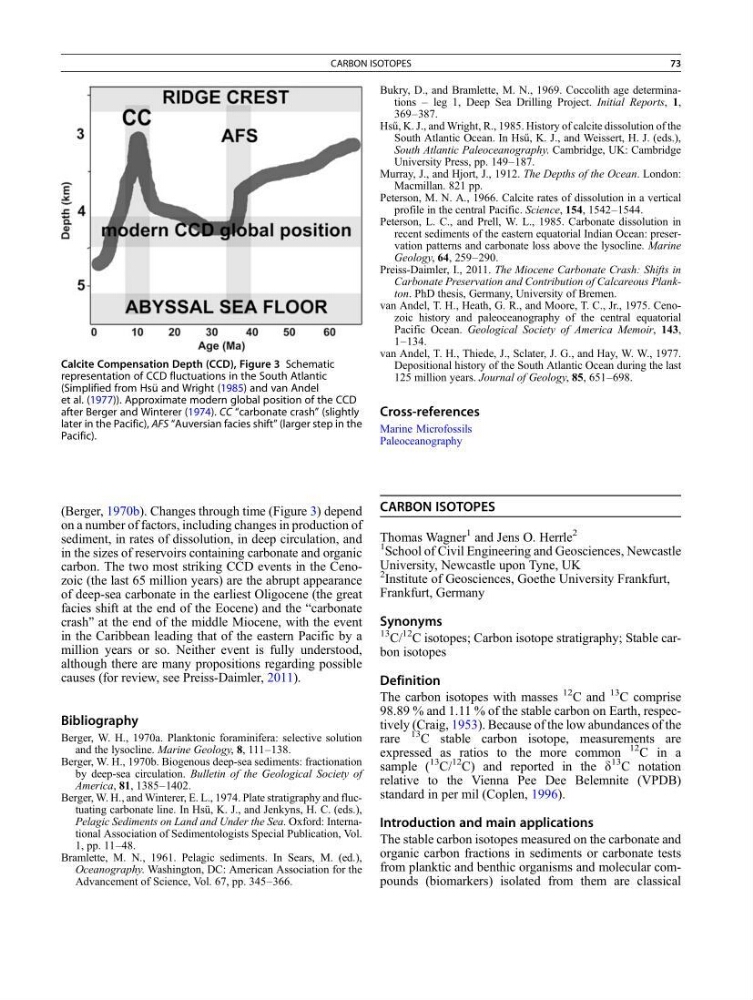
(Berger, 1970b). Changes through time (Figure 3) depend
on a number of factors, including changes in production of
sediment, in rates of dissolution, in deep circulation, and
in the sizes of reservoirs containing carbonate and organic
carbon. The two most striking CCD events in the Cenozoic (the last 65 million years) are the abrupt appearance
of deep-sea carbonate in the earliest Oligocene (the great
facies shift at the end of the Eocene) and the “carbonate
crash” at the end of the middle Miocene, with the event
in the Caribbean leading that of the eastern Pacific by a
million years or so. Neither event is fully understood,
although there are many propositions regarding possible
causes (for review, see Preiss-Daimler, 2011).
Bibliography
Berger, W. H., 1970a. Planktonic foraminifera: selective solution
and the lysocline. Marine Geology, 8, 111–138.
Berger, W. H., 1970b. Biogenous deep-sea sediments: fractionation
by deep-sea circulation. Bulletin of the Geological Society of
America, 81, 1385–1402.
Berger, W. H., and Winterer, E. L., 1974. Plate stratigraphy and fluctuating carbonate line. In Hsü, K. J., and Jenkyns, H. C. (eds.),
Pelagic Sediments on Land and Under the Sea. Oxford: International Association of Sedimentologists Special Publication, Vol.
1, pp. 11–48.
Bramlette, M. N., 1961. Pelagic sediments. In Sears, M. (ed.),
Oceanography. Washington, DC: American Association for the
Advancement of Science, Vol. 67, pp. 345–366.
Bukry, D., and Bramlette, M. N., 1969. Coccolith age determinations – leg 1, Deep Sea Drilling Project. Initial Reports, 1,
369–387.
Hsű, K. J., and Wright, R., 1985. History of calcite dissolution of the
South Atlantic Ocean. In Hsű, K. J., and Weissert, H. J. (eds.),
South Atlantic Paleoceanography. Cambridge, UK: Cambridge
University Press, pp. 149–187.
Murray, J., and Hjort, J., 1912. The Depths of the Ocean. London:
Macmillan. 821 pp.
Peterson, M. N. A., 1966. Calcite rates of dissolution in a vertical
profile in the central Pacific. Science, 154, 1542–1544.
Peterson, L. C., and Prell, W. L., 1985. Carbonate dissolution in
recent sediments of the eastern equatorial Indian Ocean: preservation patterns and carbonate loss above the lysocline. Marine
Geology, 64, 259–290.
Preiss-Daimler, I., 2011. The Miocene Carbonate Crash: Shifts in
Carbonate Preservation and Contribution of Calcareous Plankton. PhD thesis, Germany, University of Bremen.
van Andel, T. H., Heath, G. R., and Moore, T. C., Jr., 1975. Cenozoic history and paleoceanography of the central equatorial
Pacific Ocean. Geological Society of America Memoir, 143,
1–134.
van Andel, T. H., Thiede, J., Sclater, J. G., and Hay, W. W., 1977.
Depositional history of the South Atlantic Ocean during the last
125 million years. Journal of Geology, 85, 651–698.
Cross-references
Marine Microfossils
Paleoceanography
CARBON ISOTOPES
Thomas Wagner
1 and Jens O. Herrle
2
1
School of Civil Engineering and Geosciences, Newcastle
University, Newcastle upon Tyne, UK
2
Institute of Geosciences, Goethe University Frankfurt,
Frankfurt, Germany
Synonyms
13
C/
12
C isotopes; Carbon isotope stratigraphy; Stable carbon isotopes
Definition
The carbon isotopes with masses
12 C and
13
C comprise
98.89 % and 1.11 % of the stable carbon on Earth, respectively (Craig, 1953). Because of the low abundances of the
rare
13
C stable carbon isotope, measurements are
expressed as ratios to the more common
12 C in a
sample (
13
C/
12
C) and reported in the d
13
C notation
relative to the Vienna Pee Dee Belemnite (VPDB)
standard in per mil (Coplen, 1996).
Introduction and main applications
The stable carbon isotopes measured on the carbonate and
organic carbon fractions in sediments or carbonate tests
from planktic and benthic organisms and molecular compounds (biomarkers) isolated from them are classical
Calcite Compensation Depth (CCD), Figure 3 Schematic
representation of CCD fluctuations in the South Atlantic
(Simplified from Hsu ¨ and Wright (1985) and van Andel
et al. (1977)). Approximate modern global position of the CCD
after Berger and Winterer (1974). CC “carbonate crash” (slightly
later in the Pacific), AFS “Auversian facies shift” (larger step in the
Pacific).
CARBON ISOTOPES
73
on a number of factors, including changes in production of
sediment, in rates of dissolution, in deep circulation, and
in the sizes of reservoirs containing carbonate and organic
carbon. The two most striking CCD events in the Cenozoic (the last 65 million years) are the abrupt appearance
of deep-sea carbonate in the earliest Oligocene (the great
facies shift at the end of the Eocene) and the “carbonate
crash” at the end of the middle Miocene, with the event
in the Caribbean leading that of the eastern Pacific by a
million years or so. Neither event is fully understood,
although there are many propositions regarding possible
causes (for review, see Preiss-Daimler, 2011).
Bibliography
Berger, W. H., 1970a. Planktonic foraminifera: selective solution
and the lysocline. Marine Geology, 8, 111–138.
Berger, W. H., 1970b. Biogenous deep-sea sediments: fractionation
by deep-sea circulation. Bulletin of the Geological Society of
America, 81, 1385–1402.
Berger, W. H., and Winterer, E. L., 1974. Plate stratigraphy and fluctuating carbonate line. In Hsü, K. J., and Jenkyns, H. C. (eds.),
Pelagic Sediments on Land and Under the Sea. Oxford: International Association of Sedimentologists Special Publication, Vol.
1, pp. 11–48.
Bramlette, M. N., 1961. Pelagic sediments. In Sears, M. (ed.),
Oceanography. Washington, DC: American Association for the
Advancement of Science, Vol. 67, pp. 345–366.
Bukry, D., and Bramlette, M. N., 1969. Coccolith age determinations – leg 1, Deep Sea Drilling Project. Initial Reports, 1,
369–387.
Hsű, K. J., and Wright, R., 1985. History of calcite dissolution of the
South Atlantic Ocean. In Hsű, K. J., and Weissert, H. J. (eds.),
South Atlantic Paleoceanography. Cambridge, UK: Cambridge
University Press, pp. 149–187.
Murray, J., and Hjort, J., 1912. The Depths of the Ocean. London:
Macmillan. 821 pp.
Peterson, M. N. A., 1966. Calcite rates of dissolution in a vertical
profile in the central Pacific. Science, 154, 1542–1544.
Peterson, L. C., and Prell, W. L., 1985. Carbonate dissolution in
recent sediments of the eastern equatorial Indian Ocean: preservation patterns and carbonate loss above the lysocline. Marine
Geology, 64, 259–290.
Preiss-Daimler, I., 2011. The Miocene Carbonate Crash: Shifts in
Carbonate Preservation and Contribution of Calcareous Plankton. PhD thesis, Germany, University of Bremen.
van Andel, T. H., Heath, G. R., and Moore, T. C., Jr., 1975. Cenozoic history and paleoceanography of the central equatorial
Pacific Ocean. Geological Society of America Memoir, 143,
1–134.
van Andel, T. H., Thiede, J., Sclater, J. G., and Hay, W. W., 1977.
Depositional history of the South Atlantic Ocean during the last
125 million years. Journal of Geology, 85, 651–698.
Cross-references
Marine Microfossils
Paleoceanography
CARBON ISOTOPES
Thomas Wagner
1 and Jens O. Herrle
2
1
School of Civil Engineering and Geosciences, Newcastle
University, Newcastle upon Tyne, UK
2
Institute of Geosciences, Goethe University Frankfurt,
Frankfurt, Germany
Synonyms
13
C/
12
C isotopes; Carbon isotope stratigraphy; Stable carbon isotopes
Definition
The carbon isotopes with masses
12 C and
13
C comprise
98.89 % and 1.11 % of the stable carbon on Earth, respectively (Craig, 1953). Because of the low abundances of the
rare
13
C stable carbon isotope, measurements are
expressed as ratios to the more common
12 C in a
sample (
13
C/
12
C) and reported in the d
13
C notation
relative to the Vienna Pee Dee Belemnite (VPDB)
standard in per mil (Coplen, 1996).
Introduction and main applications
The stable carbon isotopes measured on the carbonate and
organic carbon fractions in sediments or carbonate tests
from planktic and benthic organisms and molecular compounds (biomarkers) isolated from them are classical
Calcite Compensation Depth (CCD), Figure 3 Schematic
representation of CCD fluctuations in the South Atlantic
(Simplified from Hsu ¨ and Wright (1985) and van Andel
et al. (1977)). Approximate modern global position of the CCD
after Berger and Winterer (1974). CC “carbonate crash” (slightly
later in the Pacific), AFS “Auversian facies shift” (larger step in the
Pacific).
CARBON ISOTOPES
73